
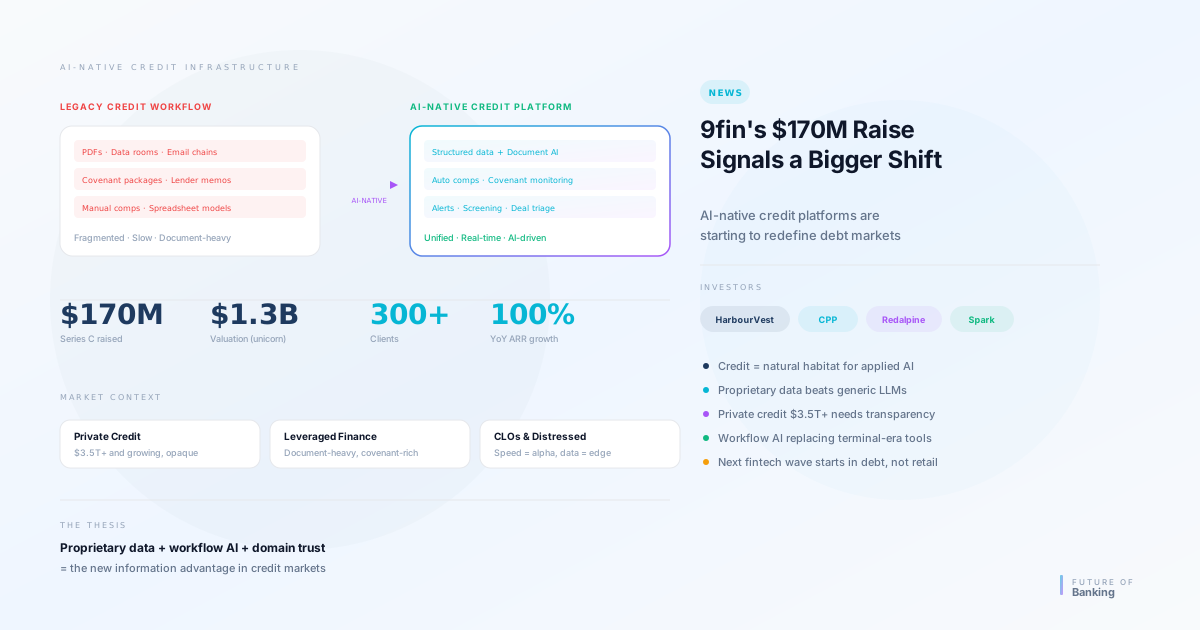
For years, large parts of the credit world have operated with a strange contradiction: debt markets are enormous, but much of the underlying workflow still feels stubbornly pre-digital. Information is scattered across PDFs, data rooms, lender memos, emails, covenant packages, and proprietary models. In syndicated loans, leveraged finance, distressed debt, and especially private credit, speed often depends less on who has the smartest analyst and more on who can surface the right information fastest.
That is the backdrop to 9fin's latest raise. On March 31, 2026, the London- and New York-based company announced a $170 million Series C at a $1.3 billion valuation, led by HarbourVest, with participation from CPP Investments and existing backers including Redalpine, Highland Europe, Spark Capital, and Seedcamp. The company said the capital will be used to deepen its AI capabilities, expand its proprietary dataset, and continue growing in the United States. 9fin says it now has more than 300 clients across banks, asset managers, law firms, and advisory firms, and has delivered multiple years of 100% ARR growth.
On the surface, this is a classic fintech funding story: strong growth, a large market, AI positioning, and fresh capital. But the more interesting angle is what kind of company 9fin is trying to become.
This is not a neobank. It is not a consumer-facing AI app. And it is not just another market data terminal. 9fin is positioning itself as an AI-native operating layer for credit professionals — a platform that combines debt market data, analytics, news, documents, and workflow tools into a single environment spanning leveraged finance, distressed debt, CLOs, private credit, and asset-based finance.
Why credit is a natural habitat for AI
Unlike public equity markets, where pricing is continuous and information is more standardized, credit markets are often messy and document-heavy. A huge share of the real work involves parsing terms, comparing structures, spotting changes in covenants, mapping comparable deals, assessing borrower risk, and monitoring situations that evolve through amendments, waivers, and restructurings. These are exactly the kinds of workflows where AI becomes powerful when paired with high-quality proprietary data and trusted document extraction.
That is the core of the 9fin thesis: AI is only useful in debt markets if it sits on top of a proprietary, structured, constantly refreshed credit dataset rather than a generic large language model alone. In that sense, the company is betting that the winners in financial AI will not just be model wrappers, but firms that own hard-to-replicate data pipelines and embed them into day-to-day workflows.
Private credit is too large and too opaque for legacy tools
And there is a broader reason investors may be leaning in now. Private credit and adjacent debt markets have become too large, too important, and too opaque to keep running on legacy information flows. Recent reporting has highlighted how private credit's scale and limited transparency are becoming bigger concerns for investors and regulators alike. The broader private credit market now has more than $3.5 trillion tied up in it, even as questions mount around valuations, defaults, and visibility into underlying exposures.
That does not mean AI-native platforms will "fix" credit markets overnight. But it does explain why a new layer of infrastructure is emerging around them.
The new information advantage
In the old world, information advantage often came from access and human hustle. In the new one, advantage increasingly comes from structured data + workflow AI + domain-specific trust. That is why the most consequential fintech AI companies may not look like flashy chat interfaces. They may look more like industry-specific intelligence systems built for high-value professionals in markets where one missed clause, one unseen amendment, or one stale comp can materially affect outcomes.
The rise of AI-native vertical software in finance
The first wave of financial AI was mostly copilots layered on top of existing tools. The next wave is starting to look more structural. Instead of simply helping analysts write notes faster, these platforms aim to become the place where credit teams source opportunities, read documents, compare issuers, track market moves, and make decisions. That is a much more ambitious proposition. It is less "add AI to finance" and more "rebuild the information stack around AI."
This is also where disruption could become real. Debt markets have long been dominated by incumbents with powerful data businesses, distribution, and entrenched workflows. But AI changes the competitive equation in two ways:
- It rewards platforms that can ingest messy unstructured information and turn it into usable intelligence at scale
- It increases the value of workflow integration: users want answers, comparisons, summaries, alerts, and actionability inside the same product
That creates an opening for younger firms that were designed for AI from day one rather than retrofitted for it later.
What this means for the market
So the real takeaway from 9fin's raise is not just that one company became a unicorn. It is that credit is becoming an AI-native category.
That shift will likely unfold in layers. First, intelligence platforms organize fragmented market information. Next, more workflows become automated: document review, covenant monitoring, comps, screening, and deal triage. Over time, parts of origination, portfolio monitoring, secondary trading intelligence, restructuring analysis, and private credit reporting may all become more machine-assisted.
The next generation of financial infrastructure may not begin in payments or retail banking. It may begin in the least glamorous corners of finance: debt docs, credit memos, covenant packages, and private market workflows. But that is exactly why it matters. Once AI starts working reliably in environments this complex and this document-heavy, it stops being a demo and starts becoming infrastructure.