
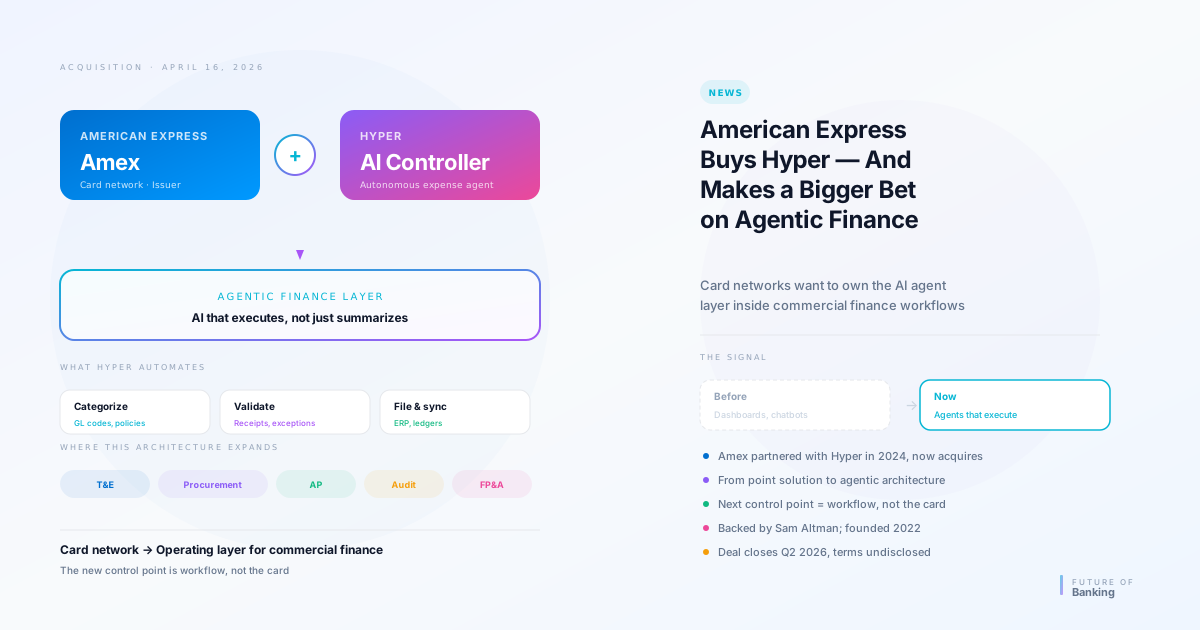
The real story in Amex's acquisition of Hyper is not expense software. It is the growing conviction that AI agents will sit inside core financial workflows — and that card networks want to own that layer before someone else does.
American Express has agreed to acquire Hyper, the AI-focused expense management startup it had already been working with, in a deal that points to a much larger shift underway in financial services. The transaction was announced on April 16, 2026, and Amex said it is expected to close in the second quarter of 2026, subject to customary conditions. Financial terms were not disclosed.
Beyond a point solution
On the surface, this looks like a straightforward product acquisition. Hyper is best known for building AI-driven expense automation software: agents that can categorize expenses, check them against company policy and budgets, file reports, and remind employees when submissions are due. Reuters described Hyper as a startup founded in 2022 and backed by OpenAI CEO Sam Altman.
But the deeper significance of the deal is that Amex is not just buying a point solution. It is buying into a model of finance software in which AI does not merely summarize, recommend, or flag — it executes. Hyper's own positioning is explicit. The company calls itself "the world's first autonomous expense solution" and describes its system as an "AI controller" that reviews, validates, and files expenses in seconds.
Why expense management is an ideal proving ground
Expense management is one of the clearest early proving grounds for agentic finance. It is rules-heavy, repetitive, document-driven, and tied to compliance. It is full of small but time-consuming actions:
- Matching receipts
- Assigning GL codes
- Checking attendees
- Enforcing per diem policies
- Validating exceptions
- Chasing missing data
- Pushing clean entries into downstream systems
In traditional software, those tasks are fragmented across forms, workflows, and review queues. In agentic software, they can collapse into a few prompts, background checks, and automated actions.
Partner first, then acquire
Amex's move also did not come out of nowhere. In 2024, American Express and Hyper had already partnered on the Hypercard Rewards American Express card, which Amex said embedded AI-powered expense agents through its Agile Partner Platform. This acquisition is therefore less a cold acquisition than a conversion of an existing partnership into ownership.
In banking and payments, those sequences are often revealing: partner first, test distribution, understand workflow fit, then acquire once the strategic relevance becomes obvious.
Amex signals a structural AI shift
The timing is also notable. In its 2026 Chairman's Letter to Shareholders, Amex said advances in AI are creating a "structural shift" in how colleagues work and how businesses operate, compete, and create value. The company said it has explored hundreds of AI use cases across the business, provided access to leading AI tools across its workforce, and is focusing on high-impact initiatives that put AI at the center of the enterprise.
Hyper fits neatly into that broader posture: Amex is not experimenting with AI as a side project, but increasingly treating it as infrastructure.
The new control point is workflow, not the card
From a banking and payments perspective, the acquisition says something even more important: the next control point in corporate spend may not be the card itself, but the software layer that interprets, routes, approves, and reconciles the spend around it. For years, banks and card networks competed on issuance, rewards, acceptance, and data. The new battleground is workflow ownership.
Whoever controls the intelligent layer around spend can influence policy, approvals, accounting, visibility, and ultimately customer lock-in.
From expense to the broader finance stack
This is why the Hyper deal should be read as a signal to the broader industry. Financial institutions are beginning to realize that "AI in finance" does not only mean better chatbots, fraud models, or internal productivity tools. It also means operational agents embedded directly into payment-linked workflows.
In Hyper's case, that starts with travel and expense. But the same architecture can expand outward into:
- Purchasing controls
- Travel booking
- Policy enforcement
- Accounts payable
- Audit trails
- Ledger sync
- Finance planning
Hyper's own public product language already points in that direction, including forthcoming FP&A and travel-oriented agents.
Two opportunities for Amex
1. The practical opportunity: reduce manual work for commercial customers and strengthen the value of its business card ecosystem.
2. The strategic opportunity: move from being a payment rail and card issuer to becoming a more embedded operating layer inside commercial finance.
If that happens, Amex is no longer just helping businesses pay. It is helping software decide what should be paid, how it should be coded, whether it fits policy, and what should happen next. That is where agentic finance starts becoming defensible platform strategy.
The broader competitive implication
Fintech startups once had the advantage in workflow innovation, while incumbents owned scale, trust, and distribution. AI may compress that gap. A company like Amex can now acquire agentic capability rather than build every piece from scratch, then distribute it into a massive commercial customer base.
That makes acquisitions like Hyper strategically potent: they let incumbents import startup speed into regulated, trusted financial stacks.
The bottom line
The Hyper acquisition is therefore about more than expense software. It is an early marker that card networks, banks, and commercial finance platforms are starting to compete for the agent layer itself. And once that layer matures, the winners may not be the companies with the prettiest dashboards, but the ones whose AI is trusted to act inside live financial workflows.
For Amex, this deal is a step in that direction. For the rest of the industry, it is a warning: agentic finance is moving from demo to distribution.