
Backbase's launch of an AI-native, agentic banking operating system signals a major inflection point: banking is moving from digital interfaces to autonomous, AI-executed systems.
Agentic AI — software that can independently make decisions and execute workflows — is redefining how financial services are delivered. Instead of simply assisting users, these systems can complete tasks end-to-end, from onboarding and compliance to servicing and credit operations.
Backbase's new platform positions itself as an orchestration layer where such AI agents can operate securely at scale — embedding intelligence directly into the bank's operating core rather than layering it on top.
But while this announcement is significant, it is also part of a broader, fast-emerging category: the AI-native, agentic banking platform.
Open's BankingStack: an early mover in agentic business banking infrastructure
Among the notable players in this space is BankingStack by Open Financial Technologies, which has been quietly building toward this shift.
Open — a billion-dollar fintech backed by Visa, Google, and Temasek — already has deep distribution through partnerships with leading banks like ICICI Bank, HDFC Bank, and Axis Bank, where its infrastructure powers business banking experiences at scale.
Building on this foundation, BankingStack has introduced its own AI-native, agentic business banking OS, focused specifically on enabling banks to deliver intelligent, automated business banking for SMEs and corporates.
This positioning is important for two reasons:
1. Built on real banking distribution, not just concept
Unlike many new AI-native platforms, BankingStack is layered on top of existing, large-scale bank deployments, giving it immediate real-world applicability and scale.
2. Focused on business banking complexity
SME and corporate banking involve multi-step workflows — payments, invoicing, credit, compliance, reconciliation — which are particularly well-suited to agentic automation. BankingStack embeds AI agents directly into these workflows, enabling banks to automate operations that have traditionally been manual and fragmented.
In effect, Open is extending its role from banking infrastructure provider to AI-native operating layer for business banking.
A rapidly forming category with different strategic models
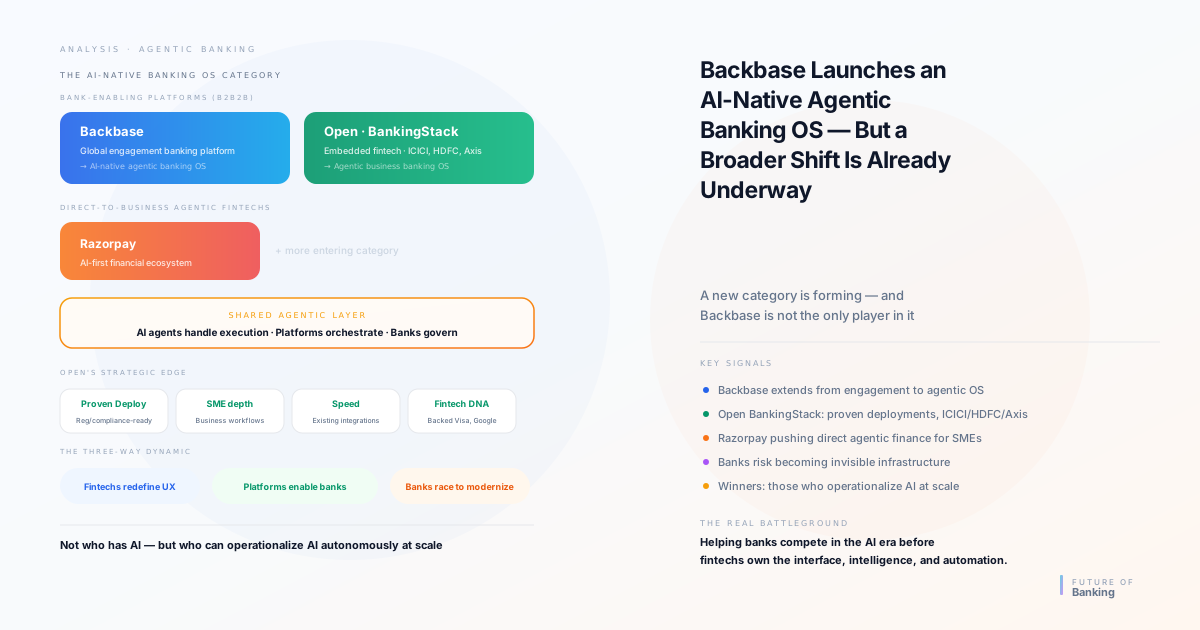
The emergence of both Backbase and BankingStack highlights a new competitive layer in fintech: the AI-native banking OS. But not all players are approaching this the same way.
Bank-enabling platforms (B2B2B)
- Backbase — extending from global engagement banking platform to agentic OS
- BankingStack (Open Financial Technologies) — agentic business banking infrastructure for banks
These platforms equip banks with AI-native capabilities, enable autonomous workflows within bank-controlled environments, and help banks retain customer ownership.
Direct-to-business agentic fintechs
- Razorpay — agentic business banking built directly for SMEs and corporates
These players build AI-first financial ecosystems that abstract away traditional banking interfaces and potentially disintermediate banks at the experience layer.
Why Open's approach stands out in this transition
While Backbase is extending its global engagement banking platform into agentic AI, Open's BankingStack represents a different, highly pragmatic path:
Proven deployment expertise
BankingStack has proven deployment expertise with ICICI Bank, HDFC Bank, and Axis Bank — institutions that operate at enormous scale under some of the most demanding regulatory and compliance environments in banking. These are not pilots. They are live, regulated deployments that have required deep understanding of RBI frameworks, KYC mandates, data localisation requirements, and enterprise-grade security standards. That compliance muscle is already built in.
Use-case depth
A strong focus on business banking workflows — payments, invoicing, reconciliation, compliance, credit — rather than generic AI layering.
Speed to market
Banks can launch AI-native capabilities faster by extending existing integrations rather than building from scratch.
Fintech DNA
Built with the agility and UX expectations of modern fintech platforms, backed by blue-chip investors Visa, Google, and Temasek.
This makes BankingStack particularly relevant in markets like India and other high-growth economies, where SME banking is both underserved and intensely competitive.
The real battleground: helping banks compete in the AI era
The rise of agentic fintechs creates an urgent challenge for banks. If fintechs own the interface, the intelligence layer, and the automation — banks risk becoming invisible infrastructure providers.
This is where platforms like Backbase and BankingStack play a critical role. They allow banks to:
- Launch AI-native business banking experiences
- Embed autonomous agents across key workflows
- Compete with fintechs on speed, intelligence, and user experience
- Retain ownership of the customer relationship
From AI features to AI-native banking systems
What is becoming clear is that the industry is moving beyond isolated AI features toward fully AI-native operating systems. In this new model:
- AI agents handle execution
- Platforms orchestrate workflows and governance
- Banks define strategy, risk, and compliance frameworks
Both Backbase and Open's BankingStack are contributing to this shift — but from different starting points. Backbase comes from global digital banking infrastructure. Open comes from embedded fintech and business banking rails.
Final take
Backbase's launch validates the arrival of the agentic banking OS category — but it is not a single-player narrative.
Players like Open, through BankingStack, are already advancing this model with a strong foothold in real-world banking deployments, particularly in business banking. And fintechs like Razorpay are pushing the boundaries with direct, AI-native financial ecosystems.
The result is a three-way dynamic:
- Fintechs redefining user expectations with direct agentic models
- Platforms like Backbase and BankingStack enabling banks to respond
- Banks racing to modernize before losing relevance
The next phase of banking won't be defined by who has AI — but by who can operationalize AI autonomously at scale.