
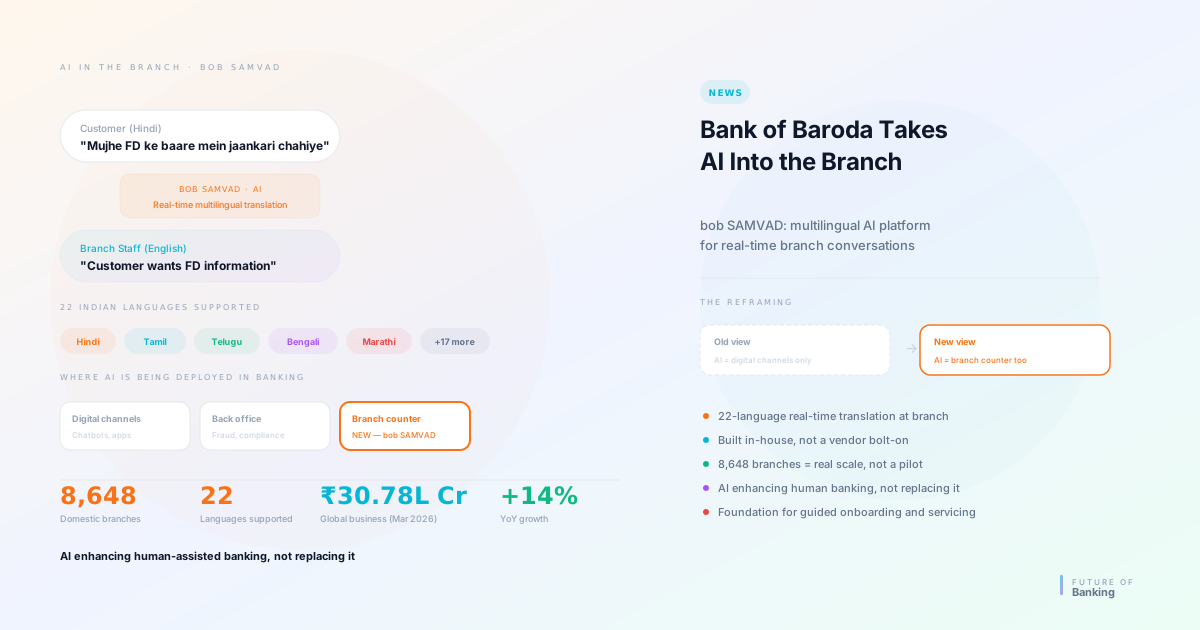
Bank of Baroda has launched an AI-powered multilingual conversational platform aimed at improving customer interactions inside its branch network, offering a notable example of how artificial intelligence is beginning to move beyond chatbots and back-office automation into frontline banking service.
The platform, called bob SAMVAD, was launched in Mumbai and is designed to enable real-time, two-way communication between customers and branch employees in their preferred languages. According to the official announcement, the system supports 22 Indian languages, operates with low latency, and has been developed in-house by the bank.
Why this matters: AI at the branch counter
For a global audience, the importance of the launch lies less in the branding and more in the use case. Banks have spent the past several years applying AI primarily to fraud detection, digital assistants, underwriting, compliance workflows and employee productivity. Bank of Baroda's move highlights a different direction: using AI at the branch counter, where human interaction still matters in onboarding, servicing, issue resolution and relationship banking.
That matters particularly in India, where language diversity is not simply a customer-experience feature but a core part of access. A nationwide bank serving customers across states and regions inevitably encounters situations where a branch employee and a customer are more comfortable in different languages. In that context, a multilingual AI layer can help make branch interactions clearer, faster and more inclusive.
Not a pilot — this is real scale
The branch channel also remains meaningful at Bank of Baroda's scale. The bank says it had 8,648 domestic branches and 80 overseas branches and offices, including overseas subsidiaries. That makes this less of a pilot-style experiment and more of a signal about how a large incumbent bank is thinking about AI-enabled service delivery across a major physical network.
The launch comes as Bank of Baroda continues to operate at considerable scale. Recent business updates reported the lender's global business at ₹30.78 lakh crore for the quarter ended March 31, 2026, up 14% year over year. Those figures help place the initiative in context: this is not a small innovation lab exercise, but an AI deployment by one of India's largest public sector banks.
A different model of branch transformation
More broadly, the move suggests a useful reframing of branch transformation. In many markets, the future of the branch has often been discussed in terms of self-service migration, digitized forms or footprint rationalization. Bank of Baroda's approach points to another model — one in which AI enhances human-assisted banking rather than replacing it. In multilingual, high-touch environments, that may prove to be one of the more practical and durable applications of AI in retail banking.
What this could become
What begins as a communication layer could also become an important foundation for broader AI-assisted branch service over time. A system that helps customers and staff interact across languages can naturally support more intelligent onboarding, guided servicing, product discovery and relationship management at the point of interaction.
For banks operating in linguistically diverse markets, that makes AI not just a digital channel tool, but a meaningful part of the in-person banking experience.
The signal for global banking leaders
For banking leaders outside India, the message is straightforward: the next wave of AI in banking may not be confined to apps, contact centers and internal copilots. It may also emerge in the places where customers still walk in, ask questions and expect to be understood.
Bank of Baroda's launch is an early sign of that shift.