
For decades, banks asked one narrow question before saying yes to a borrower: what does the bureau say?
That question is starting to lose its power.
Not because bureau scores suddenly stopped being useful. Not because AI magically solved lending. But because the old score no longer has exclusive rights to the truth.
That is the real shift.
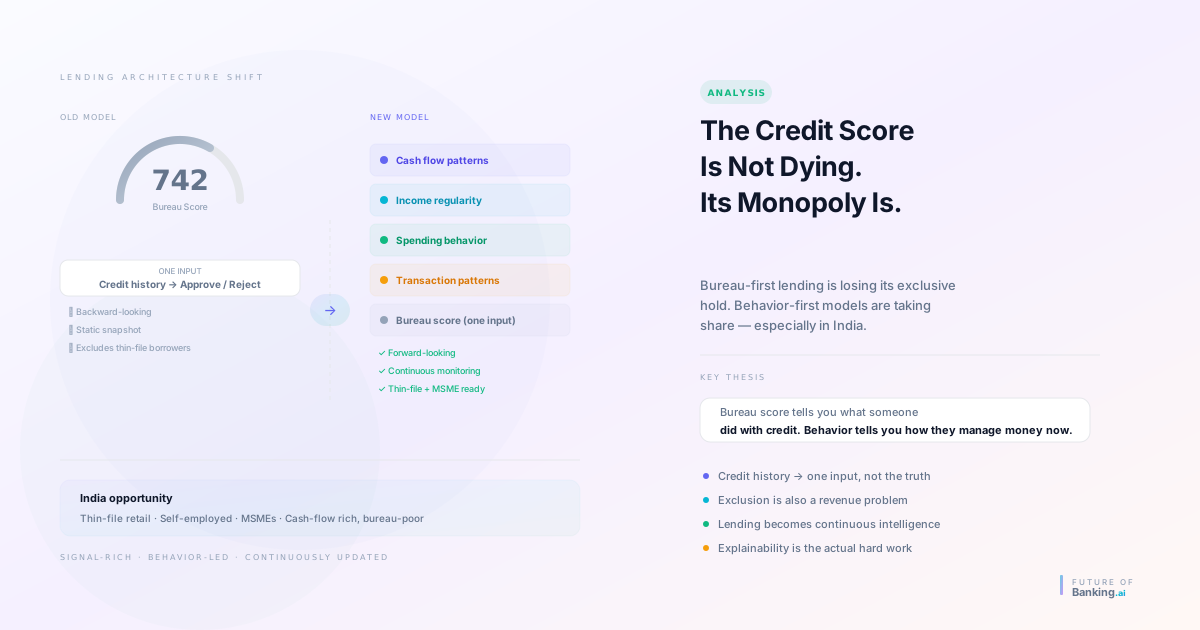
Credit assessment is moving from a bureau-first model to a behavior-first model. Traditional scorecards look backward. Newer AI-driven models can look at cash flow, income regularity, spending behavior, and live financial patterns in ways the old system simply could not. That is not a scoring upgrade. It is the beginning of a different lending architecture.
The old scorecard is not broken. It is just too narrow.
FICO and bureau-led models were built for a world of formal credit histories, slower data, and periodic updates. In that world, they made sense.
But today's borrower leaves behind a much richer financial trail.
Money moves in real time. Income arrives unevenly. Spending patterns reveal stress earlier. Cash flow says things a bureau file never will. A bureau score tells you what someone did with credit in the past; a behavioral model tells you how someone is managing money now. For many lending decisions, the second question is simply more valuable.
That is where the old monopoly begins to crack.
The bigger story is not inclusion. It is growth.
Banks often frame this conversation as financial inclusion. That is true, but incomplete.
The stronger commercial point is that exclusion is also a revenue problem. If a traditional model rejects borrowers who are actually creditworthy, the lender is not being prudent. It is being inaccurate. And inaccurate lenders leave money on the table.
That is why this matters strategically.
A bank that reads richer behavioral data can approve borrowers its competitors still misclassify. It can price risk better. It can win customers earlier. And over time, it can build a portfolio the bureau-first lender cannot easily copy — because the edge does not sit in the score itself. It sits in the underlying data and decision system.
That is the real competitive shift.
Lending is becoming continuous
This is probably the deepest insight in this entire conversation, and probably the most important one.
AI does not just improve the approval decision. It changes what a lending system is.
Once agentic or AI-driven systems connect acquisition, underwriting, monitoring, servicing, and collections, lending stops being a chain of disconnected handoffs and starts becoming a continuous intelligence layer. That means the future credit engine is not a smarter gatekeeper at the point of application. It is a live system that keeps learning after disbursal.
That matters because credit risk is not static. Borrowers change. Businesses slow down. Incomes become volatile. Good accounts deteriorate. Weak accounts stabilize. A one-time score misses all of that.
A continuous model does not.
This is why Indian banks should care
This shift may matter even more in India than in many developed credit markets.
Why? Because India has millions of borrowers and small businesses that do not fit neatly into bureau-led underwriting. Many are new-to-credit. Many are thin-file. Many have healthy financial behavior but weak formal credit visibility.
That is exactly where behavior-led lending becomes powerful.
For Indian banks, the real opportunity is not to throw away bureau scores. It is to stop treating them as the only credible signal. The next lending edge in India will likely come from combining bureau data with cash-flow data, consented financial information, account behavior, transaction patterns, and ongoing monitoring.
That is where the market can open up. Not just for personal loans. For MSME lending too.
Because this is where traditional models are often weakest. A small business may look unimpressive through a narrow bureau lens, while still showing strong repayment capacity through account flows, receivables discipline, payment behavior, and operating consistency. That difference matters enormously in a country like India, where underwriting the "obvious borrower" is no longer enough.
The next winners may be the banks that learn to read economic behavior, not just credit history.
But the hard part is not the model
It is governance.
The more sophisticated the model becomes, the harder it can be to explain clearly.
Why was this borrower rejected? Why was this APR offered? Why did this edge case go one way and not another? Can the decision survive a regulator, an appeal, or an internal audit?
Those questions do not go away because the model is smarter. They become more important.
The institutions that get this right will not be the ones with the most complex models alone. They will be the ones that build reason codes, fallback rules, human review layers, and decision documentation into the architecture from day one. Explainability is not a side issue. It is the actual work. And it is probably the single most important operational requirement in the shift from bureau-first to behavior-first lending.
What banks should actually do now
The practical takeaway is not "replace FICO tomorrow."
It is more disciplined than that.
Use bureau scores as one input, not the truth. Start layering behavioral and cash-flow data where it improves signal. Build models that connect origination to monitoring. Treat explainability as a product requirement, not a legal afterthought. And in India especially, focus where the upside is biggest: thin-file retail, self-employed borrowers, and MSMEs.
Because the future of lending is not score-only. It is signal-rich, behavior-led, and continuously updated.
The real conclusion
The credit score is not dying. Its monopoly is.
And for Indian banks, that may turn out to be one of the biggest strategic shifts in lending this decade.
The institutions that adapt will not just underwrite better. They will serve a larger market than the old scorecard system ever could.