
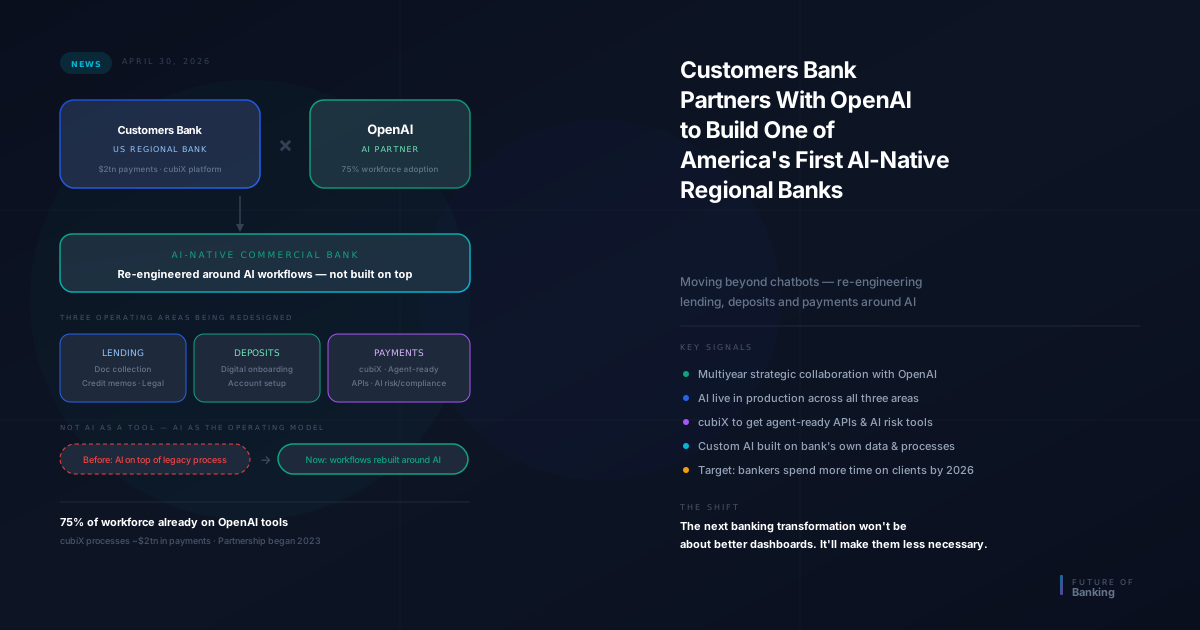
Customers Bank has announced a multiyear strategic collaboration with OpenAI to deploy artificial intelligence across its commercial banking operations, marking one of the clearest moves yet by a US regional bank to reposition itself as an AI-native institution.
The partnership will see Customers Bank work directly with OpenAI's technical teams to build custom AI capabilities around the bank's own processes, data and institutional knowledge. Unlike generic AI tool adoption, the collaboration is focused on redesigning core banking workflows across three major operating areas: lending, deposits and payments.
What is being built
The bank said AI will be applied to lending workflows such as document collection, credit memorandum preparation, legal documentation and post-closing portfolio monitoring. In deposits, the focus will be on digital onboarding and account setup. In payments, AI will be used to enhance cubiX — Customers Bank's proprietary payments platform — with agent-ready APIs and AI-driven risk and compliance capabilities.
cubiX is not a small operation. FinTech Global reported that the platform processes around $2 trillion in payments.
Customers Bank said the AI capabilities will be deployed inside its existing secure enterprise infrastructure, with data governance, access controls and risk management designed into the operating model from the beginning. The bank also indicated that AI is already live in production and progressing across the three focus areas.
From ChatGPT Enterprise to full operating model
The announcement builds on a relationship that began in 2023, when Customers Bank became an early adopter of ChatGPT Enterprise. Today, the bank says 75% of its workforce uses tools powered by OpenAI.
Customers Bancorp president and CEO Sam Sidhu described the collaboration as part of a broader operational reset, saying the bank expects a "fundamental re-engineering" of how Customers Bank operates. He said the bank has spent the past year building the governance and operational infrastructure required to deploy AI at scale.
Why this matters
For banks, the important part of this announcement is not simply that Customers Bank is using OpenAI. Many large financial institutions are already experimenting with generative AI for internal productivity, customer support and knowledge search.
What makes this announcement more significant is the shift from AI as a tool to AI as an operating model.
Customers Bank is not positioning AI as a side assistant sitting on top of legacy processes. It is applying AI directly into the workflows that define commercial banking: underwriting, onboarding, documentation, compliance, portfolio monitoring and payments risk. That is a major strategic distinction.
For decades, bank digitisation has largely meant taking existing processes and putting a digital interface on top of them. Forms became portals. Branch workflows became dashboards. Relationship banking became CRM-led. But the underlying operating model often remained the same: manual review, document-heavy processes, fragmented systems, long approval chains and human coordination across multiple teams.
The Customers Bank–OpenAI collaboration points to a different future: one where AI agents can collect information, prepare documents, surface risks, support compliance checks, monitor portfolios and help bankers act faster — while humans remain responsible for judgment, relationship management and final decisions.
The rise of the AI-native bank
The phrase "AI-native bank" is still emerging, but this announcement gives it a practical shape.
An AI-native bank is not just a bank with a chatbot. It is a bank where AI is embedded into the bank's core operating fabric: its workflows, controls, data access, approvals, risk systems and customer journeys.
In that model, the banker's role changes. Instead of spending large amounts of time collecting documents, checking information, preparing memos or chasing internal updates, bankers can spend more time advising customers, structuring transactions and managing relationships.
That is exactly the direction Customers Bank is signalling. The bank said its longer-term vision is for bankers to spend more time on client-facing work by the end of 2026.
This is also where regional banks may find an unexpected advantage. Large banks have bigger technology budgets, but they also carry more complexity: legacy systems, global compliance layers, multiple product silos and slower transformation cycles. A focused regional bank with strong executive sponsorship may be able to move faster if it chooses specific high-value workflows and builds AI deeply around them.
Payments may be the most interesting part
While lending and onboarding are obvious areas for AI automation, the payments angle is especially important.
Customers Bank is applying AI to cubiX, its proprietary payments platform. The goal is not merely faster processing, but agent-ready APIs and AI-driven risk and compliance tooling.
This matters because payments are increasingly becoming machine-to-machine and agent-to-system workflows. As AI agents begin to initiate, approve, reconcile and monitor financial actions, banks will need infrastructure that can support both human users and software agents.
That means banks may need to rethink APIs, permissions, fraud monitoring, transaction context, approval flows and compliance evidence. In the future, a payment may not be initiated by a person clicking a button inside a dashboard. It may be initiated by an AI agent acting within a defined policy, with the human approving only exceptions or high-risk actions.
Customers Bank's reference to agent-ready APIs suggests that at least some banks are beginning to prepare for that shift.
A signal to the wider banking industry
The partnership also comes as more banks are moving from AI pilots to production-grade AI deployments. NatWest announced a collaboration with OpenAI in 2025 focused on digital assistants, customer support and fraud-related use cases, while major global banks such as Bank of America, Goldman Sachs and Morgan Stanley have been expanding AI tools for bankers, developers and advisers.
But Customers Bank's announcement stands out because it is explicitly framed around re-engineering the commercial banking operating model.
For bank CEOs and CIOs, this raises a strategic question: is AI just another productivity layer, or is it the foundation for the next banking architecture? The answer may define the next decade of banking technology.
Banks that treat AI only as a chatbot may achieve incremental gains. Banks that rebuild workflows around AI, governance and human-in-the-loop controls may unlock a very different operating model: faster lending, lower operational friction, better compliance visibility, richer client coverage and more scalable relationship banking.
The FutureOfBanking view
Customers Bank's partnership with OpenAI is an early example of where banking is heading.
The next wave of banking transformation will not be about better dashboards alone. It will be about making dashboards less necessary.
If AI can understand bank data, execute workflows, prepare documentation, monitor risk, initiate actions and escalate exceptions, then the interface of banking changes. The bank becomes less of a screen-based system and more of an intelligent operating layer.
That does not remove humans from banking. In fact, the opposite may happen. The most valuable bankers may become more human, not less — spending less time managing process and more time managing trust, judgment and relationships.
For regional banks, this could be a powerful opportunity. AI may allow them to compete with larger banks not by matching their headcount or technology budgets, but by redesigning how work gets done.
Customers Bank has now made its bet: the future commercial bank will not simply be digital. It will be AI-native.