
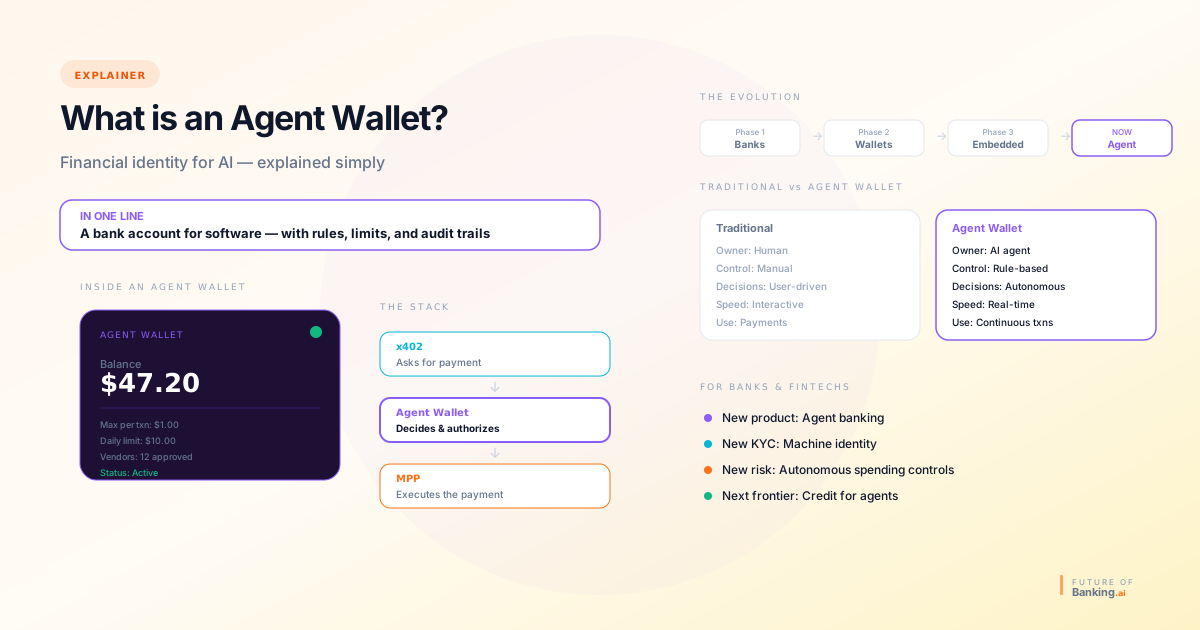
An agent wallet is a digital wallet designed for AI agents — allowing them to hold funds, make payments, and operate within defined financial rules.
The big idea
In the traditional internet, humans have bank accounts, humans approve payments, humans control money. In the AI-native internet, software makes decisions and executes actions.
But until recently, software could not hold or control money independently.
Agent wallets solve this. They give AI agents the ability to participate in the economy — safely and autonomously.
The evolution: From user wallets to agent wallets
Phase 1: Human banking
Bank accounts, cards, manual transactions. Money was fully controlled by humans through physical and digital interfaces.
Phase 2: Digital wallets
Mobile wallets, online payments, faster transactions. Money became more accessible, but still required human intent for every action.
Phase 3: Embedded finance
Payments inside apps, platforms managing user funds. Money moved closer to the point of action. But every transaction still required user intent.
Phase 4: AI agents
Agents could analyze, decide, and act. But they could not hold funds, pay independently, or operate within budgets.
Phase 5: Agent wallets
Agent wallets complete the system. They allow software to not just act — but manage money.
What is an Agent Wallet?
An agent wallet is a financial identity and payment layer for AI systems. It enables an agent to hold a balance, authorize transactions, operate within predefined rules, and interact with payment protocols like MPP.
If MPP is how agents pay, the agent wallet is what they pay with.
How an Agent Wallet works
- Wallet is assigned to an agent — Each AI agent gets a wallet address or ID and secure credentials
- Funds are allocated — The wallet is funded by a user, a business, or a platform
- Rules are defined — Spending limits ($10/day), allowed services, approval thresholds
- Agent executes transactions — It evaluates cost, checks rules, and authorizes payment
- Transactions are recorded — All payments are logged, traceable, and auditable
The agent acts — but within boundaries defined by humans.
How Agent Wallets fit into the stack
Agent wallets sit at the center of the agentic payments stack:
- x402 → asks for payment (the communication layer)
- Agent Wallet → decides and authorizes (the control layer)
- MPP → executes the payment (the rail)
The wallet is the decision and control layer.
A real-world example
Imagine an AI procurement agent for a company. It needs supplier pricing data from multiple APIs. Each API charges $0.05, $0.10, or $0.20.
The agent wallet is configured with: $50 monthly budget, access to approved vendors, no transactions above $1 without approval.
The agent evaluates options, pays small amounts automatically, and stays within budget. No manual intervention.
This is autonomous, controlled spending.
How Agent Wallets are different from traditional wallets
- Traditional: Owner is human, control is manual, decisions are user-driven, speed is interactive
- Agent Wallet: Owner is AI agent, control is rule-based, decisions are autonomous, speed is real-time
Agent wallets are not just storage — they are programmable financial control systems.
Why this matters
Enables autonomous commerce. Agents can buy services, optimize costs, and execute workflows without waiting for human approval.
Introduces programmable money. Spending can be limited, conditional, and policy-driven. Money becomes code.
Creates new financial entities. For the first time, non-human actors have financial identities. This is a fundamental shift in how the financial system is structured.
What this means for banks and fintechs
A new product category: Agent banking. Banks may need to offer wallets for AI agents, programmable spending rules, and APIs for agent control.
New KYC and identity models. How do you verify an agent? Who is responsible for its actions? How is ownership defined?
Risk and compliance frameworks. Agent wallets require transaction monitoring, anomaly detection, and spending controls designed for non-human actors.
Credit for agents (next frontier). Future possibilities include agent credit lines, dynamic limits, and automated repayment. This could redefine lending itself.
The bottom line
Agent wallets are not just a feature. They are a new financial primitive.
From humans controlling money to software operating within financial boundaries.
The financial system is about to get its first non-human participants — and agent wallets are how they will operate.