
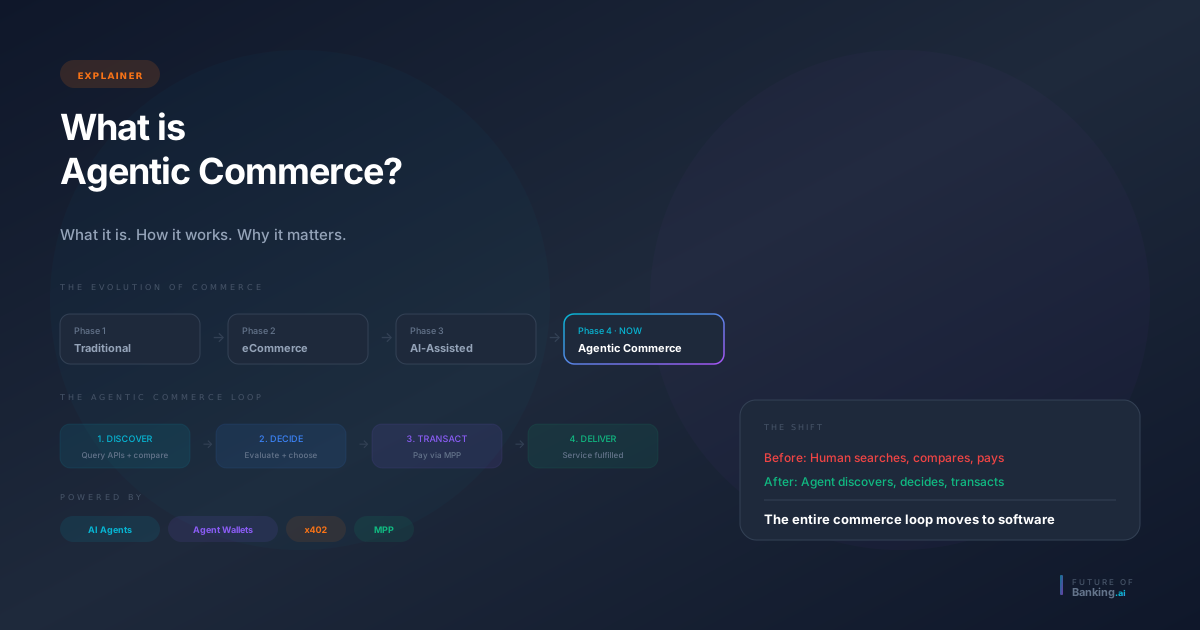
Agentic commerce is a new model of commerce where AI agents discover, decide, and transact on behalf of users — autonomously.
The big idea
For decades, commerce has been driven by humans: you search, you compare, you decide, you pay. Agentic commerce changes this completely. AI agents now do all of the above — including the payment.
This means software does not just assist. Software does not just recommend. Software executes the entire commercial transaction.
The evolution: from eCommerce to agentic commerce
Phase 1: Traditional commerce — Physical stores, human-driven decisions, manual transactions.
Phase 2: eCommerce (2000s) — Platforms like Amazon digitized shopping with search, listings, and online checkout. But users still had to browse, compare, and decide.
Phase 3: Mobile and one-click commerce — Saved cards, faster checkout, friction reduced. But humans were still in control of every step.
Phase 4: AI-assisted commerce (2020–2023) — Recommendations, chat-based shopping, personalization. AI could suggest — but not act.
Phase 5: Agentic commerce (now) — AI agents can discover products, evaluate options, make decisions, and execute payments. Commerce shifts from human-driven to agent-executed.
What is agentic commerce?
Agentic commerce is a system where AI agents act as buyers, services and APIs act as sellers, and transactions happen autonomously.
It is powered by four layers working together:
- AI agents — decision-making and workflow execution
- Agent wallets — financial control and spending boundaries
- x402 — the payment request layer (how APIs ask for money)
- MPP — the payment execution layer (how money actually moves)
Together, they enable end-to-end autonomous transactions.
How agentic commerce works
Step 1: Intent is defined. The user provides a goal: "Book the best flight under $500" or "Optimize my ad spend" or "Buy inventory at lowest cost."
Step 2: Agent discovers options. The agent queries APIs, compares services, and evaluates pricing across providers.
Step 3: Agent makes a decision. Based on cost, quality, constraints, and the user's predefined rules, the agent selects the best option.
Step 4: Agent executes the transaction. Using its agent wallet and protocols like MPP, the agent pays, completes the purchase, and confirms.
Step 5: Task is completed. The result is delivered — booking confirmed, data retrieved, service executed. No manual intervention required.
A real-world example
Imagine a business owner managing digital ads. Instead of logging into platforms, analyzing reports, and adjusting budgets, they tell their AI agent: "Optimize my campaign performance this week."
The agent buys audience data at $0.05 per request, tests creatives, reallocates budgets, and spends across platforms — all autonomously.
This is not automation. This is autonomous commerce.
How agentic commerce is different
In traditional commerce, humans decide, execute, and pay. In eCommerce, humans decide and pay while platforms execute. In AI-assisted commerce, humans still decide and pay while AI assists. In agentic commerce, AI agents decide, execute, and pay. The entire commerce loop moves from humans to software.
Why this matters
1. Commerce becomes continuous. Instead of one-time transactions, agents enable ongoing optimization and continuous buying decisions.
2. Pricing becomes dynamic. Agents can compare in real time, choose the cheapest or best option, and switch instantly between providers.
3. Decision-making shifts from humans to algorithms. This leads to faster decisions, data-driven optimization, and reduced human bias.
4. Microtransactions explode. Agents can make thousands of small payments in real time across services. Commerce becomes granular and real-time.
What this means for businesses
Your customer may not be human anymore. Businesses will increasingly sell to AI agents, not people. This changes UX (no UI needed), pricing (API-first), and distribution (machine-readable).
APIs become storefronts. Instead of websites, APIs become the primary interface. Pricing becomes programmable.
Competition becomes algorithmic. Agents will compare instantly and switch providers dynamically. The best product at the best price wins — instantly.
What this means for banks and fintechs
Payments become invisible. Transactions move from checkout flows to backend infrastructure.
New financial primitives emerge. Agent wallets, agent identity, and programmable spending become essential categories.
New revenue opportunities. Banks can power agent accounts, real-time payments, and embedded financial controls.
Risk shifts dramatically. Challenges include uncontrolled spending, fraud detection for non-human actors, and agent accountability. This will redefine compliance and financial controls.
The bottom line
Agentic commerce is not an incremental change. It is a new model of how commerce works.
From humans browsing and buying — to software discovering, deciding, and transacting.