
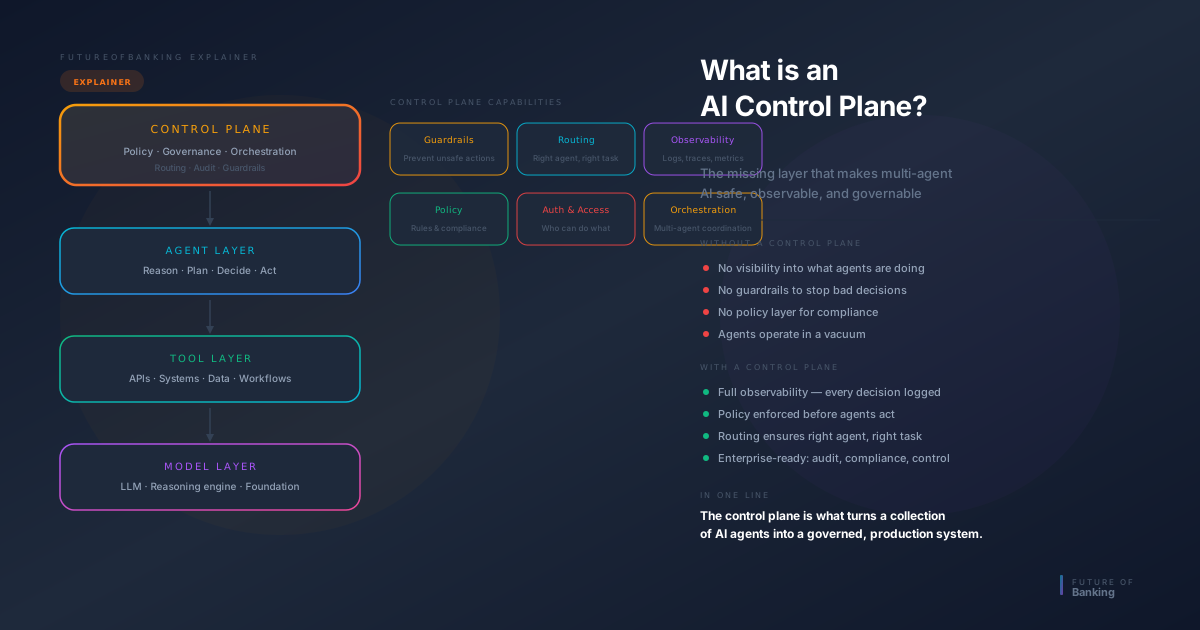
If AI agents are the brain of an intelligent system, the control plane is the nervous system that keeps everything in check.
The big idea
As AI moves from single-model experimentation to multi-agent production systems, a new challenge emerges: how do you manage, govern, and observe dozens of agents running simultaneously? How do you prevent an agent from taking an action it should not take? How do you route the right task to the right agent? How do you ensure compliance in a regulated industry like banking?
That is what an AI control plane does.
What is an AI Control Plane?
An AI control plane is the coordination and governance layer that sits above your AI agents. It does not do the reasoning — the agents and models do that. Instead, it governs how agents behave, what they are allowed to do, how they communicate with each other, and whether their actions comply with policy.
Think of it this way: a large bank might run hundreds of AI agents — for KYC, fraud detection, loan processing, customer support, treasury ops, and compliance. Without a control plane, each agent is independent, ungoverned, and unobservable. With a control plane, they are coordinated, logged, policy-bound, and auditable.
The four layers of an AI system
Layer 1: Model
The foundation. Large language models like GPT-4o or Claude — these do the reasoning, language understanding, and generation. They respond to prompts and produce outputs.
Layer 2: Tool
The execution layer. APIs, databases, external services, business systems. When an agent needs to retrieve data, trigger a workflow, or call a service — it uses tools.
Layer 3: Agent
The intelligence layer. An agent is a model given a goal, tools, and a context. It reasons, plans, and takes actions iteratively to complete a task.
Layer 4: Control Plane (this is new)
The control plane sits above all of this. It is the management layer for your entire AI system. It watches, governs, routes, enforces, and coordinates.
What a control plane does
1. Observability
The control plane logs every decision an agent makes: what it was asked, what tool it used, what it decided, and what happened as a result. Without this, you have no visibility into agent behaviour.
2. Guardrails
Before an agent takes an action, the control plane can intercept and check: Is this action allowed? Does it comply with policy? Is it within the defined scope? If not, it blocks or escalates.
3. Policy enforcement
In banking, this is critical. Agents must operate within compliance rules, regulatory requirements, and business policies. The control plane is where those rules are defined and enforced — not inside each individual agent.
4. Routing and orchestration
In a multi-agent system, the control plane decides which agent handles which task. A customer query might need to go to the KYC agent first, then a product recommendation agent, then a compliance check agent. Routing logic lives in the control plane.
5. Auth and access control
Agents should only have access to the tools and data they need for their specific role. The control plane manages permissions — ensuring agents cannot exceed their scope.
6. Audit trails
For regulated industries, you need a complete record of what every agent did and why. The control plane generates this automatically.
The problem it solves: AI in production is hard
Without a control plane:
- An agent might take an action it was never authorized to take
- You have no log of what agents did or why
- Multiple agents may conflict or duplicate work
- There is no way to enforce compliance rules across agents
- Debugging failures becomes nearly impossible
- Scaling to many agents creates chaos
With a control plane:
- Every agent action is logged, traceable, and auditable
- Policy is enforced centrally, not per-agent
- Agents are coordinated, not siloed
- Compliance and governance are built in
- The system can scale safely
A banking example
A trade finance bank deploys an AI system to handle letter of credit (LC) processing. Several agents are involved:
- Document agent — extracts and validates trade documents
- Compliance agent — checks against sanctions lists and KYC requirements
- Credit agent — assesses the underlying transaction risk
- Approval agent — routes the LC for sign-off
Without a control plane, these agents operate independently. There is no guarantee they run in the right order, no log of their decisions, and no way to enforce the bank's credit or compliance policies centrally.
With a control plane: the system knows the workflow, enforces the sequence, applies compliance rules before any agent takes action, logs every step for audit, and escalates if any agent triggers a policy exception. The bank now has a governed, auditable AI system — not just a collection of models.
Why banks need this now
Regulatory pressure
Regulators are starting to ask: who is responsible for what your AI system does? A control plane gives you the answer — because it logs everything and enforces policy centrally.
Scale requirements
Running one agent is easy. Running fifty agents across different business lines, each with different rules, different tools, and different risk tolerances, requires a coordination layer.
Trust and safety
Customers and boards need to trust that AI is not acting outside its mandate. Guardrails and policy enforcement, baked into the control plane, provide that assurance.
Integration with existing systems
Banks have complex technology stacks built over decades. A control plane provides a centralized interface so agents can interact with legacy systems safely and consistently.
What this means for the industry
The control plane is becoming the next infrastructure bet in enterprise AI. Early providers include companies like LangSmith (LangChain), Weights & Biases, Arize AI, and a growing set of enterprise-focused AI operations platforms. Cloud providers are also building native control plane capabilities.
For banks and fintechs, the control plane is not optional — it is the difference between a demo and a production system.
The institutions that invest in control plane infrastructure now will be the ones that can safely scale AI across regulated workflows — while others are still trying to understand why their agents behaved unexpectedly.
The bottom line
A control plane turns a collection of AI agents into a governed, observable, compliant production system.
It is not the most visible part of an AI deployment. But it is what makes AI trustworthy enough to run inside a bank.
From agents that can think — to agents that banks can trust to act.