
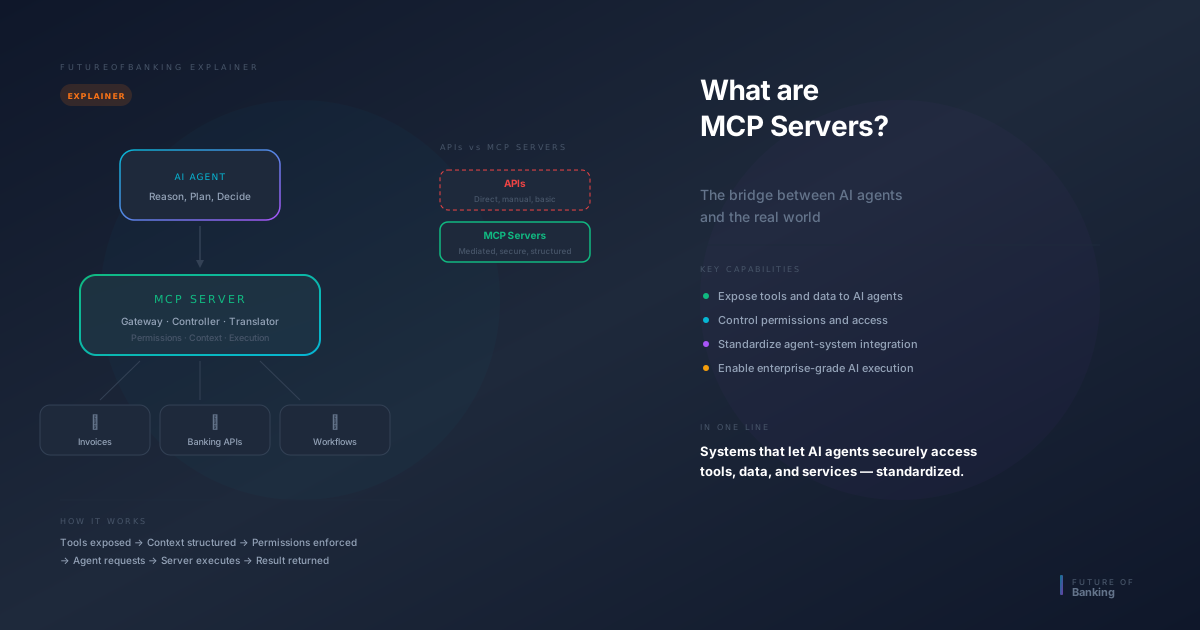
MCP servers are systems that allow AI agents to securely access tools, data, and services in a standardized way.
The big idea
AI agents are powerful — but on their own, they are limited. They can understand language, reason, and generate outputs. But they cannot access your systems, use real-world tools, or interact with software safely. MCP servers solve this by acting as a bridge between AI agents and the real world.
What is MCP?
MCP stands for Model Context Protocol. It is an emerging standard designed to connect AI models to external systems, provide structured access to tools and data, and ensure secure and controlled interactions.
If AI agents are the brain, MCP servers are the interface to the world.
The evolution: Why MCP was needed
Phase 1: Standalone AI (early LLMs)
AI systems could answer questions and generate content. But they had no access to real-time data, no ability to take action, and no integration with systems.
Phase 2: Plugins and integrations
Platforms introduced plugins and API integrations. But these were fragmented, inconsistent, insecure, and not standardized.
Phase 3: AI agents
Agents needed to use tools, access data, and execute workflows. But there was no standard way to expose tools to agents, control access, or manage permissions.
Phase 4: MCP servers
MCP introduces a standardized, secure way for AI agents to interact with external systems.
What is an MCP Server?
An MCP server is a system that exposes tools and data, defines how they can be used, controls access and permissions, and communicates with AI agents. It acts as a gateway, a controller, and a translator. It allows AI agents to safely operate in real environments.
How MCP servers work
1. Tools are exposed
The MCP server defines available tools, such as "create invoice," "fetch bank transactions," or "send email."
2. Context is structured
The server provides data, schemas, and instructions so the agent understands how to use each tool.
3. Permissions are enforced
The MCP server controls what the agent can access, what actions it can perform, and what limits and constraints apply.
4. Agent makes a request
The AI agent selects a tool and sends a structured request.
5. Server executes the action
The MCP server validates the request, executes it, and returns the result.
Think of MCP as a controlled execution environment for AI agents.
A real-world example
Imagine a finance agent inside a company. Without MCP, it cannot access accounting systems, trigger payments, or retrieve real-time data. With an MCP server, it can fetch invoices, reconcile transactions, generate reports, and trigger workflows — all within defined permissions.
The agent becomes operational — not just intelligent.
How MCP servers are different from APIs
APIs expose functionality directly, with developer-defined structure and basic security. MCP servers mediate access with standardized structure, rich context, and permission-controlled security. APIs were built for developers. MCP servers are built for AI agents.
Where MCP fits in the stack
MCP sits between AI agents (the decision layer) and tools/systems (the execution layer). It is the control and access layer that makes AI operational.
Why this matters
1. Enables real-world AI execution
Without MCP, AI is theoretical. With MCP, AI becomes operational.
2. Introduces control and safety
MCP ensures permissioned access, controlled execution, and auditability.
3. Standardizes integrations
Instead of custom integrations for every tool, MCP provides a unified protocol.
4. Unlocks enterprise adoption
Enterprises require security, compliance, and control. MCP provides the foundation for this.
What this means for banks and fintechs
Secure AI integration layer
Banks can use MCP to expose core systems and allow agents to operate safely.
Controlled automation
Agents can execute workflows within strict rules — payments, reconciliation, compliance checks.
New infrastructure opportunity
Financial institutions can build MCP-compatible platforms and agent-accessible systems.
Governance and compliance
MCP enables monitoring, audit trails, and access control — critical for regulated industries like banking.
The bottom line
MCP servers are not just another integration layer. They are a new interface between AI and the real world.
From AI that can think — to AI that can act, safely and at scale.