
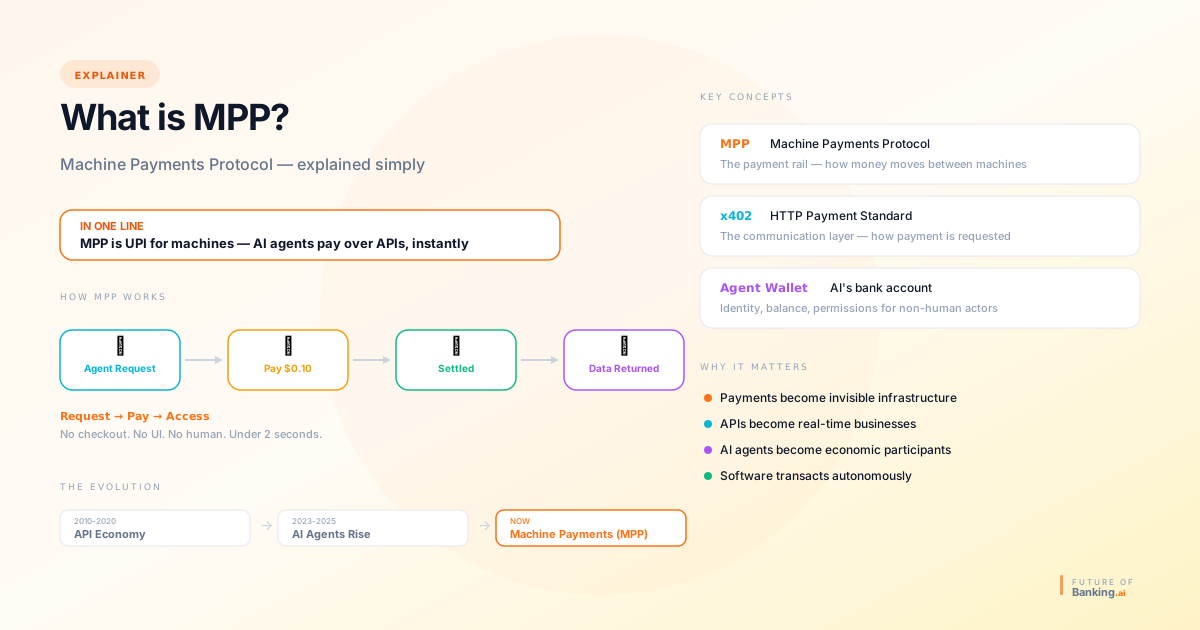
MPP is a payment protocol that allows AI agents and software to pay other software directly over APIs — without any human involvement.
The big idea
For decades, the internet has allowed software to request data.
MPP introduces something fundamentally new: software can now pay for that data — natively.
This may sound incremental. It is not.
This is the first time in internet history that software can natively pay other software — without humans.
Who created MPP
The Machine Payments Protocol is emerging from the developer payments ecosystem led by Stripe, alongside infrastructure collaborators such as Tempo and a growing set of early-stage builders.
MPP is not a single product. It is being shaped as an open, internet-native standard — much like how HTTP defined communication, SMTP defined email, and UPI defined real-time payments in India.
MPP aims to define how machines exchange value over the internet.
The evolution: From APIs to autonomous payments
MPP is not an isolated innovation. It is the natural next step in how the internet has evolved.
Phase 1: APIs (2010s)
Companies like Stripe, Twilio, and AWS turned software into services. Everything became accessible via APIs. Businesses started charging developers. The API economy was born.
But even in this world, payments were still handled separately. Billing was monthly or credit-based. Humans remained in the loop.
Phase 2: Embedded finance (late 2010s)
Payments moved closer to the user: one-click checkout, in-app payments, real-time systems. But payments still required user action. Authentication and approval were mandatory.
Phase 3: AI agents (2023 onwards)
Software evolved again. AI systems began to make decisions, execute workflows, and interact with multiple services.
Agents could think, plan, and act — but they could not transact.
Phase 4: MPP (now)
MPP completes the stack. It enables software to not just act — but pay.
What is MPP (Machine Payments Protocol)?
MPP is a machine-native payment standard designed for AI agents, APIs, and software systems. It allows them to request payment, authorize payment, and settle transactions — all within a single API interaction.
MPP turns payments into a native part of the internet's request–response cycle.
How MPP works
At its core, MPP is simple.
- A request is made — An AI agent calls an API for a service (data, compute, content)
- The API responds with a payment requirement — Instead of returning data: "This request costs $0.10"
- The agent authorizes payment — It checks permissions and signs the payment using its wallet
- Payment is executed instantly — No UI, no redirects, no manual approval
- Access is granted — The API returns the requested data
Request → Pay → Access. All happens seamlessly, in seconds.
How MPP is different from existing payment systems
MPP is not just another payment method. It is built for a completely different user: machines.
- Cards — designed for humans, manual entry, high friction
- Real-time payments (e.g. UPI) — designed for humans, requires user approval
- Billing APIs — designed for developers, monthly/credits, delayed settlement
- MPP — designed for machines, real-time, API-native, fully autonomous
MPP is the first payment system designed for software, not people.
Where x402 fits in
MPP doesn't operate alone. Another emerging concept — x402 — plays a critical role.
Inspired by the HTTP status code 402 "Payment Required", x402 defines how APIs request payment, how payment challenges are structured, and how agents respond.
Think of it like this: MPP moves the money. x402 communicates the payment request. Together, they form the foundation of machine-to-machine commerce on the internet.
A real-world example
Imagine an AI agent managing your business operations. It needs pricing data from a premium API.
Instead of subscriptions, invoices, and approvals, the API simply says: "$0.05 for this request." Your agent evaluates the cost, pays instantly, and retrieves the data.
You were never involved. This is agentic payments in action.
MPP is the foundation of agentic payments
Agentic systems require three capabilities: decision-making, execution, and transaction.
Until now, agents could decide and act — but not transact. MPP enables the final layer: transactions.
This transforms AI agents into economic participants, not just tools.
Why this matters
MPP changes how value flows across the internet.
Payments become invisible infrastructure. From visible user actions to embedded system behavior. You don't "make a payment" — the system handles it within the workflow.
APIs become real-time businesses. From subscriptions to per-request monetization. Pricing becomes granular and dynamic.
Software becomes economic. AI systems can now spend, optimize costs, and choose services dynamically. Software is no longer just functional — it becomes economic.
What this means for banks and fintechs
MPP introduces a new financial layer.
Agent wallets. Every AI agent will need a wallet, identity, and spending rules — essentially a bank account for software.
New risk models. Autonomous payments require limits, policies, and monitoring systems. Traditional fraud models weren't built for non-human actors.
Evolution of payment rails. Existing systems are real-time and scalable but largely human-first. MPP introduces machine-first payments. The next phase of fintech will likely combine both.
What happens next
MPP is still early. But the trajectory is clear: APIs will charge per call, agents will manage budgets, and software will transact autonomously.
The bottom line
MPP is not just a new protocol. It is a shift in how the internet works.
From humans paying through interfaces to machines paying through protocols.
The financial systems of the next decade will need to serve not just users — but autonomous software agents.