
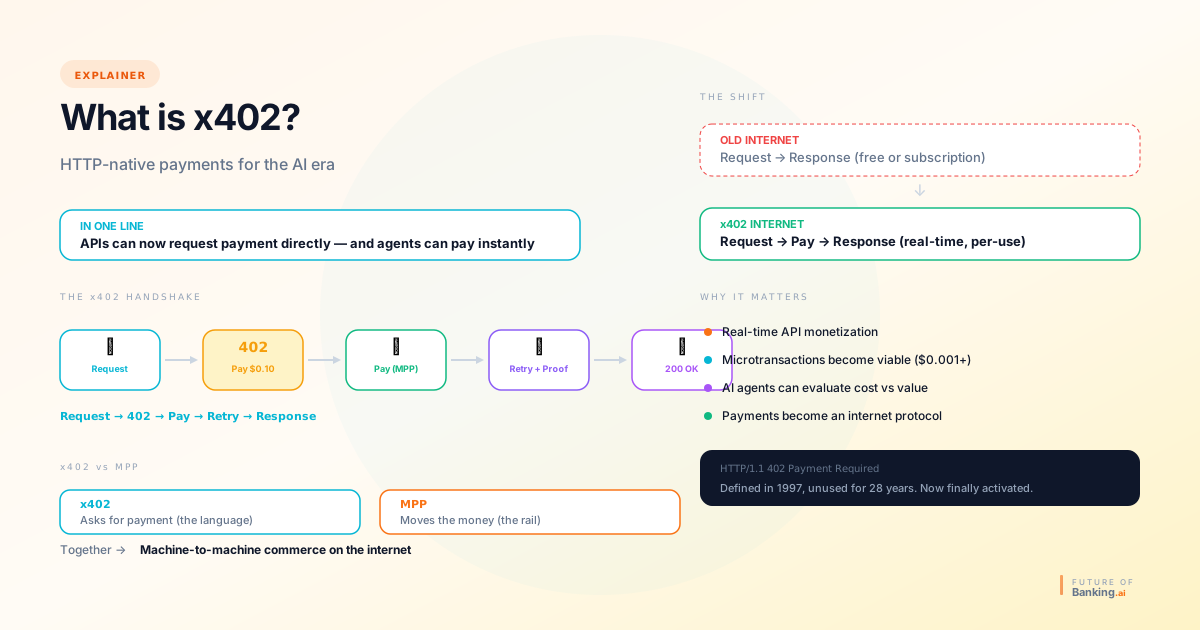
x402 is a web standard that allows APIs to request payment directly — enabling software and AI agents to pay for services in real time.
The big idea
For decades, the internet has worked like this: Request → Response. You ask for something, and the server responds.
But what if the server wants to charge you before responding?
x402 turns the internet into: Request → Pay → Response.
Where x402 comes from
x402 is inspired by an existing but rarely used HTTP status code: 402 Payment Required. This status code has existed since the early days of the web, but it was never standardized, no clear implementation existed, and browsers and APIs didn't use it.
As a result, the internet had no native way to request payments. With the rise of APIs as businesses, AI agents as users, and real-time digital services, this gap became critical.
x402 is the missing layer. It standardizes how servers ask for payment, how clients or agents respond, and how transactions happen inline with API calls.
The evolution: Why x402 became necessary
Phase 1: Free web (early internet)
Websites served content for free. Monetization was indirect — through ads and subscriptions.
Phase 2: API economy (2010s)
Companies like Stripe and AWS turned services into APIs. Developers consumed APIs. Billing was monthly or credit-based. But there was no real-time charging per request — payments were disconnected from usage.
Phase 3: AI agents (2023 onwards)
AI systems began to call APIs autonomously, execute workflows, and make decisions. But APIs could not charge instantly or enforce payment before response.
Phase 4: x402
x402 introduces a standard way for APIs to say: "Pay first, then get access."
What is x402 (in simple terms)
x402 is a communication layer for payments on the web. It defines how a server asks for payment, how the request is structured, and how a client or AI agent responds.
x402 does not move money. It requests it.
How x402 works
Let's break it down:
- Client sends a request — An AI agent or application requests an API
- Server responds with 402 — Instead of data, it returns: HTTP 402 Payment Required, with amount ($0.10), method (MPP), and instructions
- Client processes the request — The agent evaluates the cost and decides whether to proceed
- Payment is executed — Using MPP, the agent signs, authorizes, and completes the payment
- Request is retried — The agent re-sends the request with proof of payment
- Server responds with data — Access is granted
Request → x402 challenge → Pay → Retry → Response.
How x402 and MPP work together
This is where things become powerful.
x402 asks for payment (the "language"). MPP executes the payment (the "rail").
Without x402, APIs don't know how to ask for money. Without MPP, agents don't know how to pay. Together, they enable machine-to-machine commerce.
How x402 is different from existing approaches
- APIs today — billing after usage, delayed and indirect
- SaaS — subscription-based, not granular
- Payment gateways — external checkout, breaks the flow
- x402 — payment inside the API flow, real-time and native
x402 makes payments part of the internet protocol itself.
A real-world example
Imagine an AI research agent. It needs premium financial data.
Without x402: Subscribe to a plan. Manage billing. Handle credentials.
With x402: API says "$0.10 required." Agent pays instantly. Data is returned.
All happens in seconds. No subscriptions. No friction. Just pay-per-use.
Why this matters
Enables real-time API monetization. Every request can be priced, charged, and settled instantly.
Unlocks microtransactions. Payments as small as $0.01 or even $0.001 become viable.
Powers agentic payments. AI agents can evaluate cost vs value, decide, and transact autonomously. This is the foundation of agent-driven commerce.
What this means for banks and fintechs
Payments move deeper into infrastructure. Checkout flows become less relevant. Payments become backend primitives.
New financial entities emerge. Agent wallets, machine identities, autonomous accounts — all new categories that will need financial rails.
New risk and compliance models. Who authorizes agent payments? How are limits enforced? How is fraud detected? These questions will define the next generation of fintech.
The bottom line
x402 is not just a technical standard. It is a shift in how the internet works.
From requesting data to negotiating value in real time.
The internet is learning to charge — and AI agents are learning to pay.