
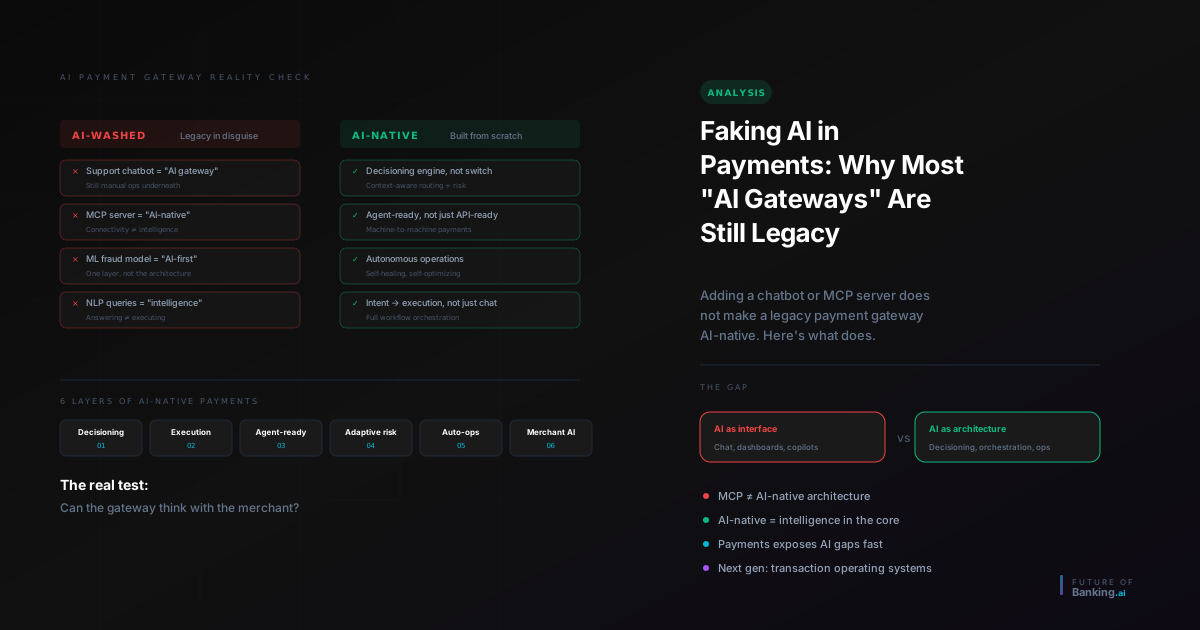
For the past year, the payments industry has started using a new phrase with growing confidence: AI payment gateway.
In many cases, what this actually means is far less impressive.
A legacy gateway adds a support bot. Or an AI dashboard for merchants. Or a basic rules engine with better copywriting. Or, more recently, an MCP server that lets an LLM call a few payment APIs. Suddenly the company starts speaking the language of "agentic commerce," "AI-first payments," or "AI-native checkout."
But that is not an AI-native payment gateway. That is branding.
And the distinction matters, because payments is one of the domains where superficial AI adoption will be exposed very quickly. In content, search, and support, a weak AI layer can still look clever for a while. In payments, it collides almost immediately with fraud, risk, routing, settlement, chargebacks, compliance, reconciliation, merchant trust, and authorization rates. The gap between AI as interface and AI as operating logic becomes impossible to hide.
The industry is now entering a phase where simply exposing payments to AI agents through protocols like MCP is becoming easier. MCP itself is an open standard for connecting AI applications to external tools and systems; it is a connectivity layer, not a reinvention of the underlying payments stack. Some major players have launched MCP servers or agent toolkits, and Stripe has also pushed the conversation toward agentic commerce with its Machine Payments Protocol and related work around machine-to-machine payments. That is important progress. But it also creates a temptation: to confuse AI accessibility with AI nativeness.
They are not the same thing.
The new payments theatre
A lot of legacy payment providers are approaching AI the same way large software companies approached mobile in the early 2010s. They are taking an old core system and wrapping a new interface around it.
That usually shows up in one of five ways.
First, they add conversational access to existing APIs and call it intelligence. A merchant can ask, "How many failed payments did I have yesterday?" and get an answer in plain English. Useful, yes. AI-native, no.
Second, they launch an "AI fraud engine" that is really just a rules engine with some machine learning models attached to one part of the flow. Important, but still partial.
Third, they release copilots for merchant support, dispute responses, analytics summaries, or onboarding. Again, helpful. Still not a rethinking of the gateway.
Fourth, they publish an MCP server and imply that because an LLM can now create a payment link or fetch a transaction, the gateway itself has become AI-first. But MCP is only a standard way to expose tools to models. It does not magically transform the underlying orchestration, risk engine, merchant experience, or network intelligence.
Fifth, they use the phrase "agentic commerce" while their underlying stack still assumes a human clicks through every step, every exception path is manual, and every operations workflow sits in dashboards built for people, not software agents.
This is the core problem: they are treating AI as a feature on top of payments, instead of redesigning payments for a world where software agents, models, workflows, and humans all participate in commerce together.
What an AI-first payment gateway actually means
An AI-first payment gateway is not just a gateway with AI features. It is a gateway whose architecture, workflows, and product surface are designed with AI as a primary operating assumption.
That means the system is not built only for human developers and merchant operators. It is built for human users, merchant software, internal finance and ops teams, AI copilots, autonomous or semi-autonomous agents, and machine-to-machine transaction flows.
In an AI-first gateway, AI is not parked in the support layer. It sits much closer to the core of decisioning and orchestration.
A truly AI-first payments platform should think differently across at least six layers.
1. Payments as decisioning, not just processing
Traditional gateways think in terms of transaction processing: request comes in, payment method is tokenized, routed, authorized, settled, reported.
AI-first gateways think in terms of continuous decisioning.
Every payment is not just a transaction. It is a live context window: who is paying, through which agent or interface, what prior trust exists, what merchant behavior suggests, what fraud patterns are emerging, what payment rail is optimal, whether the system should ask for a step-up, whether retry logic should happen silently, whether the transaction should be split, delayed, or re-routed, whether human approval is required.
In other words, the gateway becomes a decision engine, not merely a switch.
2. Natural language is not the product. Intent execution is.
A lot of legacy players mistake chat for architecture.
A merchant typing "refund customer X" is not the breakthrough. The breakthrough is whether the system truly understands operational context, permissions, risk, ledger impact, downstream reconciliation, and customer communication.
If the AI layer still has to hand off to old dashboards, brittle APIs, and manual teams, then the "AI experience" is mostly cosmetic.
An AI-first gateway should convert business intent into safe, auditable payment actions. Not just answer questions. Not just trigger APIs. Actually execute workflows with context.
3. The gateway must be agent-ready, not just API-ready
APIs were built for developers. The next layer is being built for agents.
That means the gateway should support structured tool use, clear authorization, scoped permissions, machine-readable actions, reversible workflows, verifiable state changes, and event-driven feedback loops. MCP can help expose tools to AI applications, and emerging protocols around machine payments point in this direction. But being agent-ready requires much more than exposing endpoints.
A real AI-first gateway needs agent-safe primitives, approval chains, transaction explainability, fraud confidence scoring visible to both humans and machines, machine-readable receipts and disputes, programmable post-payment actions, and persistent memory around merchant behavior and payment context.
The key is this: an AI-native system assumes non-human actors will increasingly initiate, monitor, retry, optimize, and reconcile payment activity.
Most legacy gateways are nowhere close to this.
4. Risk and fraud should be adaptive, not static
Legacy providers often bolt AI onto fraud because it is the most obvious use case. But even here, many are getting it wrong. They are applying AI as a model improvement inside an otherwise static operational structure.
AI-native risk is different. It is continuous, multi-layered, and feedback-driven. It learns across merchant categories, transaction behaviors, device signals, conversational flows, account changes, agent identities, and network outcomes. It should also understand new forms of commerce, including payments initiated or influenced by AI assistants and software agents.
An AI-native gateway should ask: Is this a human buyer, a delegated agent, or a malicious bot? Is this transaction normal for this merchant's business model? Should the checkout experience change in real time? Should the system optimize for approval, fraud reduction, merchant margin, or customer experience in this moment? Can the model explain why it acted?
That is much deeper than "we use AI to detect suspicious transactions."
5. Operations must become autonomous-by-default
The most under-discussed part of AI in payments is not checkout. It is operations.
Legacy gateways still depend on armies of people and dashboards for merchant onboarding reviews, risk escalations, payment ops, dispute handling, reconciliation support, account health monitoring, routing changes, and exception management.
So they market AI on the front end while their back office remains deeply manual.
An AI-first gateway should automate large parts of internal and merchant-facing operations: detecting and fixing payment failures, summarizing root causes, proposing or executing routing changes, automating dispute evidence assembly, reconciling settlements, watching for merchant abuse, flagging anomalies before merchants complain, and orchestrating compliance workflows.
This is where "AI-native" becomes real: when the gateway itself behaves like an intelligent payment operating system, not just a processor with prettier documentation.
6. The product should be built for merchants who will themselves be AI-native
This may be the most important point.
The merchants of the next five years will not operate like the merchants of the last fifteen. Their storefronts will have agents. Their customer support will have agents. Their finance stack will have agents. Their growth engine will have agents. Their procurement systems will have agents. Their ERP and accounting systems will talk to payment systems automatically.
So an AI-first payment gateway must be designed not only for current merchants, but for a future in which businesses are increasingly software-orchestrated.
Legacy gateways are still largely selling to developers and finance teams. AI-native gateways will increasingly sell to merchant systems.
So what is an AI-native payment gateway?
If AI-first means AI is a primary design principle, AI-native means the gateway is built from the ground up with that principle embedded across its core architecture. That is a higher bar.
An AI-native payment gateway is not one that merely "supports AI." It is one whose core system behavior improves because intelligence is woven into its transaction lifecycle, risk graph, orchestration logic, merchant tooling, and operational architecture from day one.
It has a machine-readable, action-oriented core — not just REST APIs, but tool-ready capabilities, structured events, contextual state, and safely executable workflows. It is built for dynamic orchestration — not one-size-fits-all processing, but real-time routing, retries, fraud controls, pricing logic, and payment method decisions based on context. It treats payments as part of a broader business workflow — not isolated authorizations, but connected flows across commerce, finance, support, accounting, ledgers, refunds, subscriptions, and reconciliation.
It supports human-in-the-loop intelligence. It has persistent memory and learning loops. It is explainable. And it is designed for agentic commerce.
Why legacy payment gateways are getting this wrong
The reason is not just technical. It is structural.
Their architecture was built for another era. Most legacy gateways were built for a web-and-app world, not an agent-and-model world. Their systems assume human-led integrations, static merchant configurations, dashboard-driven operations, fragmented analytics, separate fraud, support, and payment stacks, and batch-heavy back-office workflows. Adding AI on top does not remove these assumptions.
They think feature-first, not system-first. Large incumbents often treat every new wave the same way: create a product line, add some UI, announce a capability, update positioning. But AI is not like BNPL, wallets, or tokenization. It is not just another module. AI changes how the gateway should think, act, decide, communicate, and optimize. If the core system does not change, the AI layer eventually becomes decorative.
They confuse protocol support with product transformation. Releasing an MCP server is useful. It makes the platform more accessible to LLM applications and agents. But that is a developer access improvement, not proof of AI-native architecture. A company can have a fantastic MCP server and still be a deeply legacy payment platform underneath.
And their business model rewards incrementalism. Incumbents do not like architectural resets. They already have merchant bases, partner ecosystems, risk controls, compliance layers, and revenue tied to current workflows. So the safer route is to market AI gradually rather than rebuild around it. That is rational in the short term. But dangerous in the long term.
What the next generation should look like
The next generation of payment gateways will likely look less like payment processors and more like intelligent transaction operating systems.
They will not just expose APIs. They will expose decisioning. They will not just process payments. They will orchestrate commerce. They will not just generate reports. They will explain performance and act on it. They will not just flag fraud. They will continuously balance trust, conversion, and control. They will not just integrate with software. They will collaborate with agents.
And they will not think of AI as a marketing layer. They will treat AI as the architecture.
That is the line the industry still struggles to see.
Because in this moment, many payment companies are still trying to look AI-native before they have done the harder work of becoming AI-native.
And in payments, that gap will not stay hidden for long.