
Fraud has always had one brutal advantage over banks: speed.
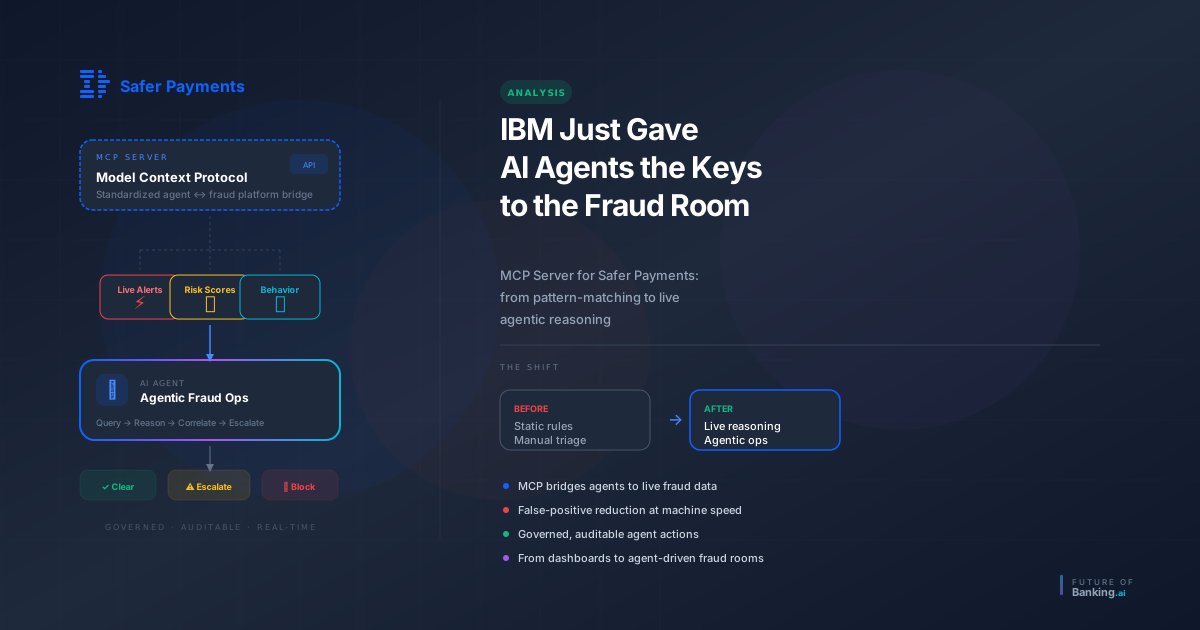
Criminals move in seconds. Banks investigate in queues. By the time an alert is reviewed, context is gathered, and someone decides whether the threat is real, the loss may already be locked in. That timing gap has defined fraud operations for years. IBM's latest move matters because it is aimed squarely at that gap. On March 5, IBM announced an MCP Server for IBM Safer Payments that allows MCP-compatible AI agents to securely query the fraud platform directly, pull live risk intelligence, and use that context in real time. IBM says the goal is to accelerate detection, investigation, and response while keeping the process governed and auditable.
That may sound like plumbing. It is actually strategy.
What IBM has done is open the fraud stack to agents. Until now, most "AI in fraud" systems were still trapped inside older operating models: static rules, historical pattern matching, dashboards, and manual analyst handoffs. Even when AI was present, it was often being used inside a narrow scoring engine rather than as an active reasoning layer that could move across systems and act on live information. IBM is pushing toward something different: agentic fraud operations.
This is not another "AI-powered fraud detection" press release
The financial industry has been talking about AI-driven fraud detection for years. But much of that talk has boiled down to a familiar formula: train models on old fraud patterns, score transactions, send alerts, and let human teams do the rest.
That model works — until it doesn't.
Fraud does not stand still. Attack patterns mutate, mule networks adapt, device behavior changes, and synthetic identities get harder to spot with static playbooks. IBM's framing is notable because the agent is not just being asked, "does this payment resemble something fraudulent from the past?" IBM says the agent can query real-time transaction risk assessments, alerts, and behavioral context, correlate those with signals from other authorized systems, and then dynamically prioritize or escalate its next action. That is a materially different architecture from a traditional fraud model.
The important shift here is from pattern-matching to live reasoning.
Why MCP matters more than most people think
MCP is one of those technical terms that can sound more boring than it is. IBM describes the Model Context Protocol as a standardized way for AI applications to interact with external tools, databases, and services. In simpler terms, it gives agents a structured way to reach outside the model and work with live systems instead of relying only on static prompts or preloaded data. IBM even compares MCP's role to what USB-C did for hardware interoperability.
In fraud, that is a big deal.
The problem in many bank AI deployments is not that the model is weak. It is that the model is blind. It cannot see enough of the right data, quickly enough, in a form it can use. By putting an MCP Server in front of Safer Payments, IBM is saying: the agent can now work directly against trusted fraud intelligence, not a delayed export, not a manually assembled case file, not a sanitized summary.
That is how fraud teams get closer to machine-speed defense.
The real target is not just fraud — it is false positives
Fraud prevention teams do not spend all day catching sophisticated criminals. Much of the daily grind is triage.
Alerts pile up. Many are noise. Analysts burn time on transactions that turn out to be legitimate. Good customers get blocked. Operations slow down. Trust erodes.
IBM explicitly says the new setup can help with false-positive reduction and alert triage by letting AI agents instantly cross-reference alerts against live fraud intelligence and separate genuine threats from irrelevant activity. It also says agents can pivot across fraud data without manual analyst queries and arrive at supported conclusions within seconds.
That matters because false positives are not a side issue. They are one of the core cost centers in fraud operations. The bank that gets fraud detection right but floods itself with bad alerts has not solved the problem. It has simply shifted the burden downstream.
If this architecture works as IBM intends, the biggest early win may not be more fraud catches. It may be less wasted human effort.
IBM is quietly defining what the fraud room of the future looks like
The old fraud room was dashboard-driven. Analysts watched queues, opened cases, gathered context, and made calls.
The next fraud room will be agent-driven.
Not fully autonomous. Not unsupervised. But agent-driven.
IBM's announcement is careful on that point. The company repeatedly emphasizes accuracy, transparency, control, trusted data, governance, and auditability. It says agents remain grounded in authoritative fraud intelligence and that actions stay governed and traceable. It also says the MCP capability is in preview only, offered for evaluation and feedback, and not yet supported for production use.
That caution is not just compliance language. It is the whole game.
Banks will not hand critical fraud workflows to AI agents unless they can explain what data was queried, what reasoning path was followed, and why a specific escalation or action occurred. In fraud, autonomy without auditability is a non-starter. IBM seems to understand that.
Why this could matter beyond IBM
The deeper significance of this move is that it hints at where financial security infrastructure is going.
The long-term destination is not a prettier fraud dashboard. It is a stack where intelligent agents continuously scan live transactions, correlate behavior across systems, rank what matters, draft investigations, escalate cases, and trigger narrow defensive actions before a human analyst even opens the file. Humans stay in control, but they are supervising exceptions rather than performing the first pass manually.
That future is still early. IBM has not shipped a full production-ready autonomous fraud workforce here. What it has shipped is the connective tissue that makes that future plausible.
And that is why this announcement matters more than it first appears.
The real question now
IBM has built a bridge between AI agents and live fraud intelligence.
The next question is whether banks are operationally ready to cross it.
Many institutions still run fraud programs built around fragmented systems, manual investigations, rigid approval structures, and risk teams understandably wary of handing decisioning authority to anything that sounds like an "agent." The technology may now be moving faster than organizational comfort.
But the direction is becoming clearer.
Fraud will not wait for banks to modernize at their own pace. Attackers are already operating with automation, adaptability, and scale. Defending with slower workflows is becoming less viable each year. IBM's MCP launch is important because it recognizes that reality. It starts to re-architect fraud prevention around the idea that intelligence should not sit passively in a platform waiting for a human to ask for it. It should be available, queryable, and actionable at machine speed.
That is the real story here.
IBM did not just add another AI label to a fraud product. It gave AI agents a governed path into the fraud room.
And over time, that may change how the entire room works.