
Across India's banking sector, a subtle but meaningful shift is underway.
It isn't being announced through large campaigns or headline-grabbing product launches. Instead, it's happening internally — through mandates, roadmap changes, and technology priorities that are steadily reshaping how banks operate.
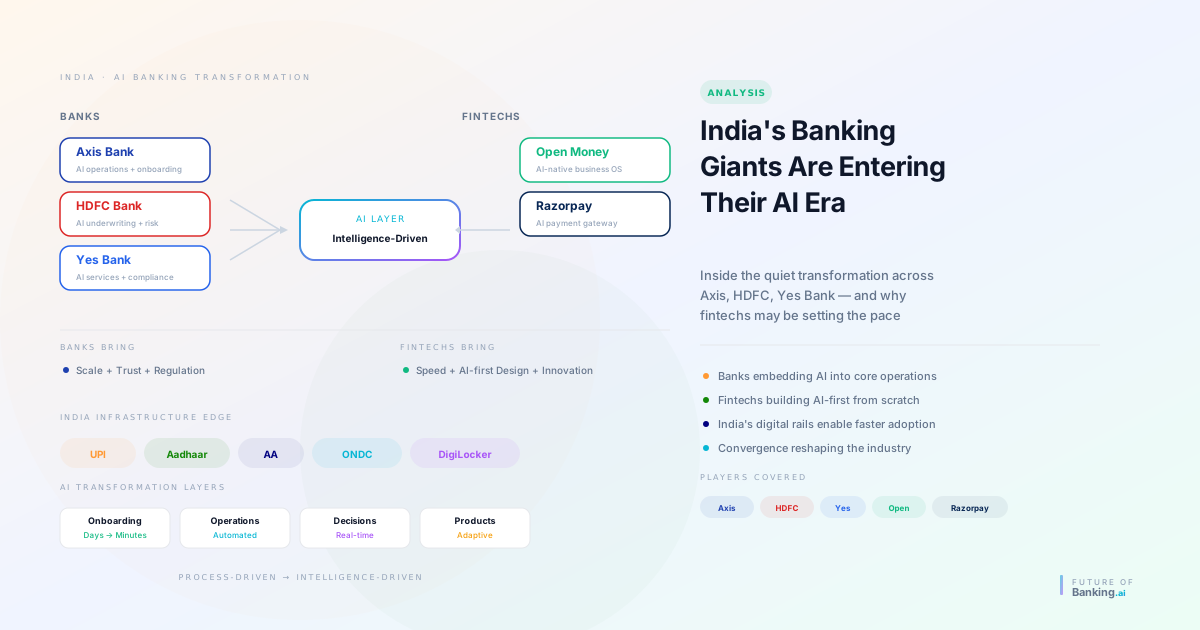
According to sources, institutions such as Axis Bank, HDFC Bank and Yes Bank have begun embedding artificial intelligence more deeply across their products, services, and operational layers.
While Indian banks have experimented with AI for years, what's different now is intent. This is no longer about isolated use cases or innovation labs. It is about integrating AI into the core fabric of the bank — gradually, but at scale.
What's driving this shift
The forces behind this transformation are a convergence of pressures and possibilities.
On one side, the economics of banking at scale are becoming increasingly complex. Managing millions of customers, ensuring compliance, and maintaining service quality requires significant operational effort. AI offers a way to streamline this — reducing manual workloads while improving speed and consistency.
At the same time, customer expectations have evolved rapidly. India's digital public infrastructure — from UPI to Aadhaar — has conditioned users to expect immediacy. Opening an account, resolving a query, or completing a transaction is no longer seen as a process, but as an experience that should happen in real time.
For banks, this creates both a challenge and an opportunity. AI becomes the bridge between scale and experience — enabling institutions to serve large customer bases without compromising responsiveness.
The early signs of transformation
The evidence is already visible across several operational layers.
In onboarding, AI is helping compress processes that once took days into minutes. Identity verification, document checks, and risk screening are becoming faster and more seamless, improving conversion while maintaining compliance.
In operations, AI is beginning to reduce the weight of back-office workloads. Functions such as reconciliation, transaction monitoring, and customer support are increasingly supported by intelligent systems that can process large volumes of data with minimal latency.
Decision-making is also evolving. Credit underwriting, fraud detection, and risk assessment are benefiting from models that can analyse patterns across vast datasets, allowing banks to make more informed and timely decisions. Importantly, these systems continue to operate within regulatory frameworks, ensuring that speed does not come at the cost of control.
India's infrastructure advantage
What makes India particularly interesting in this context is its underlying infrastructure.
Few markets combine scale with structured digital rails in the way India does. The presence of interoperable systems such as UPI, along with consent-driven data sharing frameworks like Account Aggregator, creates an environment where AI can operate on high-quality, real-time data.
This gives Indian banks a unique advantage. Rather than building from scratch, they can layer intelligence on top of an already digitised ecosystem — accelerating adoption while managing risk.
But this transformation is not happening in isolation
Parallel to these developments, India's fintech ecosystem is moving quickly — often with fewer constraints and a stronger bias towards building AI-first systems from the ground up.
Companies like Open Financial Technologies have been quietly evolving beyond digital banking into what can be described as an AI-native business banking OS — where workflows such as payments, accounting, reconciliation, and financial operations are increasingly automated and orchestrated through intelligent systems. Open is not simply adding AI features to a banking product. It appears to be rethinking what a business banking platform looks like when automation and intelligence are foundational rather than supplementary.
At the same time, players like Razorpay are beginning to reimagine the payment layer itself. The emergence of AI-driven payment flows — where routing, fraud checks, retries, and optimisation can happen dynamically — signals a shift from static gateways to more adaptive, intelligent payment infrastructure. Razorpay's recent moves into agentic payments and Agent Studio suggest the company sees its future not just in processing transactions, but in orchestrating entire commerce and finance workflows through AI.
This creates an interesting dynamic.
For years, fintechs built on top of banks — leveraging APIs, infrastructure, and regulatory cover. Now, in some areas, fintechs are beginning to define the direction of innovation itself. They are shipping faster, experimenting more aggressively, and designing systems where AI is embedded from day one.
Why this matters for banks
For banks, this doesn't represent a threat as much as it does a signal. It highlights where the industry is heading.
As a result, banks are increasingly faced with a new kind of imperative — not just to adopt AI, but to integrate it deeply enough to remain competitive in an ecosystem that is becoming more intelligence-driven.
This doesn't mean replicating fintech models directly. Banks operate under very different constraints, particularly around regulation, risk, and trust. But it does mean rethinking how their systems evolve.
Instead of viewing AI as a feature, banks are beginning to treat it as an enabling layer — one that enhances how products are delivered, how decisions are made, and how operations are executed.
The risk for banks that move too slowly is not that fintechs will replace them. It is that the gap between what customers experience through a fintech interface and what they experience through a traditional banking interface will widen to the point where loyalty becomes harder to maintain. When a business owner can manage invoicing, reconciliation, and payroll through an AI-native platform with minimal friction, the expectation for their bank to deliver something comparable will only grow.
The convergence ahead
Over time, this convergence between banks and fintechs could reshape the industry in meaningful ways.
Banks bring scale, trust, and regulatory strength. Fintechs bring speed, product innovation, and AI-first design. Together, they are gradually pushing banking towards a model that is more responsive, more automated, and more adaptive.
For banks, the path forward is likely to be iterative. Core systems will continue to provide stability, while new layers introduce flexibility and intelligence. AI will be embedded progressively — first in operations, then in decision-making, and eventually more deeply into product experiences.
For fintechs, the opportunity lies in continuing to push boundaries — exploring what fully AI-driven financial workflows can look like, and setting new benchmarks for user experience and efficiency.
The quiet signal
What stands out is the way this transformation is unfolding.
There is no single announcement that captures it. No defining moment that signals its arrival. Instead, it is happening quietly — across teams, systems, and strategies.
Banks are integrating AI into their operating layers. Fintechs are building around it from the ground up. And somewhere between the two, a new model of banking is beginning to take shape.
As this evolution continues, the distinction between "bank" and "fintech" may become less important than how effectively each player can harness intelligence.
Because in the next phase of financial services, the advantage may not come from who owns the infrastructure — but from who builds the smartest systems on top of it.
For now, the shift is quiet.
But its impact is likely to be anything but.