
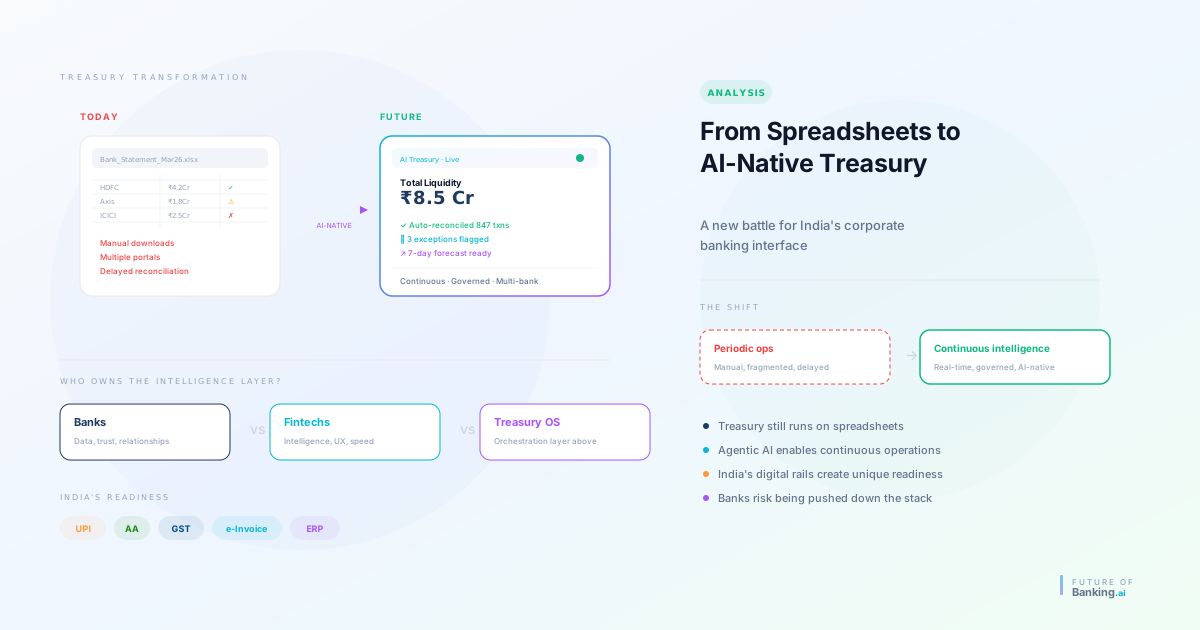
Indian treasury teams sit at the center of cash, risk, payments, compliance, and financial control. Yet across much of corporate India, treasury is still being managed through downloaded bank files, emailed reports, portal logins, and spreadsheet-based reconciliations.
That gap between strategic importance and operational reality is becoming impossible to ignore.
For years, treasury transformation was treated as a back-office modernization project. Now, with agentic and AI-native systems becoming viable, it is starting to look like something much bigger: the redesign of one of the most important functions in enterprise finance.
And that has major implications not just for CFOs and treasury teams, but also for banks.
Treasury in India is still highly manual
In many companies, the treasury workday still starts with the same ritual: logging into multiple bank portals, downloading statements, checking balances, updating trackers, reconciling movements, and trying to piece together a real view of liquidity.
This is not because finance leaders do not value technology. It is because treasury has always been difficult to automate end to end. Data is scattered across banks, ERPs, payment systems, tax workflows, and internal approvals. Exceptions are common. Compliance is critical. And real-time visibility is often more aspiration than reality.
So even in otherwise digitized organizations, treasury often remains trapped in an older operating model.
The result is striking: one of the most strategic control centers in the enterprise is still being run on spreadsheets.
Why legacy treasury automation has not gone far enough
Over the years, treasury vendors, ERP systems, and banks tried to improve this using APIs, dashboards, RPA, and rules-based workflows. Those efforts helped, but only at the edges.
The deeper issue is that treasury is not just a workflow problem. It is a judgment problem.
Payments do not always match cleanly. Forecasts change without warning. Inflows arrive late. Vendor remittances span entities or invoices. FX exposures need interpretation, not just calculation. Compliance exceptions appear in the middle of routine processes.
Traditional automation works best when the path is fixed and predictable. Treasury rarely is.
That is why human intervention remains central to the function. In treasury, the exception is not a side case. The exception is often the real work.
What AI-native treasury actually means
AI-native treasury is not about adding a chatbot to an existing treasury portal. It is not about taking old workflows, placing an AI label on top, and calling it transformation.
It means designing treasury from the ground up as a continuously intelligent system.
In an AI-native model, the treasury layer does not wait for a person to gather data and create reports. It continuously reads positions across accounts, systems, receivables, payables, and ERP workflows. It monitors liquidity in real time. It forecasts dynamically as payment behavior changes. It matches transactions, identifies anomalies, surfaces exceptions, and routes issues for approval or action.
Instead of teams manually assembling information, the system maintains a living financial picture.
That is the real shift: from periodic treasury operations to continuous treasury intelligence.
Why agentic AI changes the equation
The reason this moment feels different is that agentic AI can do more than automate one task at a time.
It can interpret intent, move across multiple systems, investigate discrepancies, take structured actions, and adapt when the data is incomplete or messy. In treasury, that matters enormously.
Instead of merely producing reports, AI agents can potentially monitor balances continuously, reconcile transactions across fragmented systems, investigate mismatches, support payment prioritization, flag risks early, escalate unresolved exceptions, and explain outcomes to human operators.
That changes the role of the finance team. People no longer spend most of their time gathering data and pushing processes forward manually. They spend more time on oversight, policy, approvals, risk judgment, and strategic decision-making.
This is not just better automation. It is a new operating model.
India may be unusually ready for AI-native treasury
India has something important in its favor: digital financial infrastructure.
The Account Aggregator framework creates the foundation for consent-based financial data sharing. UPI normalized real-time payments at scale. GST digitization and e-invoicing have increased the availability of structured financial data. ERP adoption is growing. Bank APIs are improving.
The ingredients for more intelligent treasury systems are increasingly in place.
What has been missing is the orchestration layer — the intelligence layer that can sit across these systems, unify the data, interpret what is happening, and help act on it.
That is why AI-native treasury is becoming a serious conversation now, rather than a futuristic one.
What this means for banks
This shift matters deeply for banks because treasury has historically been one of the strongest anchors of the corporate banking relationship.
Cash management, payments, collections, liquidity, FX, and working capital are not just products. They are how banks stay embedded in the day-to-day financial operations of businesses.
But AI-native treasury changes where value sits.
If a finance team starts relying on an intelligent treasury layer that sits above multiple bank accounts, multiple payment rails, ERP systems, and internal workflows, then the bank portal is no longer the main operating interface. The intelligence layer becomes the control center.
That creates both a threat and an opportunity for banks.
The threat
Banks risk being pushed down the stack.
If fintechs or treasury platforms own the user experience, the workflow orchestration, the insight layer, and the automation logic, then banks may increasingly be reduced to underlying infrastructure providers — the accounts, rails, and balance sheet behind someone else's operating system.
In that future, the customer relationship weakens at the interface level, even if the bank remains important in the background.
The opportunity
Banks can also move up the stack.
They are uniquely positioned because they already sit on highly valuable financial data and trusted enterprise relationships. If banks build or partner to offer AI-native treasury experiences, they can evolve from being service providers to becoming intelligence partners.
That means going beyond portals and basic APIs toward systems that help customers answer questions such as: Where is my real cash position right now? Which payments should be prioritized today? Which receivables are likely to slip? Where are reconciliation breaks emerging? How will my liquidity look over the next 7, 15, or 30 days?
The banks that understand this shift early could strengthen their relevance with CFOs. The ones that do not may find their products increasingly abstracted behind third-party platforms.
But AI in treasury must be governable
Treasury cannot become autonomous unless it is also controllable.
Any AI-native treasury system must operate within clear boundaries: approval thresholds, maker-checker controls, audit trails, explainability, user permissions, and compliance logic.
This is especially important in India, where treasury workflows intersect with GST, TDS, vendor controls, MSME payment obligations, internal policy rules, and bank-specific operating processes.
So the winners will not be the players who simply add AI features. They will be the ones who build AI with trust, traceability, and governance from day one.
In treasury, intelligence without control is not innovation. It is risk.
The treasurer's role is set to become more strategic
One of the biggest misconceptions around AI in finance is that it is mostly about replacing people. Treasury is more likely to evolve than disappear.
As systems take over the repetitive work of collection, matching, monitoring, and exception routing, treasury professionals can focus more on liquidity strategy, risk posture, capital efficiency, banking relationships, and policy design.
The future treasury leader may spend less time producing the view and more time governing the machine that creates it.
That is a far more strategic role than chasing statements and updating spreadsheets.
A redesign moment for both treasury teams and banks
For years, treasury transformation moved slowly because the problem was genuinely hard. The systems were fragmented, the workflows messy, and the controls too important to compromise.
That is what makes this moment different.
AI-native and agentic systems are the first credible technologies that can bring together data, workflow, judgment, and action in a way that feels operationally meaningful.
For Indian enterprises, this could finally end the spreadsheet era in treasury.
For banks, it is a wake-up call.
The question is no longer whether treasury will become more intelligent. The real question is who will own that intelligence layer: the bank, the fintech, or a new treasury operating system that sits above them both.