
Most banks have an AI strategy.
JPMorgan has an AI operating system.
That is the real difference.
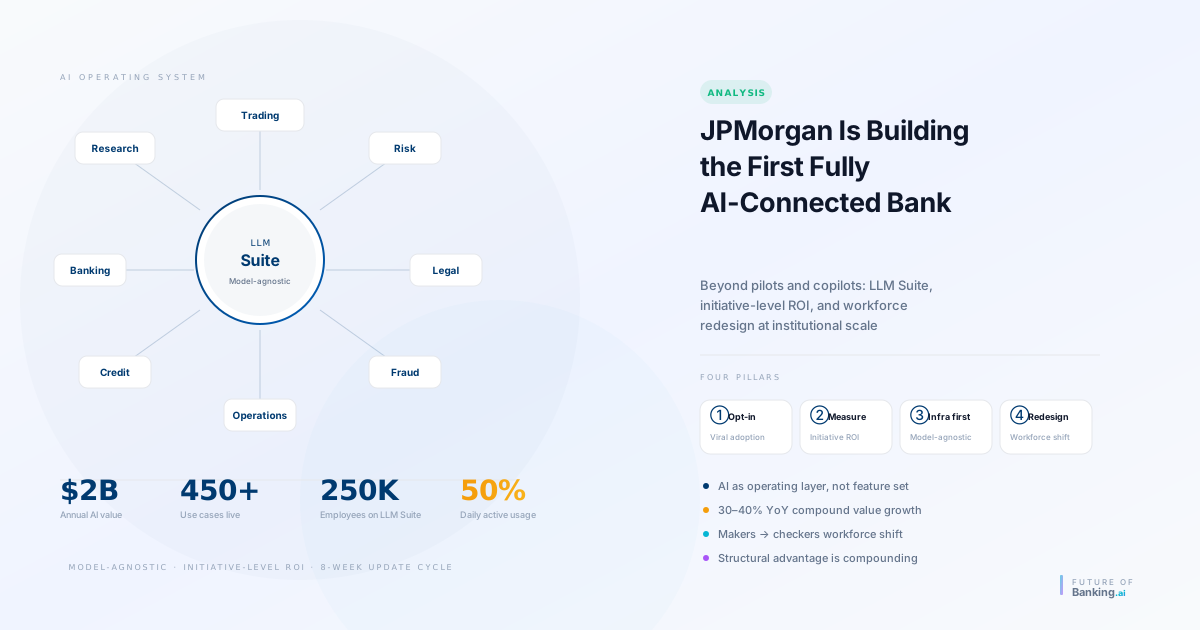
Across financial services, the industry is still full of familiar AI headlines: chatbot launches, internal copilots, isolated fraud pilots, productivity experiments in risk or compliance. None of that is meaningless. But much of it still sits at the edge of the institution. JPMorgan appears to be doing something deeper. The bank says AI is already creating around $2 billion in annual business value, with 450+ use cases in production and a path to 1,000 by year-end. Those are big numbers. But the more important point is that they suggest AI is no longer being treated as a feature set. It is becoming part of the bank's operating layer.
The clearest symbol of that shift is LLM Suite, JPMorgan's internal AI platform. By mid-2024, the bank had rolled out a proprietary system that connected employees to leading frontier models through one controlled environment. Today, around 250,000 employees have access, and roughly half reportedly use it every day. In enterprise AI, that level of daily usage matters far more than glossy launch announcements. It suggests the tool has crossed the line from corporate experiment to institutional habit.
This is not about scale alone
It is tempting to explain JPMorgan's lead by saying it simply has more money than everyone else. It is true that size helps. JPMorgan's budget, talent density, and execution capacity give it room to move faster than most banks.
But scale alone does not explain the gap.
A lot of large institutions have money. A lot of them have data. A lot of them have been talking about AI for years. What appears to distinguish JPMorgan is not just resourcing but sequencing. It made a few foundational decisions earlier than many peers, and those decisions now seem to be compounding.
The bank did not just buy models and start experimenting. It appears to have built an internal system for adoption, measurement, infrastructure durability, and workforce redesign. That is a much more serious thing than an AI program.
It is the early shape of an AI-native bank architecture.
The first smart move: make adoption opt-in
This may be one of the most underrated decisions in the entire playbook.
When JPMorgan launched LLM Suite, it did not force employees to use it. Instead, the system was made available, and adoption spread through what was described as "healthy competition" and viral usage. That sounds like a cultural detail. It is actually a strategic one.
Large institutions often mistake rollout for adoption. They mandate a tool, train everyone on it, and then count logins as success. But forced enterprise adoption usually produces surface-level behavior. People comply just enough to satisfy management, then return to old workflows.
Opt-in adoption does something different. It reveals where real value exists.
The people who find immediate use cases become internal evangelists. Teams begin to swap tactics. Workflows emerge organically. Instead of a central AI team dictating where the value should be, the institution discovers where the value actually is. That matters in a bank, where the most useful applications are often buried inside daily work: investment bankers creating decks, lawyers reviewing contracts, credit teams extracting covenants, operations staff summarizing exceptions.
If your employees have to be pushed into the tool, you probably do not yet have product-market fit internally. JPMorgan seems to have understood that earlier than most.
The second smart move: measure AI at the initiative level
This is where many AI programs fall apart.
A lot of institutions still talk about AI in platform-level language: higher productivity, faster decisions, improved efficiency, stronger customer experience. Those statements may all be true, but they are too broad to manage properly. If value is measured only at the abstract level, leadership cannot tell which deployments are actually working and which are expensive theater.
JPMorgan appears to have avoided that trap by measuring ROI at the initiative level, using controlled experiments and explicit KPIs. In other words, a use case is not judged by whether it sounds promising. It is judged by whether it produces measurable incremental benefit against a baseline.
That discipline sounds dry. It is not. It is one of the biggest structural advantages a bank can build.
Because AI value does not scale just because you deploy more tools. It scales when you can reliably identify what works, cut what does not, and keep reallocating resources toward the best-performing workflows. JPMorgan's AI-attributed benefits have grown 30–40% year over year since inception. That kind of compounding is much easier to believe when the institution is operating with initiative-level measurement rather than vague platform storytelling.
Platform-wide ROI is a narrative. Initiative-level ROI is a steering mechanism.
The third smart move: build the infrastructure before obsessing over use cases
This is probably the most important part.
Many institutions start with use cases because that feels tangible. Build a contract summarizer. Launch a support bot. Test an underwriting copilot. Each one may be useful, but together they often create fragmentation: different vendors, disconnected controls, inconsistent governance, duplicated integrations, and growing migration risk when models or priorities change.
JPMorgan seems to have taken the harder path first. LLM Suite is described as a model-agnostic platform, updated every eight weeks, connecting more systems and more internal data over time. It currently integrates models from OpenAI and Anthropic, but it is not architected around permanent dependence on any one provider.
That is a quiet but crucial decision.
The best-performing model today may not be the best-performing model next year. The cheapest model may change. The safest deployment path may change. The regulatory expectations around hosting, controls, or explainability may change. If a bank hardwires itself too deeply into one vendor's stack, short-term speed can turn into long-term rigidity.
In AI, the moat is rarely the model itself. The moat is the internal architecture that lets you swap, govern, deploy, and scale models without rebuilding the institution every time the landscape changes.
The workforce redesign is the real story
This may be the most under-discussed part of all.
JPMorgan's AI story is not just about software. It is about the redesign of human work.
The shift can be framed as the move from "makers" to "checkers." As AI begins producing first drafts, summaries, analyses, presentations, and extracted data, human roles shift upward from production toward verification, direction, context-setting, and judgment.
That sounds efficient. It is actually profound.
Because once that shift takes hold, the institution is no longer simply giving employees better tools. It is changing what employees are for. Some jobs become more leveraged and valuable because human judgment sits on top of faster machine-generated output. Other jobs become more exposed because their core value was process repetition rather than judgment or relationship management.
JPMorgan has been unusually candid about this. Roles in areas like account setup, fraud detection, and trade settlement are expected to decline as automation scales, while new categories emerge around context, knowledge management, and output verification.
That honesty matters.
A lot of institutions still prefer a softer story: AI will help everyone, augment everyone, and make everyone more productive. Some of that is true. But it is incomplete. The more consequential reality is that AI changes role design. It shifts labor mix. It alters org charts. It changes what kinds of people become more strategic inside the bank.
Why this creates a widening gap in banking
The big risk for the rest of the industry is not that JPMorgan has better prompts or more internal enthusiasm.
It is that AI advantage may now begin to compound institutionally.
A bank with strong internal adoption finds better use cases faster. A bank that measures initiatives well knows what to scale. A bank with model-agnostic infrastructure moves faster when the model landscape changes. A bank that redesigns work early gets more value out of the same tools. Those things reinforce each other.
That is how a lead becomes structural.
And once that happens, the gap no longer shows up only in tech headlines. It shows up in speed-to-decision, cost structure, process cycle times, employee leverage, and eventually customer experience. The divergence is beginning to show up in operational performance and these gaps compound over time.
This is why the JPMorgan story should make other banks uncomfortable.
What everyone else should actually copy
JPMorgan's exact scale is not replicable.
Its principles are.
Start with broad access rather than top-down mandates. Let internal demand reveal real use cases. Measure value at the initiative level, not through vague platform narratives. Build model-agnostic infrastructure before overcommitting to one vendor or one generation of tooling. Design the human role explicitly. Do not assume workforce redesign will sort itself out.
Those are not glamorous lessons. But they are probably the ones that matter most.
Because the institutions pulling away in this cycle may not be the ones with the most public AI announcements. They may be the ones quietly making the right architectural decisions early.
Right now, JPMorgan looks like the clearest example of that.
It is not just deploying AI inside the bank.
It is building the bank around it.