
Indian stealth-mode startup MoltPe, based out of Bangalore, announced in a LinkedIn post that it has gone live on the Machine Payments Protocol (MPP) — making it one of the earliest real-world implementations of agentic payments, where AI agents autonomously execute transactions over HTTP.
The announcement signals a shift that the fintech industry has been anticipating but has yet to see in production: AI agents not just deciding — but transacting.
What exactly happened
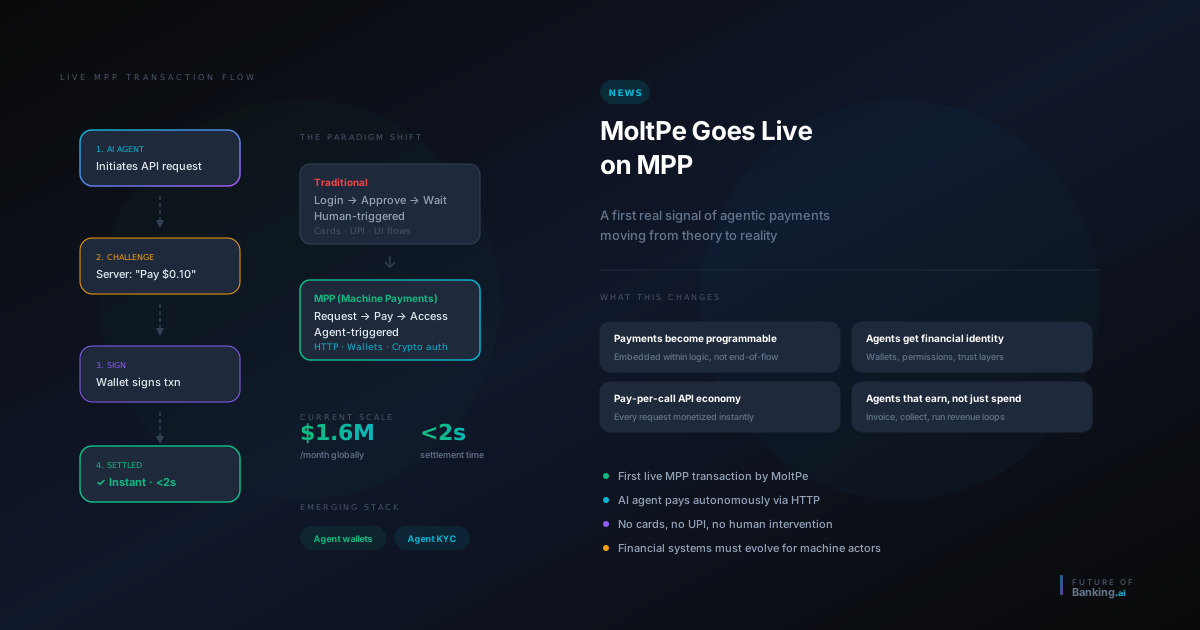
MoltPe demonstrated a live transaction where an AI agent initiated an API request, received a payment challenge, signed the transaction using its wallet, completed a payment of $0.10, and received the requested service. All of this happened autonomously, without human intervention, without cards, UPI, or UI flows, in under 2 seconds with instant settlement.
This is not a concept demo. It is a working implementation of machine-to-machine payments.
What is MPP — and why it matters
The Machine Payments Protocol (MPP), introduced by Stripe in collaboration with infrastructure players like Tempo, is an emerging open standard designed specifically for AI-native systems. At its core, MPP allows payments to be embedded directly into HTTP interactions, services to charge per API call in real time, and machines (agents, software) to transact without human involvement.
MPP turns payments into a native part of the internet's request–response cycle.
Instead of logging into a payment page, approving a transaction, and waiting for confirmation, MPP enables: Request → Payment → Access — all in one continuous machine flow.
How MPP works inside the transaction
The architecture is deceptively simple, but fundamentally new. First, an AI agent requests access to a service — data, compute, or content. The server responds with a structured payment requirement. The agent verifies the request and signs the transaction using its wallet credentials. Payment is executed and confirmed in real time. The API returns the requested data or service.
This replaces an entire layer of traditional payment infrastructure. No checkout flows. No redirects. No manual approvals. Just programmable value exchange between machines.
Why MoltPe's implementation is significant
Until now, most conversations around agentic payments have been conceptual, experimental, or infrastructure-led. MoltPe represents something different: an application-layer implementation where an AI agent actually pays.
That matters for three reasons. First, it validates demand for machine-native payment rails — payments are no longer just user-triggered events, they are becoming part of software execution. Second, it proves latency and feasibility — sub-2-second settlement shows that these systems can operate in real-time production environments. Third, it opens up new monetization models — APIs can now charge per request, per response, dynamically, without friction.
The current paradox: tiny volume, massive implication
Despite the breakthrough, the current scale of agentic payments remains extremely small — approximately $1.6 million per month globally, roughly $28,000 per day. Insignificant by payments industry standards.
But historically, this is exactly how foundational shifts begin. Stripe launched before SaaS exploded. UPI launched before India went cashless. Infrastructure precedes behavior change.
What this means for agentic payments
MoltPe going live on MPP is not just a product update — it is a signal that payments are becoming programmable primitives, embedded within logic, triggered by agents, and executed in real time. AI agents will need financial identities — every agent will require a wallet, spending permissions, and trust and identity layers. This introduces an entirely new category: financial infrastructure for non-human actors.
The API economy will evolve into a pay-per-call economy. Today, APIs are billed monthly or via credits. With MPP, every request can be monetized instantly, and pricing becomes granular and dynamic.
The missing piece: agents that earn
Interestingly, most infrastructure today focuses on agents that spend money. But the next frontier is agents that invoice, agents that collect payments, and agents that run revenue loops autonomously. This is where the real economic transformation lies.
What this means for banks and fintechs
For financial institutions, this shift raises deeper questions. Are existing rails ready for non-human transactions? Current systems — cards, UPI, net banking — are designed for human authentication and explicit consent flows. MPP introduces machine-authenticated payments and policy-driven approvals.
Who owns the agent wallet? Will it be banks, fintechs, infrastructure providers, or entirely new players? Will UPI evolve into agent-native rails? India's UPI stack offers real-time settlement and massive scale, but remains human-first. MPP represents machine-first payments. The convergence of the two could define the next phase of fintech innovation.
The bigger picture
MoltPe going live on MPP may appear small in isolation. But structurally, it represents something much larger: the beginning of an economy where software does not just consume services — it pays for them.
If this trajectory holds, payments will become invisible infrastructure, pricing will become real-time and usage-based, AI agents will become economic participants, and most importantly, financial systems will need to evolve from serving users to serving autonomous software.