
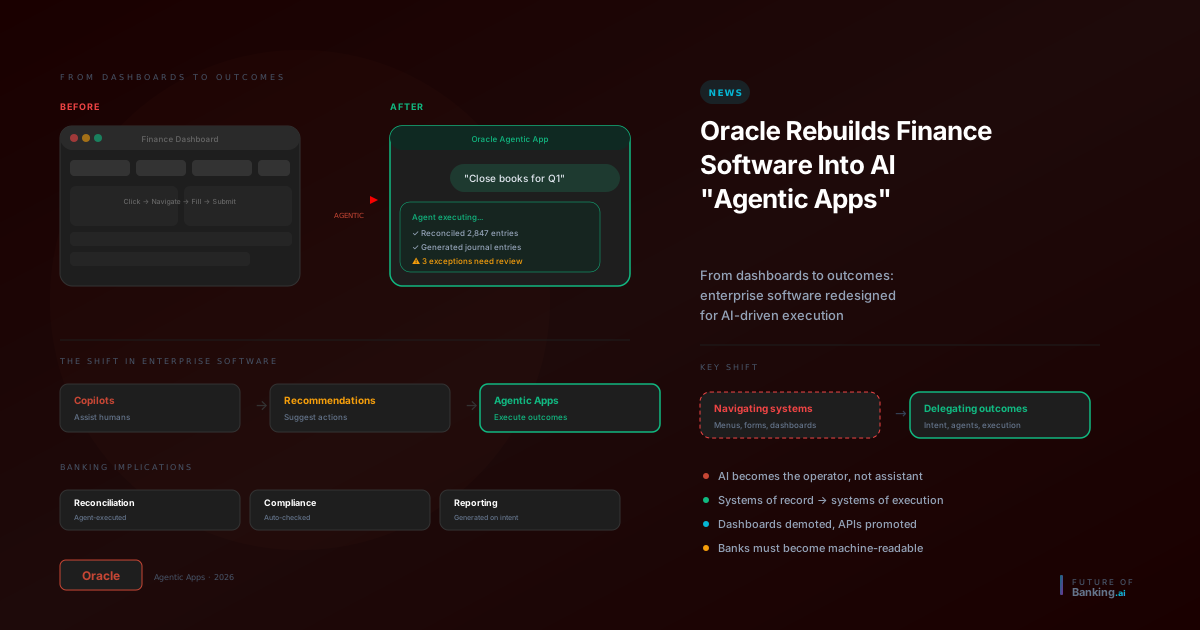
Oracle is reworking its finance and procurement software into what it calls "agentic applications" — systems where AI agents can execute workflows end-to-end instead of users navigating dashboards.
This marks a shift in enterprise software design: from menu-driven interfaces to AI-driven execution layers.
That distinction matters because it changes how software is used, how decisions are executed, and how systems are designed.
What's actually changing
Traditionally, enterprise finance systems required users to log into dashboards, navigate multiple modules, and manually trigger workflows such as approvals, reconciliations, and reporting.
With Oracle's new approach, users describe an outcome — for example, "close books for this quarter" — and AI agents execute the workflow across systems. Exceptions are flagged for human review.
This moves enterprise software closer to an intent-to-execution model. The user no longer needs to know which module to open, which form to fill, or which sequence to follow. The system interprets the goal and orchestrates the work.
Why this is not just another AI feature
Most enterprise AI so far has been copilots, recommendations, and summarisation layers. Useful, but still fundamentally assistive. The human remains the operator. The AI remains the sidebar.
Oracle's move is different. It positions AI as the operator of workflows, not just an assistant.
That distinction matters because it changes how software is used, how decisions are executed, and how entire systems are designed.
In a copilot model, the software still assumes a human is driving. In an agentic model, the software assumes an AI agent will handle the process, and humans will supervise exceptions. That is a fundamentally different design philosophy.
What this means for banks and fintechs
For financial institutions, the implications go well beyond ERP software.
Internal banking workflows will become agent-driven
Functions like reconciliations, compliance checks, treasury operations, and financial reporting can move from manual workflows to AI-executed processes with human oversight. The operational model shifts from teams performing tasks to teams governing agents that perform tasks.
Core systems may shift from systems of record to systems of execution
Banks have traditionally used software to store and process data. Agentic systems introduce execution layers that act on that data. This changes how core banking, payments, and risk systems are architected over time. The database does not just hold the truth. The agent layer acts on the truth.
The interface layer is being abstracted away
If AI agents become the primary interface, dashboards matter less and APIs and workflows matter more. Banks and fintechs will need to become machine-readable systems, not just user-facing ones. The front-end becomes less important than the action surface.
Why this matters now
This announcement aligns with a broader shift across the industry. Pine Labs has launched Grantex, an AI authorization layer for agents. Razorpay has introduced agentic business banking with five specialised AI agents. Trading and fintech platforms are moving toward AI-led interfaces across payments, treasury, and lending.
Together, these point to a consistent direction: AI is moving from the interface layer to the execution layer.
Oracle's move is significant because it validates this shift at enterprise scale. When one of the world's largest enterprise software companies redesigns its core finance products around agentic execution, it signals that the transition is no longer experimental. It is becoming the new design standard.
The bigger picture
Oracle's move signals that enterprise software is no longer being redesigned for better UX. It is being redesigned for no UX.
Instead of interacting with software, users will increasingly interact with agents that operate software. The dashboard does not disappear entirely. But it is demoted from the primary interface to a verification and audit surface.
That is a profound change for every institution that builds on or buys enterprise software.
The bottom line
Oracle is not just adding AI into finance software. It is redefining how enterprise systems are used: from navigating systems to delegating outcomes.
For banks and fintechs, the question is no longer whether to adopt AI.
It is: are your systems ready to be operated by AI — not just used by humans?