
For years, the fintech industry has treated authorization as a solved problem.
A user logs in. An app gets consent. An API key is issued. A transaction happens.
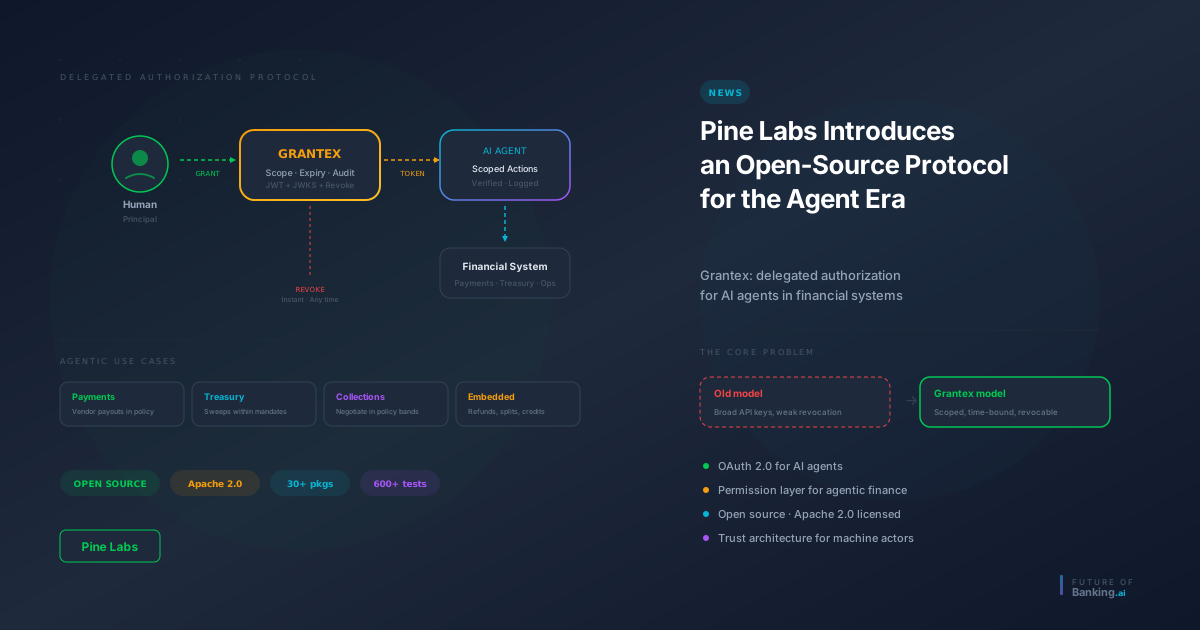
That model was built for a world where humans clicked buttons and software merely executed instructions. It was not built for a world where AI agents send emails, reconcile ledgers, operate software, and increasingly, initiate financial actions on behalf of users. That is precisely the gap Pine Labs is now trying to address with Grantex, which the company is positioning as an open protocol for delegated authorization in the AI era — effectively, "OAuth 2.0 for AI agents."
This matters because the next wave of fintech will not be defined by prettier dashboards. It will be defined by whether institutions can trust AI systems to act safely inside real financial workflows.
Pine Labs' own framing makes that clear. In announcing Grantex, CEO Amrish Rau said AI agents are no longer limited to generating text; they are now taking actions such as sending emails, moving money, writing code, and operating systems. He argued that the missing piece is a standard way to safely grant, manage, and audit what those agents are allowed to do.
That framing is not incidental. It follows Pine Labs' broader push into what it calls agentic commerce. In February, the company announced a collaboration with OpenAI and said it was embedding LLM capabilities directly into its commerce stack across payments orchestration, credit decisioning, risk monitoring, merchant workflows, and consumer interactions.
That is the real context for Grantex. This is not a side experiment. It is infrastructure for a future Pine Labs clearly believes is coming fast.
Why this matters now
The problem with today's "AI agent" stack is that most systems were never designed for agent-level permissions. In practice, many agentic workflows still rely on broad API keys, long-lived credentials, weak revocation, and limited auditability.
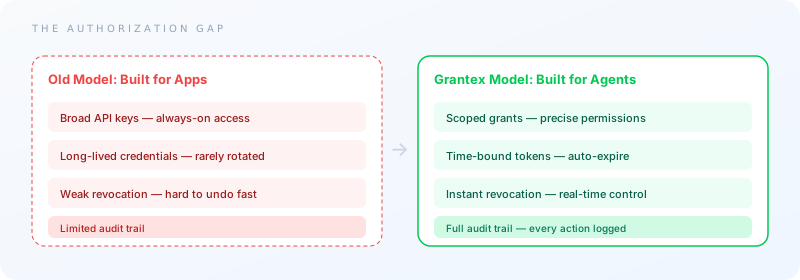
Grantex is trying to replace that with scoped, time-bound, revocable grants that can be verified and logged across services. Its public materials describe signed JWT grant tokens, offline verification through JWKS, instant revocation, and full audit trails for issuance, verification, and revocation events.
That is a meaningful shift for financial services.
Because once an AI system can do more than suggest — once it can actually act — the conversation changes from convenience to control.
A chatbot recommending a payment option is one thing. An AI agent actually executing a vendor payout, releasing a refund, rerouting collections, or triggering a treasury action is something else entirely.
The first is an interface improvement. The second changes the risk model.
What Grantex is actually trying to do
At a high level, Grantex creates a permission layer between a human principal, an application, and an AI agent. The idea is simple: an agent should not hold unrestricted power. It should receive a defined grant with clear scopes, boundaries, expiry, and revocation controls.
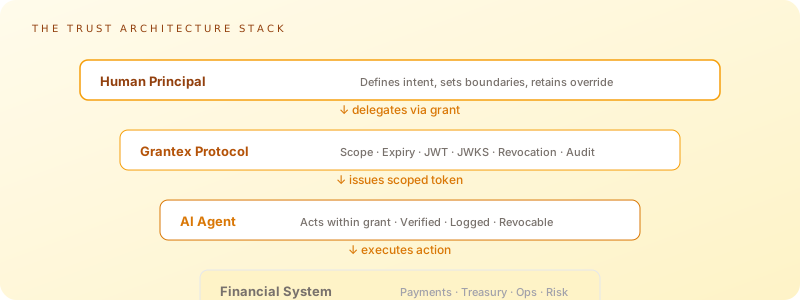
According to Pine Labs' announcement and the Grantex site, the protocol is designed to support fine-grained permissions, policy enforcement, auditable actions, and enterprise deployment patterns. Pine Labs says it already includes 30+ packages across TypeScript, Python, and Go, 600+ tests, policy engine integrations, and self-hosting options via Docker, Helm, and Terraform. The project is also described as Apache 2.0 licensed and open source.
In other words, Grantex is aiming to become a trust layer for action-taking AI.
What this means for fintechs
For fintech companies, the most immediate implication is that AI can start moving from copilots to operators.
A large portion of fintech AI today still sits in the low-risk zone: support chat, document extraction, underwriting assistance, anomaly detection, collections prompts. Useful, yes. Transformative, not yet.
The real step-change happens when AI systems begin to execute operational and financial tasks on behalf of users or institutions.
Take accounts payable automation. A finance AI agent could read invoices, match them to purchase orders, recommend release dates based on cash position, and prepare payouts. But before it can actually trigger a payment, someone has to define what the agent is allowed to do. Which vendors? Up to what amount? During what time window? Under what approval chain? With what audit record?
This is where Pine Labs may be early, but directionally right: fintechs will need an authorization architecture built for agents, not just apps.
What this means for banks
For banks, the implications are even more profound.
Most banks are still discussing AI through the lens of productivity, service, and automation. Those are safe starting points. But the next strategic question is harder: What happens when AI begins to sit inside regulated execution flows?
That could mean an AI relationship manager initiating workflows across deposits, cards, lending, or treasury. It could mean a small-business banking assistant that not only explains cash flows, but actually schedules payouts, opens products, sets controls, and coordinates collections. It could mean internal agents acting across compliance, operations, fraud review, and reconciliation.
Once that future arrives, traditional IAM and role-based access controls will not be enough on their own. Banks will need finer controls around delegated intent, agent identity, scoped authority, revocation, traceability, and policy enforcement.
Banks have spent decades building guardrails around human users and application access. The next decade will require guardrails around autonomous and semi-autonomous digital actors.
The most interesting use cases
The real value of a protocol like this becomes visible in specific workflows.
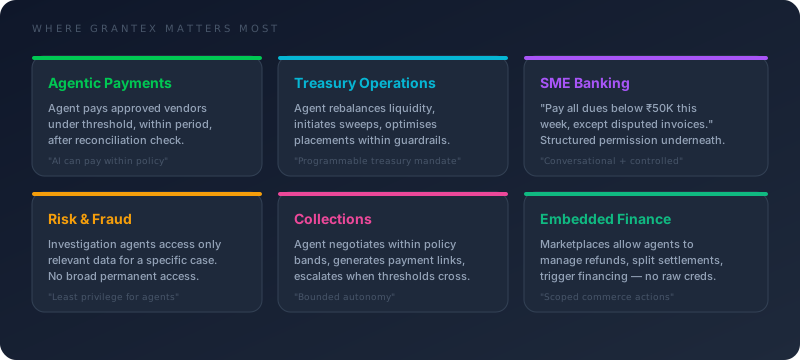
In agentic payments, an AI agent could be permitted to pay only approved vendors, under a set threshold, within a defined period, and only after checking invoice and bank reconciliation status. That turns "AI can pay" into "AI can pay within policy."
In treasury operations, an agent could rebalance liquidity between accounts, initiate sweeps, or optimize short-term placements based on predefined guardrails. Here, authorization becomes a programmable treasury mandate.
In SME banking, a business owner could tell a banking assistant: "Pay all dues below ₹50,000 this week, except any invoice under dispute." That sounds conversational on the surface, but underneath it requires a deeply structured permission layer.
In collections, an AI agent could be authorized to negotiate within policy bands, generate payment links, schedule reminders, and escalate only when certain thresholds are crossed.
In embedded finance, marketplaces and SaaS platforms could allow agents to manage refunds, split settlements, working-capital triggers, or fee adjustments without exposing raw credentials or universal system access.
These are not far-fetched scenarios. They are the logical next layer once AI systems move from assisting workflows to executing them.
Why Pine Labs is the company doing this
That a payments company is proposing this is not surprising. Payments sits at the sharpest edge of agentic risk. In many industries, an over-permissioned agent creates inconvenience. In payments, it can create direct financial loss, liability, fraud exposure, and regulatory trouble.
Pine Labs also has a strategic reason to move here now. Its recent OpenAI collaboration and public writing on agentic commerce show that the company is trying to position itself not just as a payments processor or merchant infrastructure player, but as a company helping define how financial action happens in conversational and AI-native environments.
Grantex fits that thesis neatly. If AI is becoming the interface, then permissioning becomes the control plane. That is a powerful place to be.
The bigger signal for the industry
The deeper significance of Grantex is not the protocol alone. It is the signal that the market is beginning to move beyond AI demos into AI governance infrastructure.
For the last two years, fintech has been flooded with AI wrappers, copilots, and dashboard-level intelligence. Much of it has been incremental. Useful, yes, but still layered on top of old systems.
Grantex points toward something more foundational: the architecture required for financial systems where agents are first-class actors.
That does not mean Pine Labs has solved the whole problem. Questions around liability, dispute handling, consent frameworks, regulator expectations, and interoperability across banks, fintechs, payment networks, and enterprise software remain open.
But the larger point still stands. The industry is finally starting to grapple with the real bottleneck for agentic finance. It is not model capability. It is trust architecture.
The Future of Banking view
This is why Pine Labs' launch deserves attention. Not because every bank should rush to deploy Grantex tomorrow. Not because every fintech now needs an "AI agent strategy" slide. But because the company has correctly identified one of the most important questions in financial infrastructure over the next few years:
How do we let AI act inside financial systems without surrendering control?
That is the question that will separate shallow AI adoption from true AI-native financial infrastructure.
Pine Labs has made its bet. Now the rest of the industry has to decide whether it is still building software for users — or starting to build systems for agents.