
There was a time when business software felt revolutionary simply because it replaced paper.
Then came the cloud era, when software became cleaner, faster, collaborative, and available from anywhere. Dashboards became the center of gravity. Every workflow had a page. Every task had a form. Every team had another tab open.
Now that model is starting to crack.
At FTX 2026, Razorpay launched Agentic Business Banking, positioning it as the next evolution of business banking for Indian startups and finance teams. The company's pitch is strikingly direct: businesses should no longer have to navigate software through endless workflows, forms, and manual operations. Instead, users should be able to state intent, and the system should understand, adapt, and execute. Razorpay says this new experience is now rolling out through RazorpayX Business Banking+, with AI agents handling collections, payouts, reporting, bookkeeping, and insights through a chat-led interface.
That makes this more than a product launch.
It is a statement about the future of user interfaces in finance.
The age of clicking through software is ending
For nearly three decades, enterprise and fintech software trained us to think in menus.
Need to pay a vendor? Open the payouts module. Fill in the beneficiary details. Confirm tax context. Review approvals. Re-enter information already available somewhere else. Need a cash-flow view? Pull data from multiple screens, spreadsheets, and exports, then stitch it into a report. Need collections to move faster? That often means a mix of dashboards, Excel trackers, reminder messages, and human follow-ups.
That design philosophy made sense in the Web 2.0 and SaaS eras. Software was primarily about digitization and workflow structuring. It brought order, visibility, and process control. But it also forced humans to adapt to the software's architecture.
The next shift is different. In the AI era, the expectation is no longer that the user must learn the workflow. The expectation is that the software should understand the goal. Razorpay's broader FTX 2026 framing makes this explicit, describing the moment as the beginning of an "agentic era" in which AI becomes the foundation for how financial systems are built and operated.
That is the real story here.
Razorpay is not merely adding an AI assistant to business banking. It is trying to move the interface from navigation to intention.
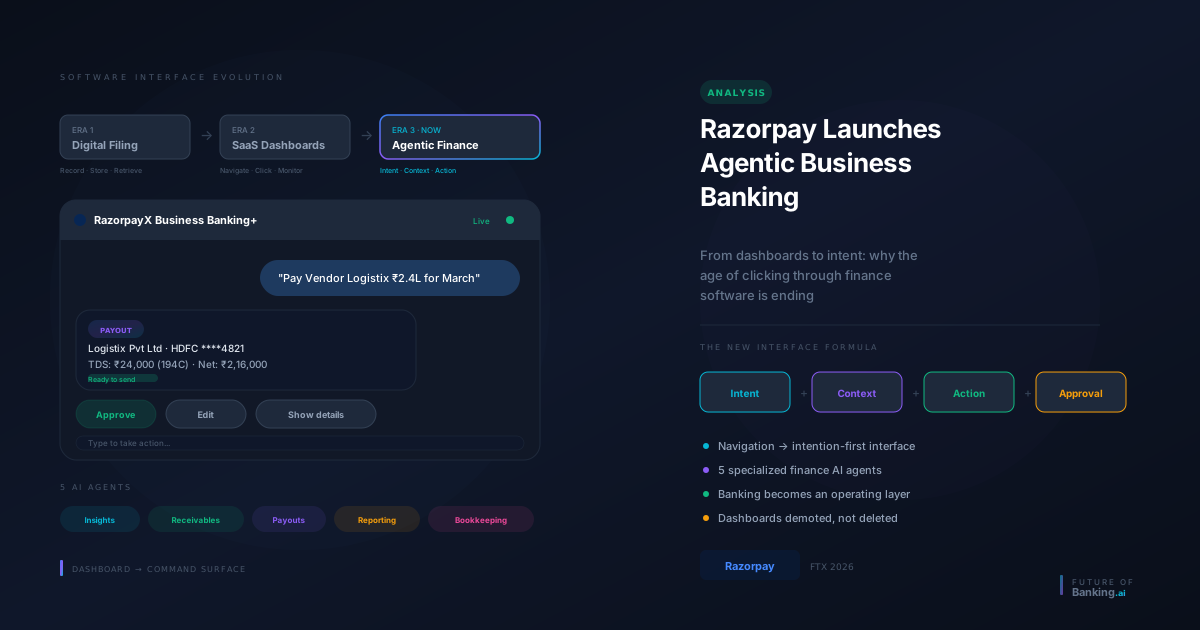
How software evolved: from Web 1.0 to SaaS to agentic systems
To understand why this moment matters, it helps to look at the broader evolution of business software.
In the early internet and post-desktop software era, most finance systems were essentially digital filing cabinets. Their job was to record transactions, store documents, and make data retrievable. The value was in replacing manual ledgers and paper-based processes.
Then came the cloud and SaaS era. This was the age of systems like Bill.com, Expensify, Navan, Anaplan, Carta, and many others that broke large ERP functions into cleaner, specialized tools. Finance teams gained better usability, faster access to information, and more modern workflows. But they also inherited fragmentation: multiple systems, multiple data silos, and constant syncing back to an ERP or bank stack.
The third era is what companies are now racing toward: agentic finance software.
In this world, the interface is no longer primarily a dashboard. It is a system that listens, understands context, reasons across connected data, and completes work. Human language becomes the starting point. The product does not just display the state of the business. It acts on behalf of the business.
That is what Razorpay is betting on.
Why dashboards are no longer enough
Dashboards were the defining UI metaphor of SaaS.
They gave teams visibility. They centralized metrics. They allowed founders and finance leaders to monitor cash, collections, spend, and growth in one place.
But dashboards have an increasingly obvious limitation: they tell you what is happening, yet they still leave the user with the burden of doing the next ten steps manually.
A founder does not really want a receivables graph. The founder wants payments to come in faster.
A finance manager does not want a static payout history. They want the system to prepare and execute payouts with the right context already attached.
A CFO does not want three disconnected reports. They want a system that can flag risk, suggest action, and surface the right recommendation before the problem compounds.
This is why the dashboard is becoming a secondary layer rather than the primary one. In an agentic world, dashboards do not disappear. They become supporting surfaces for visibility, audit, exception handling, and approvals. The main interaction shifts elsewhere. It shifts to intent.
What a modern user interface looks like in the agentic era
The biggest mistake companies can make right now is to confuse "agentic" with "chatbot."
A chatbot is still mostly an answer surface. An agentic interface is an execution surface.
The modern UI in an agentic world has four defining traits.
First, it starts with intent, not navigation. Users should not need to know where the relevant function lives. The system should interpret what they want and route the work accordingly.
Second, it depends on deep context. Good agentic software needs memory: prior workflows, invoice history, beneficiary data, cash positions, bookkeeping rules, escalation logic, ERP mappings, and team permissions. Without this, the experience becomes little more than a conversational wrapper over old software.
Third, it must lead to action, not just answers. The system should fetch details, configure the workflow, prepare the transaction, generate the report, send the follow-up, or draft the accounting entry.
Fourth, it requires human control at the right points. In finance and banking, the winning model will not be blind autonomy. It will be supervised autonomy: AI handles the coordination and operational load, while humans retain approvals, auditability, and exception judgment.
Seen through that lens, the future interface is not dashboard-first and not chat-only.
It is intent + context + action + approval.
What Razorpay has actually launched
Razorpay's Agentic Business Banking experience centers on five out-of-the-box agents inside RazorpayX Business Banking+.
Razorpay describes this as "the expertise of a world-class finance team built into your bank account." It also emphasizes that users can "type to take action," configure agents once, and let them continue working in the background.
That is a significant shift in positioning.
Traditional business banking platforms mostly promise movement of money, visibility, and control. Razorpay is trying to move business banking up the stack into something closer to a finance operations layer.
How a payout actually works in the agentic model
To understand why this is different from traditional banking software, consider a simple payout.
In the traditional model, the user navigates to the right module, manually fills in every field, looks up tax rates in a separate system, calculates the net amount, and then submits. In the agentic model, the user states what they want. The system fetches the beneficiary, recalls the TDS context, configures the payout, and presents a ready-to-approve package.
The difference is not just fewer clicks. It is a fundamentally different relationship between the user and the software.
Why this matters for Indian businesses
The appeal of this model is especially strong in India's startup and SMB ecosystem, where the operational load on founders and finance teams is often severely underestimated.
Finance work in many businesses still lives across spreadsheets, email threads, messaging apps, and follow-up loops. Teams chase receivables manually, set up payouts from scratch, and compile cash-flow views from disconnected systems. The result is constant reaction instead of strategic work.
That is not just a finance problem.
In Indian startups, it often becomes a founder problem. The same founder closing sales is also checking invoice collections late at night. The same leader raising capital is reconciling operational cash-flow details over the weekend.
If agentic business banking works as promised, the benefit is not only speed. It is cognitive relief.
Once founders get used to typing a command and having finance work happen in context, they will begin to expect that everywhere: in expense management, tax, treasury, reconciliation, ERP, and even compliance software.
The deeper implication: business banking is becoming an operating layer
The most important strategic takeaway from Razorpay's launch is not just that it added AI agents.
It is that business banking itself is being redefined.
In the old model, banking software was primarily a record-and-execution layer. It held balances, enabled payouts, tracked transactions, and surfaced reports.
In the emerging model, banking software becomes a decision-and-coordination layer.
That is a much bigger ambition.
If your banking interface knows your cash position, your vendor base, your receivables cycles, your payout history, your reporting needs, and your bookkeeping logic, then the bank account is no longer just a place where money sits. It becomes the command center for financial operations.
This is why the broader fintech implications are so important. The real race in the next few years may not be about which company has the most features. It may be about which company owns the default operating interface.
Who becomes the place where the founder starts the day? Who becomes the prompt box the finance team talks to first? Who becomes the system that can see context and take action across the stack?
Razorpay is making a bid for that position.
What "agentic" should mean in finance
The term is at risk of becoming overused, so it is worth being precise.
In finance, agentic should not mean a chat interface pasted on top of old workflows.
It should mean the system can understand context, execute meaningful tasks, operate asynchronously where appropriate, and preserve clear approval and audit trails. Finance is a category where trust matters too much for magic tricks. The interface can feel conversational, but the underlying architecture has to be rigorous.
That means typed commands alone are not enough. Real agentic finance software needs systems integration, workflow memory, role-based controls, and structured execution.
Razorpay's framing suggests it understands that distinction. The company is not presenting the launch simply as a support bot or insight bot. It is describing a system of specialized finance agents across payouts, receivables, reporting, bookkeeping, and insights.
The harder question now is product depth.
Can these agents handle messy finance reality, edge cases, policy variance, tax complexity, reconciliation issues, and real-world exceptions? That is where the real test begins.
But as a directional move, the significance is already clear.
The competitive landscape: who else is moving here?
Razorpay is not alone in recognizing this shift, but it may be among the first in India to package it this clearly for business banking.
The global trend is clear. Companies like Brex and Mercury are already building AI-first financial operating systems in the US. Indian founders who interact with these products are bringing those expectations home. The question is not whether Indian business banking will become agentic. It is who will get there first with enough product depth to hold the position.
Dashboards are not dead. They are being demoted.
This may be the simplest way to understand the transition.
Dashboards are not disappearing. They are losing their status as the primary interface.
In the agentic era, dashboards still matter for audit, review, exception handling, compliance, historical analysis, and leadership visibility. But they are no longer the place where every workflow has to begin.
The new center is the command surface. The dashboard becomes the verification surface.
That shift may sound subtle. It is not.
It changes how software is designed. It changes what users expect. And it changes which companies are best positioned to win.
The companies that understand this earliest — that the interface is the product, and the interface is moving from menus to intent — will define the next era of business finance.
Razorpay just made its opening move.