
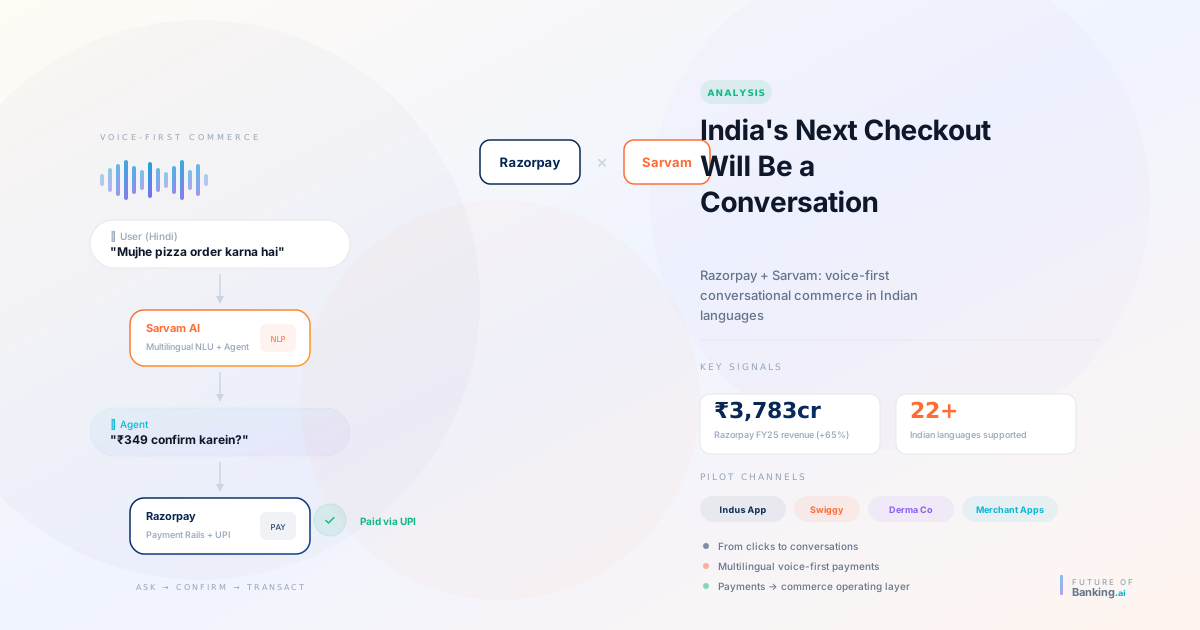
Voice-first commerce has long been a demo. Razorpay and Sarvam are trying to turn it into infrastructure.
Razorpay's new partnership with Sarvam signals something bigger than a feature launch. According to reports, the two companies are working together to enable voice-first conversational commerce, allowing users to discover products, place orders, and complete payments through natural-language interactions in Indian languages. The rollout is expected to happen in three layers: inside the Indus App starting with Swiggy, inside merchants' own apps and websites, and through early pilots such as a conversational assistant already deployed on The Derma Co's website.
At one level, this looks like a logical India-market experiment: multilingual users, rising comfort with voice interfaces, and a payments ecosystem already conditioned by UPI and mobile-first behavior. But strategically, this move is more important for a different reason. It suggests Razorpay no longer wants to remain just the company that processes a payment after a customer decides what to buy. It wants to be part of the decision layer, the interaction layer, and the operations layer around commerce as well.
Why this partnership matters
For years, digital commerce has been built around taps, forms, and checkout screens. The weakness of that model is obvious in conversational environments: once a user is inside a voice assistant, chatbot, or AI copilot, forcing them to jump out into a traditional checkout flow creates friction and kills intent. Razorpay's own framing is explicit: "commerce is shifting from clicks to conversations," and payments must now happen inside AI-native journeys rather than outside them.
That is exactly where Sarvam fits in. Sarvam brings the multilingual AI and agentic stack; Razorpay brings the payment rails and merchant infrastructure. Together, they are trying to compress the distance between intent and transaction. Instead of "search, browse, click, fill, pay," the flow becomes: "ask, confirm, transact." In a country like India, where language and literacy barriers still shape digital adoption, that shift could matter far beyond convenience.
The real significance is not that users may be able to order food by voice. It is that payment companies are beginning to treat AI agents as a distribution surface. If a customer interacts through an assistant instead of a traditional app, the payment provider that embeds itself natively into that assistant gains a new strategic position in the stack.
Razorpay's broader AI strategy is becoming clear
This partnership does not appear to be a one-off experiment. It fits neatly into Razorpay's broader 2026 push around agentic payments, AI-native commerce, and agentic business banking. The company has launched an Agentic Payments proposition aimed at embedding payments directly into AI-led in-app journeys. It has also rolled out Agent Studio, where businesses can deploy or build AI agents for payment and revenue workflows such as dispute handling, subscription recovery, abandoned-cart conversion, and COD/RTO risk reduction.
Razorpay's Agent Studio is particularly revealing because it shows where the company thinks margin expansion will come from. The prebuilt use cases are not about moving money from point A to point B. They are about recovering lost revenue, reducing operational leakage, and automating manual finance tasks. The examples Razorpay highlights include auto-responding to chargebacks, retrying failed subscription payments, nudging abandoned carts over WhatsApp or email, and detecting high-risk cash-on-delivery orders before shipment.
At the same time, RazorpayX is extending the same idea into finance operations. Its Agentic Business Banking pitch is that businesses should be able to type commands such as "show me my daily finance report" or "pay my vendors," while agents learn workflows and continue handling receivables, payouts, reminders, and reporting in the background. The company is effectively reframing the bank account and payment dashboard as a software operating surface, not just a ledger or settlement view.
Put simply, Razorpay appears to be moving from payments company to commerce-and-finance operating layer.
Why Razorpay needs this strategy
There is a hard business reason behind this shift. Payment processing is valuable, but it is also a business where margins can compress, pricing power can weaken, and regulators can shape the economics. Razorpay's reported FY25 numbers showed strong scale, with consolidated revenue rising 65% year on year to ₹3,783 crore and gross profit rising 41% to ₹1,277 crore, but the company is also under pressure to build a broader, more durable profit engine as it approaches a potential IPO window.
That makes software-led adjacencies highly attractive. Razorpay already has a wider product set beyond pure payment gateway processing, including business banking via RazorpayX, payouts, invoicing, subscriptions, payroll, and working capital/line-of-credit offerings. Its own product pages position these as a single platform that helps businesses collect recurring payments, automate bank transfers, handle payroll compliance, send invoices, and access working capital.
This matters because the best fintech businesses rarely win by staying confined to transaction tolls alone. They expand into the workflows around the transaction: onboarding, reconciliation, recovery, compliance, cash management, analytics, and credit. AI makes that expansion more natural because it can sit across all those workflows as a conversational and operational layer. In that sense, Razorpay's agent push is not a detour from its core business. It is a way to raise ARPU, deepen merchant lock-in, and move into more defensible value-added services.
Could this work in India?
The short answer is yes, but only in specific wedges.
Voice-first commerce is more likely to work where the task is frequent, low-consideration, and structured. Food ordering, repeat grocery purchases, bill payments, basic reorders, and simple service bookings are obvious candidates. These are areas where a user can say what they want, confirm quickly, and complete a purchase without needing a visually rich browse experience. The reported Swiggy and Derma Co pilots reflect exactly this logic: one is routine and high frequency, the other is guided product discovery with a relatively constrained catalog.
But the model will hit limits in categories where users want heavy comparison, visual reassurance, trust signals, or long-form browsing. Agentic commerce will not eliminate apps and websites. It will coexist with them, and likely win in moments where speed and convenience matter more than exploration.
The other challenge is trust. A conversational interface can feel magical when it gets things right, but payments are unforgiving. If an agent misunderstands a product, a quantity, a delivery address, or a final price, the experience breaks instantly. So the winners here will not just be the companies with the best language models. They will be the ones that design the best guardrails, confirmations, merchant integrations, and post-transaction recovery flows. That is another reason Razorpay may have an advantage: it already lives in the error-prone, compliance-heavy world of transaction completion and failure handling.
Will larger platforms eventually do this too?
Almost certainly.
If conversational commerce proves viable, the biggest platforms will not leave it to fintech infrastructure providers alone. Meta is already reported to have struck a deal to acquire Manus, with plans to integrate Manus agents into its social-media platforms and Meta AI experiences for both consumers and enterprises. If that trajectory holds, it reinforces the idea that major consumer platforms want to own not just attention and discovery, but also the agent layer that makes decisions and completes tasks.
That creates a future where small businesses could be offered agentic selling tools directly by platforms such as Meta, just as they were previously offered ads, storefronts, messaging tools, and catalog commerce. In that scenario, the risk for a company like Razorpay is that AI giants begin bundling agent-led commerce experiences at the top of the funnel.
But that does not mean Razorpay loses. It may simply change where Razorpay wins. The durable opportunity for a payments player is not necessarily to own the consumer-facing agent. It is to become the trusted execution and monetization layer underneath many agents. If Meta, merchant apps, AI browsers, WhatsApp bots, voice assistants, and vertical SaaS products all want transactions to happen seamlessly, someone still has to provide the payment orchestration, merchant settlement, dispute workflows, recurring billing, vendor payouts, and compliance fabric. Razorpay seems to be positioning itself for exactly that role.
So, will Razorpay's strategy pan out?
The likely answer is: partly, and in stages.
The voice-first Sarvam partnership could work well as a beachhead in India because it is local-language aware and aligns with categories where voice is genuinely useful. But the bigger prize is not voice alone. The bigger prize is whether Razorpay can build a credible agentic commerce and finance platform that merchants adopt for real outcomes: more conversions, fewer failed payments, better collections, faster dispute resolution, cleaner payouts, and simpler finance operations.
That strategy has real logic. Payment margins alone are rarely enough to create a deeply differentiated moat over time. The value moves upward into software and downward into financial products. Razorpay already spans payments, payroll, subscriptions, invoicing, business banking, and working capital. AI gives it a way to stitch those pieces together into one merchant-facing operating system.
Where the strategy could struggle is in distribution and platform power. If the largest AI and consumer ecosystems become the primary interfaces for small-business commerce, then infrastructure players may get pushed down the stack and commoditized again. To avoid that, Razorpay will need to do two things at once: build the rails that power third-party agents, and also build enough proprietary merchant workflows that businesses see Razorpay as more than a back-end processor.
That is why the Sarvam deal matters. It is not just a voice commerce story. It is a signal that Razorpay understands the next battle in fintech will not be about who owns the payment button. It will be about who owns the intelligence, orchestration, and outcomes around the payment.
And on that front, Razorpay appears to be moving early.