
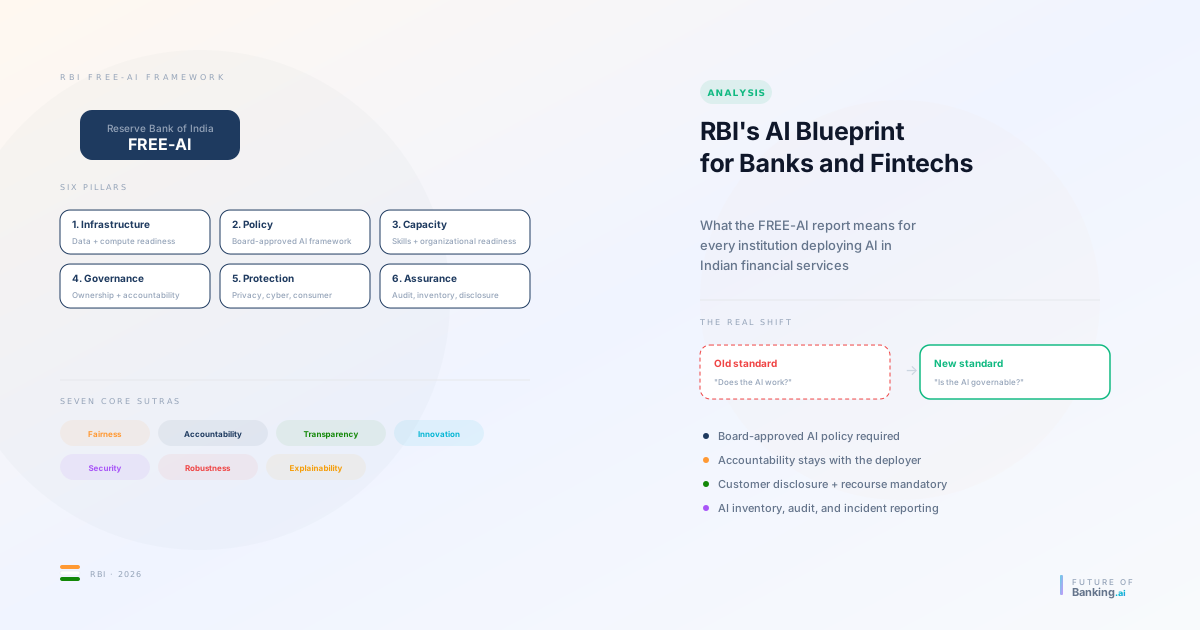
A few months ago, the Reserve Bank of India published a report on AI implementations in financial services called the FREE-AI report. It is important to note upfront: this is not a regulation. It is not a binding circular or a supervisory directive. It is a framework — a set of principles, recommendations, and indicative guidelines produced by an RBI-constituted committee.
But that distinction should not reduce its significance.
Because what the FREE-AI report actually does is far more consequential than any single rule change. It draws the outline of how the RBI expects AI to be governed inside Indian financial services. It tells every bank, NBFC, fintech, and infrastructure provider what questions they will eventually have to answer — and it does so with enough specificity that treating this as a theoretical document would be a strategic mistake.
For months, the financial sector has been talking about AI in the language of demos. AI underwriting. AI support. AI fraud detection. AI copilots. AI agents. AI-native banking.
The FREE-AI report changes the language.
It says the real question is no longer, "Where can we use AI?" It is now, "What exactly must we govern before we are allowed to trust AI inside finance?"
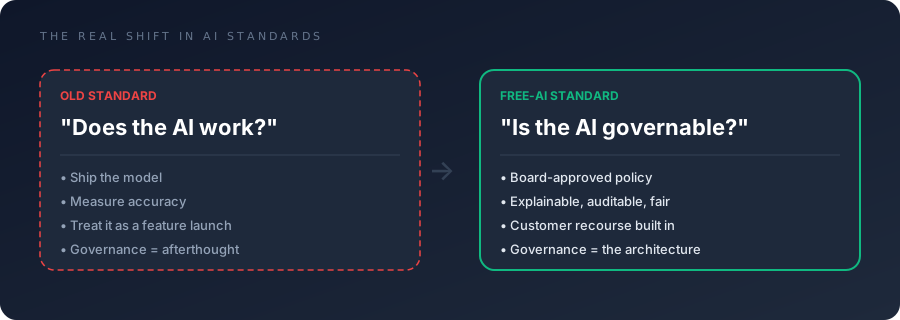
That is why this report matters far beyond policy circles. For banks, NBFCs, fintechs, infra players, AI vendors, and product teams, the FREE-AI report is not merely an ethics note. It is a deployment framework in disguise. It tells the market that in Indian finance, AI will increasingly be judged not just by intelligence, speed, or automation upside — but by accountability, explainability, consumer recourse, cybersecurity, governance, and ongoing oversight.
RBI is telling the market: AI in finance is now a boardroom issue
One of the clearest signals in the report is the recommendation that regulated entities should establish a board-approved AI policy. And not a vague one.
The report says this policy should cover governance structure, accountability, risk appetite, operational safeguards, auditability, consumer protection, AI disclosures, model lifecycle, and liability. It also says industry bodies should help smaller entities with indicative policy templates.
This is not a minor recommendation. It means RBI is pushing AI upward in the institution. Away from being just a technology-team experiment or business-side initiative. Toward formal enterprise ownership.
That has major consequences. It means AI cannot sit in the shadows anymore as scattered pilots across teams. It means institutions will increasingly need one coherent view of how AI is used, where it is used, who is accountable, and how risk is governed.
Put simply: if your AI strategy is still "a few teams are testing tools," you may have innovation activity. But you do not yet have an AI governance posture.
The report reframes AI deployment as a full-stack operating model
The FREE-AI report is organized into six pillars: Infrastructure, Policy, Capacity, Governance, Protection, and Assurance. That structure is more than presentation. It is RBI's way of saying that AI in finance is not a single decision. It is an institutional system.
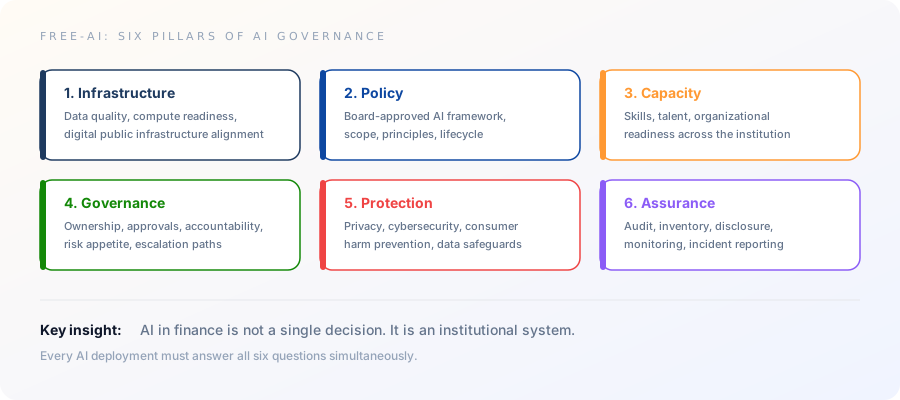
Under the RBI's framing, a serious AI deployment in finance now has to answer six different questions at once: Do we have the infrastructure and data discipline for this? Do we have internal policy clarity? Do we have organizational capacity and skills? Do we have governance around ownership and approvals? Do we have protection around privacy, cyber, and consumer harm? Do we have assurance through monitoring, audit, inventory, and disclosure?
That is a much tougher standard. But it is also the right one. Because AI in finance does not fail like traditional software. It can hallucinate, drift, amplify bias, reveal information, respond unpredictably to adversarial prompts, or create hidden dependencies on third-party models and cloud infrastructure. The report is effectively saying: you cannot manage that with ordinary product-launch rituals.
Your responsibility does not shrink when you use third-party AI
If there is one theme that runs through the entire report, it is this: accountability stays with the deploying entity. The model does not become accountable. The vendor does not absorb all blame. The algorithm does not become the responsible party. The institution does.
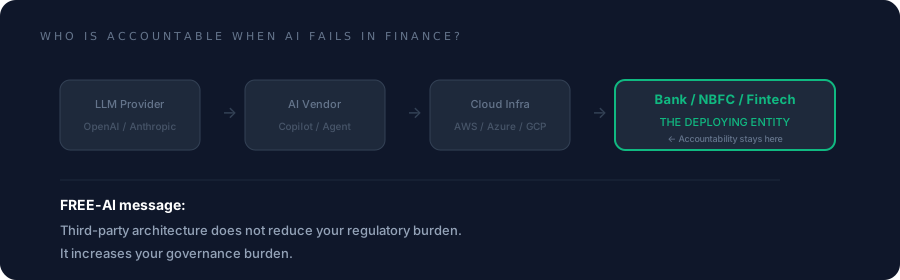
That matters enormously because most AI in finance will not be fully built in-house. It will be assembled through stacks of third-party models, cloud providers, inference layers, orchestration tools, agents, and service partners.
FREE-AI is telling the market: that architecture does not reduce your regulatory burden. It increases your governance burden.
So the practical message is blunt: if you are a bank or fintech using external LLMs, vendor copilots, AI workflows, or AI service layers, you should assume RBI will still expect you to explain the outcome, govern the risk, and protect the customer.
Customer-facing AI is headed toward disclosure, recourse, and explainability
The document repeatedly says consumers should be made aware when they are dealing with AI. It also points to grievance redressal, contestability, transparency, and customer rights.
That means the future of AI UX in finance may look very different from what many teams imagine today. The old product instinct is to make AI invisible and seamless. The regulatory instinct emerging here is different: invisible AI may be hard to defend when it affects customer outcomes.
So if you are deploying AI into onboarding, lending, collections, fraud interactions, claims, support, or servicing, expect the bar to rise on three fronts: customers may need to know they are interacting with AI; customers may need a path to human recourse or clarification; and institutions may need to document how those pathways actually work.
Lending and high-stakes decisioning will face the hardest questions
The report's posture becomes especially significant in areas like credit underwriting and digital lending. It recommends that AI-enabled products be brought within institutional product approval frameworks and that AI-specific risk evaluations be added to those processes.
This is a strong indicator of where scrutiny will land first. AI in internal productivity tools is one thing. AI in employee copilots is another. But AI in lending decisions is where questions of bias, explainability, inclusion, and customer harm become unavoidable.
That means any lender, loan platform, embedded finance player, underwriting engine, or NBFC experimenting with AI should assume that "better model performance" alone will not be enough.
Cybersecurity is now part of AI deployment itself
The report is especially strong on cybersecurity. It says institutions must identify security risks created by AI and strengthen hardware, software, and process controls accordingly. It also recommends structured red teaming across the entire AI lifecycle, with risk-based frequency and trigger-based testing for evolving threats.
This is a direct challenge to how many AI programs are currently run. In many organizations, AI is still led as an innovation initiative, with security consulted later. FREE-AI suggests that model risk, adversarial risk, prompt manipulation, data exposure, and infrastructure misuse have to be built into the deployment design from day one.
Banks and fintechs should stop thinking of AI and cybersecurity as two parallel tracks. In regulated finance, they are now the same conversation.
The report is preparing a new compliance baseline
The FREE-AI report recommends an inventory of AI systems within regulated entities, sector-wide repositories, periodic review, AI audits, AI disclosures, and an AI toolkit to help assess principles such as fairness, transparency, accountability, and robustness.
This is not cosmetic governance. Once institutions have to maintain inventories, undergo review, disclose AI-related information, and stand behind auditability, AI ceases to be an invisible capability. It becomes part of formal institutional reporting and oversight.
What banks and fintechs should do now
The mistake most firms will make is trying to solve FREE-AI as a giant compliance project. The better way is to build it in phases.
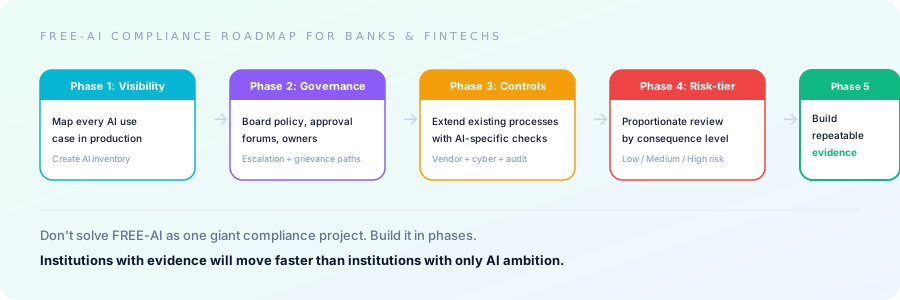
Phase 1: Get visibility. Map every AI use case already in production or pilot. Create an inventory. Tag customer-facing systems, decision-support systems, autonomous systems, and vendor-dependent systems.
Phase 2: Put governance in place. Create the board policy, define approval forums, assign owners, and define escalation and grievance paths.
Phase 3: Add AI-specific controls to existing processes. Extend product approval, vendor due diligence, cyber review, audit, grievance, and disclosure processes with AI-specific checks.
Phase 4: Prioritize by risk. Not all AI needs the same depth of review. Internal summarization tools should not be governed the same way as AI credit models or agentic payment workflows.
Phase 5: Build repeatable evidence. Logs, incident forms, approval memos, red-team results, vendor assessments, monitoring dashboards, review records. In the next phase of regulation, institutions with evidence will move faster than institutions with only AI ambition.
The sharper conclusion
The RBI FREE-AI report is ultimately telling the market something simple, but uncomfortable:
In finance, AI is no longer impressive just because it works. It has to be governable.
That is the bar now. Anyone can add a model. Anyone can launch a bot. Anyone can claim to be AI-first. But in regulated finance, the real differentiator will be this: Can you explain the system, own the outcome, protect the customer, manage the vendor, survive the incident, satisfy the board, and defend the deployment?
That is what FREE-AI is really about.
And that is why the smartest banks and fintechs should read this report not as a future compliance burden, but as a blueprint for how to build credible AI before the market is forced to.