
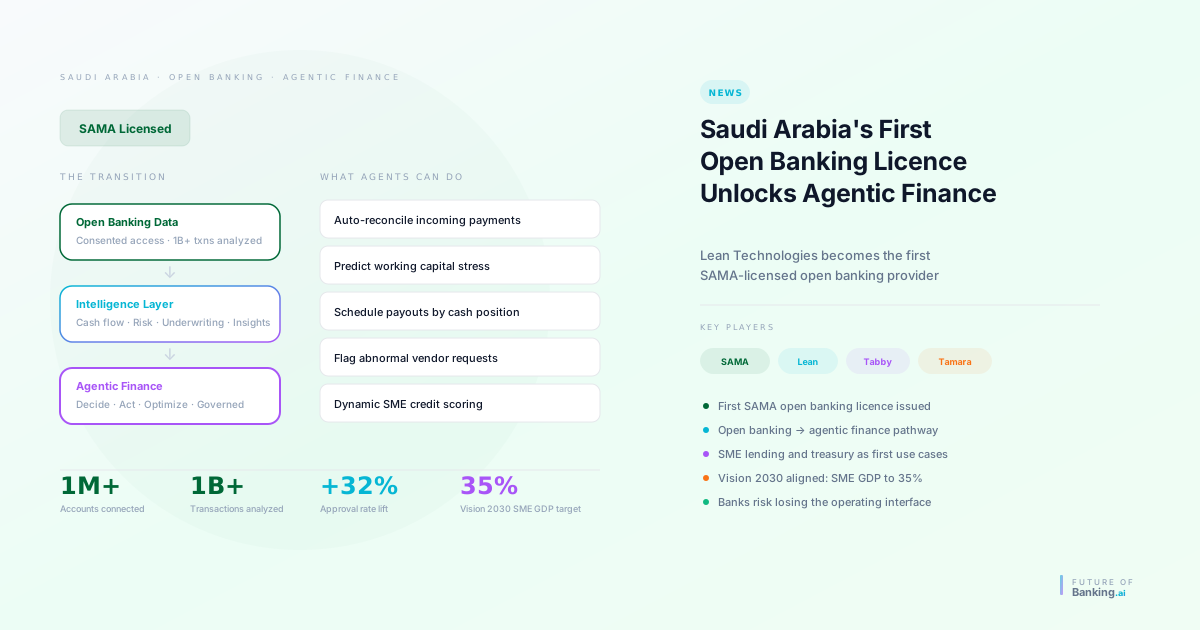
Saudi Arabia has taken a step that could prove far more important than a routine fintech licensing update. The Saudi Central Bank, SAMA, has formally begun licensing open banking providers, and Lean Technologies has become the first company in the Kingdom to receive a Major Payment Institution licence for open banking services. That means open banking in Saudi Arabia has now moved out of the sandbox era and into the regulated core of the financial system.
On paper, this looks like a market-structure story. In reality, it is also a story about what comes next for payments, lending, and business banking in the Gulf. Once open banking becomes licensed infrastructure rather than a pilot framework, it starts to create the conditions for something much bigger: agentic finance.
Lean's own journey explains why this matters. The company had already been operating inside SAMA's regulatory sandbox, where it says it connected more than one million bank accounts and analysed more than one billion transactions. Its infrastructure has been used across BNPL, consumer finance, automotive, investment services, and government-related use cases, with partners including Tabby, Tamara, Abdul Latif Jameel, Sukuk, and Tasheel. In the material behind this announcement, Tamara says that richer access to verified financial data helped lift approval rates by more than 32% in a newer consumer financing product.
That alone is significant. But the deeper point is this: open banking is no longer just about aggregating account data or making onboarding smoother. In Saudi Arabia, it is starting to become the data layer on top of which the next generation of financial software can be built.
And increasingly, that software will not just show information. It will act on it.
From open banking to agentic finance
The term "agentic payments" is still early, and often overused. But in practical terms, it means payments and financial actions that are not triggered by static forms and manual workflows alone. Instead, software agents can understand intent, assess context, recommend or initiate the next action, and operate within approval rules and policy guardrails.
That is where Saudi Arabia's open banking shift starts to matter.
When a regulated provider can securely access real-time financial data with customer consent, the software layer above it becomes much more intelligent. A finance agent can understand cash inflows, recurring obligations, payroll cycles, supplier patterns, failed collections, credit behaviour, and liquidity pressure. It can then decide whether to prompt a loan offer, delay a payout, split a receivable, suggest a cheaper payment rail, or escalate an anomaly to a human reviewer.
That is the real transition underway: finance software moving from passive interface to active operator.
Why Saudi Arabia is well positioned for this shift
Saudi Arabia is not just digitising old banking flows. It is trying to build financial infrastructure as part of a broader national transformation agenda. SAMA has linked open banking to the National Fintech Strategy and Vision 2030, positioning it as part of the Kingdom's effort to create a more innovative, inclusive, and globally competitive financial sector.
That matters because agentic finance works best in markets where there is both regulatory momentum and a real need to modernise fragmented business workflows. Saudi Arabia has both.
The Kingdom has put major emphasis on SME growth as part of Vision 2030. Official Vision 2030 materials say the country aims to increase SME contribution to GDP to 35%. This is exactly where open banking-powered agents can become valuable. SMEs do not just need better apps. They need systems that can understand messy financial reality: delayed receivables, uneven cash cycles, multiple accounts, manual invoice flows, informal approval chains, and weak reconciliation between payments and operations.
Open banking gives software access to the facts. Agentic banking turns those facts into action.
The biggest early opportunity: underwriting and SME credit
The most immediate commercial upside in Saudi Arabia is not flashy consumer finance dashboards. It is better underwriting.
That is already visible in Lean's existing use cases. Its infrastructure has been used to bring richer, verified financial information into credit assessment, especially for people and businesses that legacy systems struggle to evaluate accurately. The company's announcement highlights freelancers, gig workers, and individuals with multiple income streams as examples of segments that can be better understood through transaction-level cash-flow data.
This matters in Saudi Arabia because the traditional credit stack still leaves room for improvement when it comes to thin-file customers, newer business models, and SMEs that do not fit neat underwriting templates. Once a regulated open banking layer is in place, lenders can move beyond document collection toward continuous affordability analysis.
In other words, Saudi open banking could make the move from one-time underwriting to living underwriting.
Agentic payments could become the real unlock
The phrase "agentic payments" often gets reduced to chat interfaces or AI assistants bolted onto existing systems. But the deeper opportunity is operational.
Payments today are usually initiated as isolated events. Someone logs in, enters an amount, chooses a beneficiary, and approves the transfer. In an agentic model, payments become part of an intelligent workflow shaped by live context.
For Saudi businesses, that could eventually mean systems that:
- Pay suppliers only after invoice, delivery, and cash-position checks align
- Split incoming collections automatically across payroll, rent, taxes, and financing obligations
- Optimize payout timing based on liquidity forecasts
- Surface fraud risks before a payment is sent
- Connect bank activity to ERP and accounting workflows in real time
- Route transactions through the most efficient or appropriate rail
This is where the story stops being just about open banking and becomes about the future of business banking.
The strategic question for Saudi banks
Saudi banks should view this moment carefully.
If open banking providers and fintech platforms become the intelligence layer above bank accounts, then the customer's primary financial interface may begin to shift away from the bank app itself. The balance sheet may still sit with the bank. Compliance obligations may still sit with the bank. But the daily financial operating layer, the system a business actually uses to manage money, could increasingly sit elsewhere.
That is the real strategic risk.
The opportunity, however, is equally large. Banks in Saudi Arabia can choose to treat open banking as a compliance checkbox and let third parties own the experience. Or they can use this regulatory milestone to build their own AI-native business banking models: cash-flow-aware lending, finance copilots for SMEs, automated treasury and reconciliation workflows, and embedded financial decision engines inside digital banking platforms.
In that future, the winners will not just be the institutions with the most products. They will be the ones that become the most useful operating layer for businesses.
Why this story is bigger than Lean
Lean deserves the attention. Becoming the first licensed open banking provider in the Kingdom is a real milestone, and it validates years of work under the sandbox framework. But the bigger story is not one company.
It is that Saudi Arabia has now signaled that open banking is ready to move from experimental infrastructure to national financial infrastructure.
That shift changes what builders can attempt. It creates room for a new generation of Saudi fintech and banking products that are not just digital, but adaptive. Not just API-based, but decision-oriented. Not just interface-led, but workflow-led.
The Gulf's next big fintech wave may not be another wallet or another BNPL product. It may be a new class of agentic financial systems built on top of regulated data access and programmable payment flows.
Saudi Arabia just took an important step toward making that possible.