
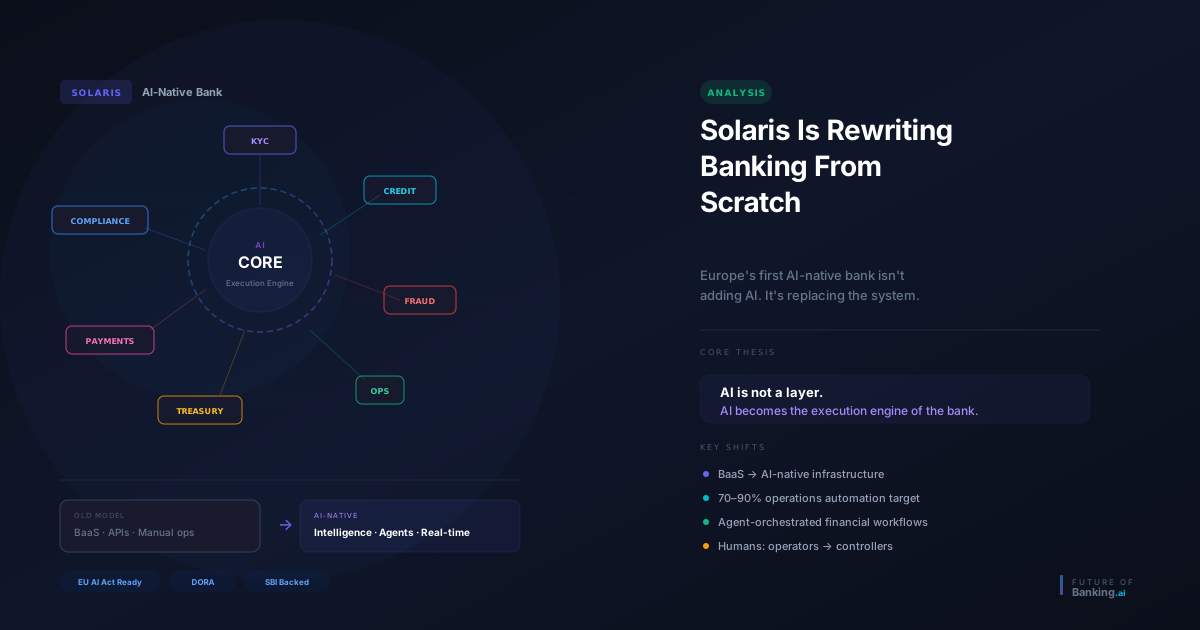
For years, fintech has layered AI on top of banking. Solaris is doing something fundamentally different.
It is attempting to become Europe's first AI-native bank — where AI is not a feature, but the core operating system of the institution. This is not an incremental upgrade. It is a structural reset of how banks are built, operated, and scaled.
Why Solaris is making this shift
The reasons behind this transformation are layered, but each one reinforces the same conclusion: the old model has run its course.
The BaaS model is breaking. Solaris was one of Europe's pioneers in Banking-as-a-Service. But today, APIs are commoditized, infrastructure is interchangeable, and margins are shrinking. Banking infrastructure alone is no longer defensible. AI becomes the new moat.
Cost structures are unsustainable. Traditional banking operations are manual, compliance-heavy, and people-intensive. Solaris' shift signals a clear thesis: the next generation of banks will run on automation-first economics. AI allows 70 to 90 percent automation of operations, drastic reduction in cost per account, and real-time scalability without proportional headcount growth.
Regulation has caught up to AI. With frameworks like the EU AI Act and DORA, Europe is becoming one of the first regions where AI in banking can scale with regulatory clarity. That removes the biggest historical blocker: compliance uncertainty.
A strategic reset moment. With new leadership and backing from SBI Group, Solaris is using this moment to reposition itself — not as a BaaS provider, but as AI-native financial infrastructure for Europe.
What "AI-native banking" actually means
Most banks today are AI-assisted. Solaris is aiming to be AI-native. The distinction matters more than it might first appear.
In an AI-assisted bank, AI supports existing systems. It powers chatbots, generates fraud alerts, and runs risk models. But the underlying operating model remains the same: human teams execute workflows, static rules govern decisions, and processes are designed around manual intervention with AI bolted on at the edges.
In an AI-native bank, AI replaces the system itself. The core principle is straightforward: AI is not a layer. AI becomes the execution engine of the bank.
Inside an AI-native bank
What does this look like in practice? The architecture shifts across four dimensions.
Operations run on AI. KYC onboarding, transaction monitoring, reconciliation, and customer service are handled by AI agents rather than by large operational teams. The human role shifts from execution to exception handling.
Decisions become continuous. Credit underwriting, fraud detection, and risk scoring shift from static rules to real-time adaptive intelligence. Instead of scoring a customer once and reviewing periodically, the system continuously updates its assessment based on live behavioral data.
Products become dynamic. Every customer does not get the same bank. Instead, pricing adjusts, limits evolve, and services personalize. The bank becomes context-aware — responding to each user's situation rather than applying blanket policies.
Infrastructure becomes agent-orchestrated. Instead of rigid workflows and static pipelines, the system runs on event-driven architectures where AI agents coordinate financial actions. This is perhaps the most radical departure from how banks have traditionally operated.
What it takes to become AI-native
This is where most banks will struggle. The transition requires far more than deploying better models.
Re-architecting core workflows. You cannot simply add AI to legacy systems. The institution must rebuild processes, standardize modules, and design for automation first. That is a multi-year, high-risk transformation that requires deep institutional commitment.
Modular financial architecture. Solaris' BaaS DNA helps here. AI-native banking requires composable services, API-first design, and interoperable financial primitives. Banks that were built as monoliths will face a much steeper climb.
An agent-based execution layer. This is the biggest shift. In traditional banking, humans execute workflows and systems store data. In AI-native banking, AI agents execute workflows and systems act on data. Static processes give way to dynamic orchestration. That is not just a technology change. It is an operating model change.
Human-in-the-loop governance. AI does not remove humans. It repositions them. Approvals, audit, and exception handling remain human responsibilities. But the role changes from operator to controller — supervising outcomes rather than performing the steps that produce them.
A unified data layer. AI-native systems require real-time data, a unified financial graph, and behavioral intelligence feeding into every decision. This data layer becomes the true competitive advantage, because the quality of the AI's output is directly tied to the quality and freshness of the data it can access.
The opportunity ahead
If Solaris executes on this vision, the implications extend well beyond one company.
Banking margins will expand. AI-native banks can operate leaner, scale faster, and reduce cost per transaction dramatically. That changes the economics of who can profitably serve which customer segments.
Banking becomes intelligence-as-a-service. The BaaS model offered APIs. The next model offers AI-driven outcomes. Partners will not just plug in payment rails or account infrastructure. They will plug in AI credit engines, AI treasury systems, and AI financial workflows. The value shifts from connectivity to cognition.
Embedded finance evolves. The current generation of embedded finance is API-driven: connect, configure, deploy. The next generation will be agent-driven: describe what you need, and the system figures out how to deliver it. That is a fundamentally different integration model.
Europe gets its first AI banking infrastructure layer. Solaris is not just building a bank. It is positioning itself as the AI financial backbone of Europe — a platform that other companies build on, but one where the intelligence layer is the primary value proposition rather than the plumbing.
The risks are real
None of this is guaranteed to work. The risks are significant and should not be understated.
Regulatory complexity. AI decisions in banking must be explainable, auditable, and compliant. The EU AI Act provides a framework, but navigating the intersection of AI regulation and financial regulation in practice will be far harder than it looks on paper. Every automated decision that touches a consumer's finances carries regulatory weight.
Trust deficit. Users trust humans and institutions. They do not yet trust autonomous systems with their money. Building that trust will take time, transparency, and a track record of reliable outcomes. One high-profile failure could set the entire category back.
Execution risk. Rebuilding a bank around AI is technically complex, operationally risky, and culturally disruptive. Solaris is not starting from a blank sheet — it has existing clients, existing infrastructure, and existing obligations. Managing the transition without disrupting live operations is one of the hardest problems in enterprise technology.
The bigger shift
Solaris is betting on a fundamental transition in what a bank actually is.
The old model of banking was defined by balance sheets, compliance processes, and manual operations. The AI-native model is defined by intelligence, automation, and real-time decision systems. That is not just a technology upgrade. It is a redefinition of the institution.
Solaris is not just evolving. It is asking a much bigger question: what if a bank did not run on systems and teams, but on intelligence itself?
If this model works, the future of banking will not be defined by branches, apps, or APIs. It will be defined by AI systems that understand, decide, and act on money in real time.
That is the bet. And right now, Solaris is one of the few institutions in Europe willing to make it.