
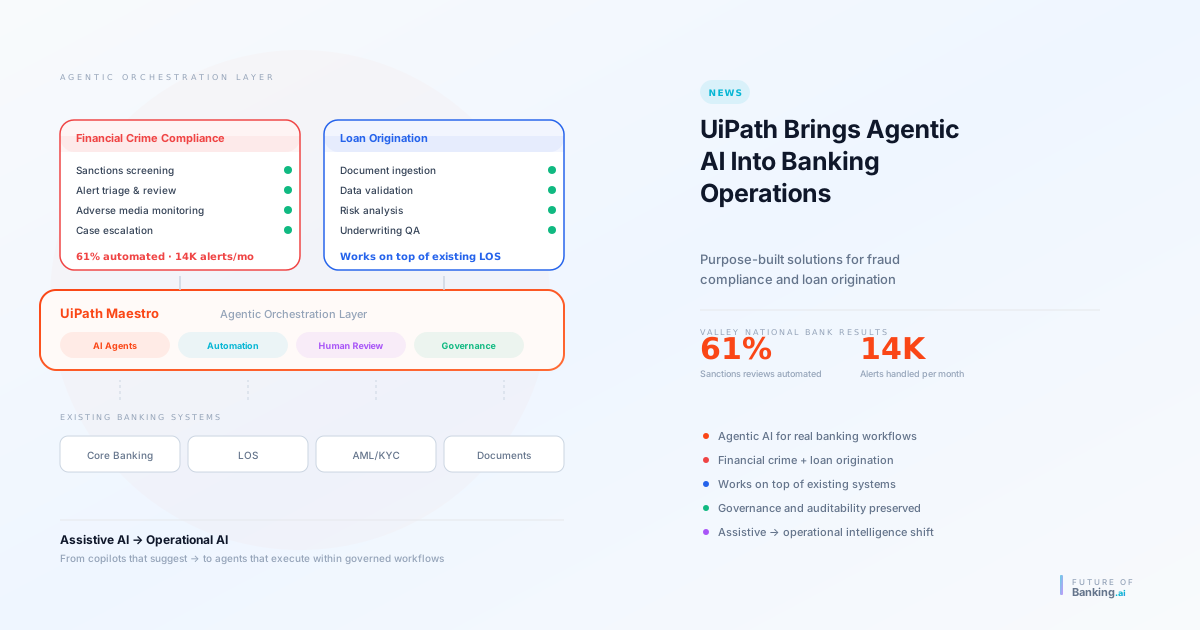
UiPath is making a bigger move into banking — not with another generic AI assistant, but with purpose-built agentic solutions aimed at some of the most operationally painful parts of the industry: financial crime compliance and loan origination. In its March 25 announcement, the company unveiled new solutions designed to automate sanctions screening, alert review, adverse media monitoring, loan setup, and underwriting-related workflows, while preserving the governance and auditability banks require.
That matters because the next AI battleground in banking is no longer just chatbots or employee copilots. It is workflows. Real ones. The messy, repetitive, document-heavy, compliance-sensitive processes that sit behind every payment, every borrower decision, and every fraud investigation. UiPath's announcement is best understood in that context: this is less about "AI in banking" as a slogan, and more about AI being embedded into the operating layer of the bank.
Financial crime compliance: where agentic AI meets real volume
The company's financial crime compliance solution appears to be the clearest example of that shift. With capabilities strengthened by UiPath's acquisition of WorkFusion, the platform is now being positioned to automate analyst workflows such as sanctions screening, alert triage, and adverse media monitoring. AI agents are meant to review watchlist alerts, gather context from internal and external sources, and escalate relevant cases to investigators. A separate adverse media agent continuously scans news and information sources to surface negative mentions that may signal fraud or counterparty risk.
In theory, that is exactly where agentic systems can create value in banking. Compliance teams do not simply need a smarter interface. They need systems that can absorb volume, structure evidence, reduce false positives, and shorten the time between detection and decision. For years, financial crime operations have been constrained by backlogs, fragmented tools, and human-heavy review cycles. If agentic AI works as promised, it could become a force multiplier for investigators rather than just another dashboard layered on top of their work.
UiPath's customer example helps make that point tangible. Valley National Bank said an AI agent for transaction screening alert review has automated 61% of sanction-hit reviews and now handles an average of 14,000 alerts a month. That is not just a productivity statistic. It suggests a world where banks can start to rethink staffing models, turnaround times, and how much of the first-line review process truly needs human labor.
Loan origination: the next frontier
The second half of UiPath's announcement focuses on lending, another area where banks have spent years digitizing interfaces without fully solving operational friction underneath. Loan origination may look digital on the surface, but in many institutions it still depends on manual data entry, document collection, human verification, and fragmented quality-control steps. UiPath is pitching its new loan origination solution as a layer that works with existing loan origination systems, core banking infrastructure, and other data sources to streamline those sub-processes rather than replace them.
That positioning is important. Banks are rarely willing to rip out their core lending systems for the sake of AI experimentation. The winning vendors in this phase of the market will likely be the ones that can sit on top of existing systems, orchestrate action across them, and deliver faster decisions without destabilizing control environments. UiPath says its solution uses Maestro to coordinate AI agents, automation workflows, and human decision-making across loan validation, risk analysis, auditing, and escalations.
Agentic AI as orchestration layer, not replacement
This is the deeper signal in the announcement: agentic AI is increasingly being sold not as a replacement for banking software, but as an orchestration layer above it. That may be the most realistic route to adoption in financial services. Banks do not need more disconnected AI pilots. They need systems that can work across existing platforms, preserve audit trails, respect policy boundaries, and still generate measurable efficiency gains. UiPath seems to understand that the path into banking is through controlled execution, not AI theater.
The customer references from Lake Michigan Credit Union and Suncoast Credit Union reinforce that framing. Both describe UiPath in practical terms: automating home equity processes, ingesting loan documents, comparing them with systems of record, and surfacing insights to review teams. That is not science fiction. It is operations engineering, now infused with AI.
The bigger trend: from assistive to operational intelligence
For the broader banking market, UiPath's move also points to a larger trend. The industry's first wave of AI adoption was largely about assistive intelligence — helping employees search, summarize, or generate content. The emerging wave is about operational intelligence — AI agents that can take bounded action inside regulated workflows. Fraud investigations, sanctions reviews, KYC escalations, loan QA, and exception handling are especially attractive entry points because they are repetitive, rules-heavy, and expensive to scale manually.
That is why this launch is worth paying attention to. UiPath is not simply releasing another AI feature. It is making the case that agentic automation is mature enough to be packaged for core banking workflows where accuracy, explainability, and governance matter as much as speed. Whether banks move aggressively or cautiously, the direction is becoming clearer: the future of enterprise banking AI will likely be won not by whoever has the flashiest chatbot, but by whoever can most effectively rewire the hidden workflows that run the institution.
In that sense, UiPath's latest launch is less a product update and more a marker of where banking AI is heading next. The interface may still matter. But increasingly, the real battle is underneath — in the orchestration layer where agents, systems, policies, and people come together to get actual work done.