
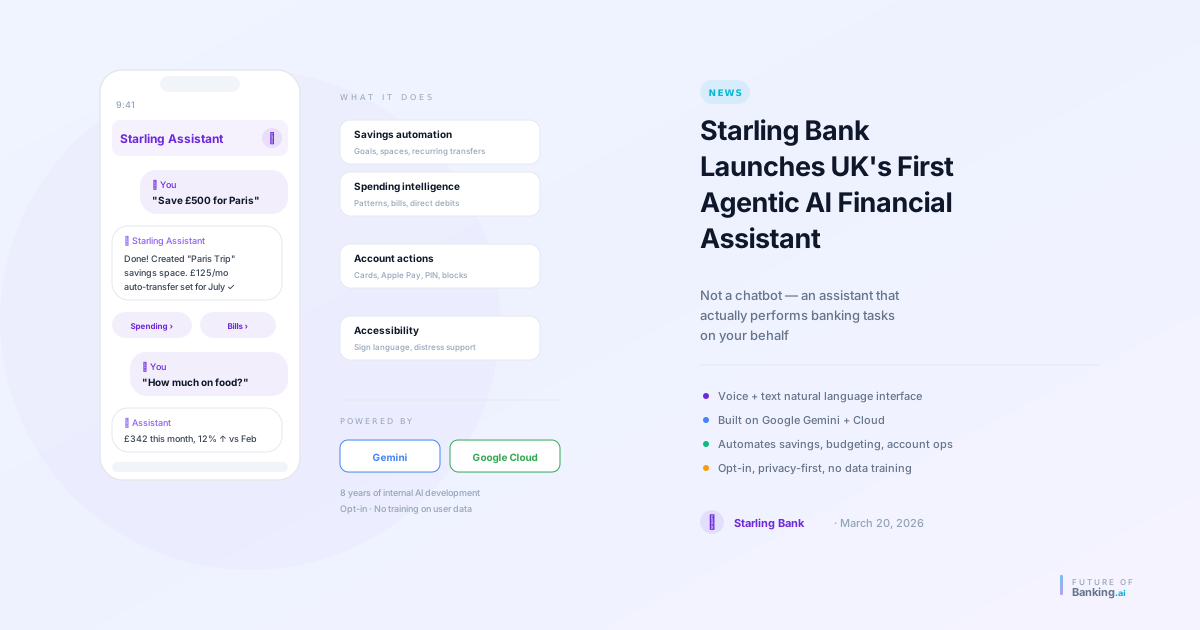
Starling Bank has launched what it calls the UK's first agentic AI financial assistant — and this one is designed to do things, not just answer questions.
The new Starling Assistant, which began rolling out to personal current account holders on March 20, can create custom savings plans, set up automated transfers, provide spending insights, manage cards, and handle account tasks — all through natural voice or text conversation inside the Starling app.
That makes it fundamentally different from the support chatbots most banks offer today. Those tools typically answer FAQs or route customers to the right department. Starling's assistant can take action on the customer's behalf within the banking environment.
What it can actually do
The range of capabilities suggests Starling has thought carefully about where agentic AI adds real value in everyday banking.
A customer planning a holiday can ask the assistant to save £500 for a trip to Paris by July. The system will create a dedicated savings space, calculate the required monthly amount, and set up recurring automatic transfers. No menu navigation, no manual setup — just a spoken instruction and an executed plan.
On the spending intelligence side, the assistant can answer questions about monthly patterns, compare spending across periods, surface direct debit information, and flag bill payment details. Starling says this builds on its existing Spending Intelligence and Scam Intelligence tools, both launched in earlier releases.
Beyond money management, the assistant also handles account operations: ordering replacement cards, setting up Apple Pay, retrieving PINs, and activating gambling blocks. It also includes accessibility features, with support for sign language services and financial distress guidance.
Built on Google Gemini
The technology behind Starling Assistant runs on Google Gemini, hosted within Starling's Google Cloud environment. Starling says the system draws on eight years of internal AI development, suggesting this is not a bolt-on integration but a capability built progressively on the bank's own platform.
Starling's CEO Raman Bhatia described the launch as the next step in how banking should work — moving from app-driven interfaces toward conversational ones. Harriet Rees, Starling's CIO, framed it as the beginning of a new era powered by agentic AI. Graham Drury of Google Cloud said the partnership is moving banking toward an experience where customers simply have a conversation about their money.
Privacy by design
In a landscape where AI and data privacy remain contentious, Starling has taken an explicitly cautious approach. The assistant is opt-in only — customers are not required to use it. All data remains within Starling's own Google Cloud environment, and the bank says no customer data is used for AI model training.
That combination of opt-in access and data containment is likely designed to build trust with customers who are wary of handing financial data to AI systems. It also positions Starling favourably against potential regulatory scrutiny around AI in consumer finance.
Why this matters beyond Starling
The launch is significant for two reasons.
First, it represents a concrete example of agentic AI in consumer banking — not a concept paper, not a pilot, but a product shipping to real customers. While many banks have discussed AI assistants, few have deployed systems that can autonomously execute financial tasks within a live banking environment.
Second, it raises the bar for what customers will expect from their banking apps. If Starling customers can set up savings goals through conversation, the question for every other UK bank becomes: why can't ours?
Business and joint account support is expected to follow, which could extend the model into small business banking — a space where automating routine financial tasks has even greater potential impact.
For now, Starling has moved first. The question is how quickly the rest of UK banking follows.