
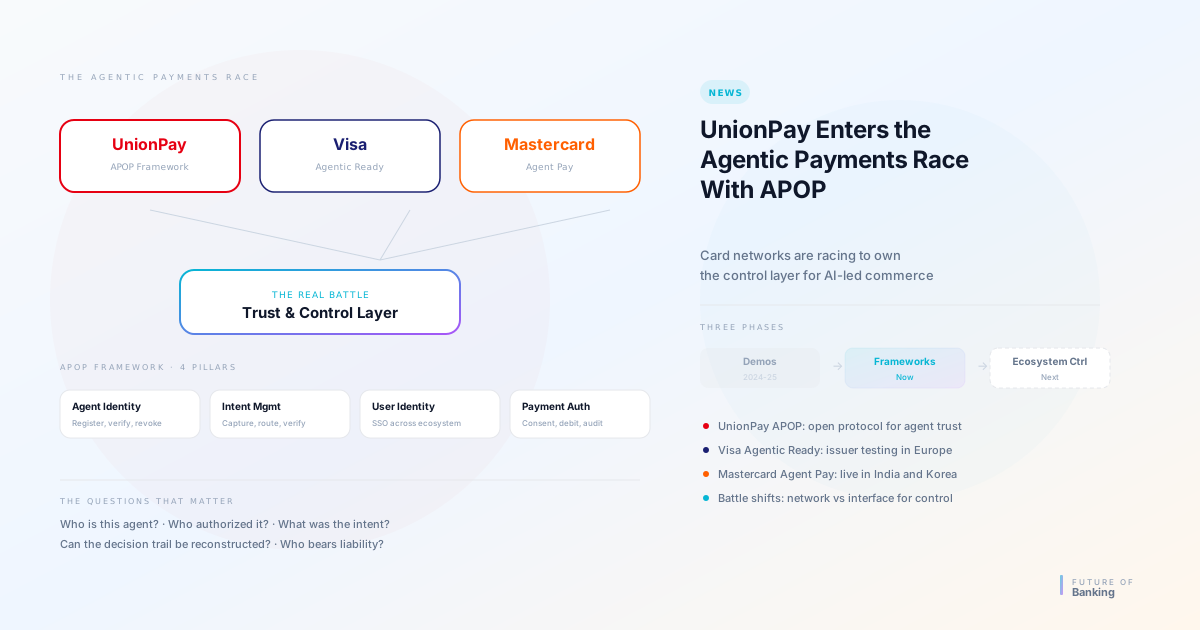
UnionPay has launched the Agentic Payment Open Protocol framework, or APOP, positioning itself not just as a payment rail, but as a trust and orchestration layer for AI-led commerce. The move shows how global card networks are racing to shape the rules, identity models, consent flows, and authorization standards that could define agentic payments.
On April 2, UnionPay tested what may look like a small transaction on the surface but points to a much bigger shift underneath. In Hong Kong, a taxi booking was completed after a user entered trip details into an AI assistant developed by Evonet, which then surfaced taxi options and pricing from the ride-hailing platform Hoppa and recommended a booking choice. A day later, UnionPay formally unveiled its Agentic Payment Open Protocol (APOP) framework.
That matters because this is no longer just about a card being used online. It is about a future where an AI agent discovers, compares, recommends, initiates, and potentially completes a purchase on a user's behalf — with the payment network acting as the layer that makes that interaction trusted, authorized, and auditable.
APOP is really a bid to define the trust layer
According to UnionPay, APOP is built around four core capabilities: agent identity lifecycle management, intent management, user identity management, and payment authorization services. In practice, that means the framework is designed to support agent registration and deregistration, end-to-end handling of user intent, single sign-on style identity flows across ecosystem participants, and payment activation, debiting, and consent verification.
That framing is important. For years, payments infrastructure has focused on authenticating cardholders and merchants. Agentic payments add a new actor into the transaction chain: the software agent. Once that happens, the hard question is no longer only "Is this card valid?" It becomes: Who is this agent? Who authorized it? What exactly was the user's intent? Can the decision trail be reconstructed later?
The company is also emphasizing openness. It says the framework is designed so that agents, merchants, financial institutions, and technology platforms can connect on a plug-and-play basis through trusted routing, using UnionPay's existing acceptance footprint as the base layer.
Why this matters beyond China
UnionPay says APOP is intended to support use cases both inside and outside mainland China, and that the framework is designed around compliance, security, traceability, dispute clarity, and broad compatibility.
That is significant because agentic payments will likely become one of the next big battlegrounds in global payments infrastructure. Whoever controls the framework for identity, intent, authorization, and liability will hold far more power than a player that only processes the final transaction.
Visa and Mastercard are also moving fast
UnionPay's launch lands in a market where Visa and Mastercard have already been making aggressive moves around agentic commerce.
Visa launched Visa Agentic Ready in Europe in March 2026, describing it as a programme to help issuers and ecosystem partners test and validate agent-initiated transactions in a structured way. Visa has also been building toward this moment for months: in December 2025, it said it had completed hundreds of secure, agent-initiated transactions with partners.
Mastercard, for its part, unveiled Agent Pay in April 2025 as its agentic payments stack and has kept extending that push across markets. In February 2026, Mastercard announced its first authenticated agentic commerce transaction in India, and in March 2026 it said it had completed Korea's first live agentic transactions.
Taken together, the major global card networks are not waiting for merchants, banks, or AI labs to define the rules of agentic commerce. They are trying to take the control seat themselves.
The real battle is not card vs wallet. It is network vs interface.
In the old world, the consumer interface and the payment credential were often the main points of competition. In the agentic world, the valuable layer could shift upward to the orchestration system that manages intent, trust, and actioning across multiple participants.
That "control seat" is not just about routing payments. It is about owning the framework that determines:
- How AI agents are identified
- How consent is captured and refreshed
- How delegated payment authority works
- How liability is assigned
- How disputes are reconstructed
- How regulators can audit what happened
A shopping or banking AI agent cannot simply be "smart." It also has to be recognized, permissioned, policy-bound, and accountable. That is the layer APOP is targeting.
What banks and fintechs should watch now
For banks, the signal is straightforward: agentic payments are no longer just experimental demos from AI companies. They are becoming a strategic agenda for global payment networks. UnionPay is now joining Visa and Mastercard in treating agent-led commerce as a network-level opportunity.
For issuers, acquirers, processors, and fintechs, the next phase of competition may revolve around questions such as:
- Can a bank expose cards safely to AI agents?
- Can it define granular spending permissions for different agents?
- Can it verify intent without breaking the user experience?
- Can it reconstruct a machine-led transaction for fraud review or dispute handling?
- Can it participate in multiple network frameworks without creating operational chaos?
Those questions are now moving from theory to product design.
The bigger takeaway
UnionPay's APOP launch is not just another payments press release. It is a sign that agentic payments are entering a more structured phase. The first phase was demos. The second phase is frameworks. The third phase will be ecosystem control.
Visa is building readiness programmes. Mastercard is proving live authenticated transactions across markets. UnionPay is now proposing an open protocol framework rooted in identity, intent, consent, and authorization.
In the age of agentic commerce, the most powerful player may not be the one that simply processes the payment. It may be the one that defines who the agent is, what it is allowed to do, and why the ecosystem should trust it.