
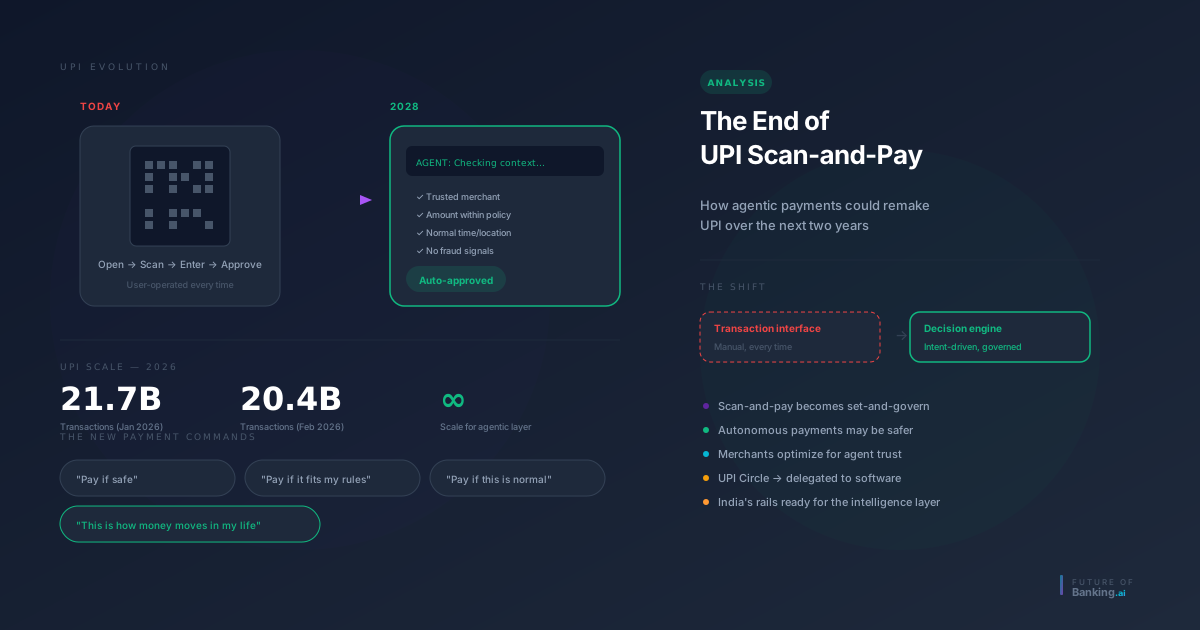
UPI has already won. The question now is not whether India will adopt digital payments. It already has. NPCI's latest numbers show UPI processed 21.70 billion transactions in January 2026 and 20.39 billion in February 2026, with monthly value still running in the tens of lakh crores. At this scale, the next chapter of UPI will not be about teaching more Indians to scan a QR code. It will be about removing the need to manually operate payments in the first place.
That is where agentic payments come in.
Not "AI payments" as a marketing layer. Not a chatbot bolted onto an old payments app. Not a voice command that still throws you back into the same approval flow.
Agentic payments mean something much bigger: payments that understand intent, operate within policy, read context, verify trust, and act on your behalf only when the conditions are right.
In that world, you do not open an app and initiate every payment from scratch. You define what is allowed. Your payment agent handles the rest.
That shift could fundamentally change UPI over the next two years.
From transaction interface to decision engine
For most of its life, UPI has been a brilliantly efficient user-operated system. Open app. Scan QR. Enter amount. Approve. Done. It made bank-to-bank payments simple, instant, and universal.
But the next leap is different. It is not about a better payment button. It is about turning UPI into a decision layer.
Two years from now, the most important payment instruction may no longer be "Pay now." It may be: "Pay if safe." "Pay if this looks normal." "Pay if it fits my rules." "Pay if it is this merchant, under this amount, from this budget."
That is the core of agentic UPI: payments triggered by intent, governed by constraints.
What agentic UPI will likely feel like in 2028
Imagine a consumer telling their bank app: Pay my electricity bill automatically every month, but alert me if it is more than 20% above my normal range.
Or a parent telling a family payments app: Give my daughter a weekly UPI spending allowance for food and transport, but block gaming and late-night purchases.
Or a small business owner saying: Pay repeat vendors automatically if the invoice matches the PO, the GST details are valid, and the amount is below ₹25,000.
Or a commuter setting this once: Every weekday, pay tolls, metro, parking, and cab charges automatically from my transport budget.
These are not just automated payments. UPI AutoPay already introduced recurring e-mandates for categories like utility bills, subscriptions, insurance, mutual funds, and EMIs. UPI Circle introduced something even more interesting: controlled delegation, where one user can extend transaction authority to another within limits. Those two ideas — pre-authorization and delegated authority — are the clearest signs yet of where UPI can go next.
The missing layer is intelligence. Agentic payments sit on top of those rails and ask: what if the "delegate" was not just another family member, but a software layer acting inside clear user-defined boundaries?
The real breakthrough is not convenience. It is judgment.
Much of the discussion around AI in payments is framed around convenience. Faster checkouts. Voice commerce. Conversational banking. Those matter. But they are not the most important thing.
The real breakthrough in agentic payments is judgment.
Today, a large part of payment safety depends on the user recognizing risk in real time. That is an unreliable defense. Users are rushed, distracted, socially engineered, confused by fake urgency, tricked by impersonation, or simply exhausted by the volume of digital prompts.
An agent, by contrast, can evaluate context before money moves. It can ask: Is this a new merchant? Is this amount unusual? Is the device trusted? Is the location unusual? Has this beneficiary ever been paid before? Does the merchant name align with the invoice metadata? Does this resemble a collect-request scam pattern?
Humans usually see a request. Agents can see a pattern.
That is why agentic payments could end up reducing fraud rather than increasing it.
Why autonomous payments may actually be safer
At first glance, "software paying on your behalf" sounds dangerous. But in practice, the current model often depends on humans making perfect judgment calls under imperfect conditions.
A well-designed payment agent can apply rules more consistently than humans ever do. A regular pharmacy payment under ₹1,500? Approve. A new merchant with a similar-looking name asking for ₹9,999 at 11:47 pm? Hold. A subscription renewal for a service the user has not used in 60 days? Ask first. A business payout to a personal UPI ID instead of a known vendor account? Block.
This is the key shift: authentication becomes adaptive, not uniform. Instead of asking the user to do the same thing for every transaction, the system applies different controls depending on risk.
The QR code will not disappear. It will become secondary.
UPI's visible symbol has been the QR code. It is everywhere — kirana stores, hospitals, taxis, roadside vendors, luxury retail, school fee counters, even temple hundis.
But the next phase of UPI may gradually reduce how central QR feels to the payment experience. The future may still include QR, but increasingly as a fallback or a point of trust, not the primary ritual.
In that world, the interface moves from scan-and-pay to set-and-govern.
What this does to merchants
For merchants, agentic UPI could change conversion more than any front-end redesign. In an agentic future, payment approval is less about persuasion in the moment and more about whether the merchant sits inside the customer's trusted payment universe.
Agents will care about things such as: merchant consistency, price predictability, refund behavior, invoice integrity, low dispute history, verified merchant identity, and fulfillment reliability.
The next battle in commerce may be: can your business be trusted by the customer's payment AI?
Families, businesses, and delegated money
One of the most underrated signs of the future is UPI Circle. NPCI describes it as a way for a payer to extend authorization to transact from their UPI account to another individual with required limits. That represents a structural shift in how UPI thinks about authority.
Once payment rights can be delegated under rules, the logic extends naturally. Families can delegate. Caregivers can delegate. Parents can delegate. Finance teams can delegate. Businesses can delegate. And eventually, software can delegate to agents.
That is when agentic UPI stops being a consumer convenience story and becomes a serious business infrastructure story.
What banks and fintechs need to build now
The easiest mistake in this category will be confusing conversation with capability. A chat window on top of a UPI app is not an agentic payments product.
To build real agentic payments, banks and fintechs will need: policy engines for conditional authorization; contextual fraud intelligence aligned with RBI's expectations; delegation architecture borrowing from UPI Circle's path; explainability for every payment decision; consent and revocation controls; and dispute readiness as autonomy rises.
This is not a UI refresh cycle. It is a control-plane rebuild.
The coming wave of fake "agentic payments"
Over the next 24 months, many payment players will relabel existing features as agentic: recurring payments called agentic, chatbot-assisted payments called agentic, voice-led approval flows called agentic. Most of this will be theater.
A true agentic payment stack needs four things working together: intent understanding, policy-based authorization, context-aware risk checks, and auditable autonomous execution. Miss one of those, and it is not really agentic.
Why India could lead this shift
India is unusually well positioned for this transition. Not because every bank is ready. Not because regulation has fully caught up. But because the foundational rail is already in place at national scale.
UPI is ubiquitous. Consumers are trained. Merchants are onboarded. Use cases span peer-to-peer, merchant payments, recurring mandates, and increasingly delegated authority. That gives India something rare: a live payments ecosystem large enough to support a move from manual payment behavior to machine-assisted payment judgment.
The bigger idea: UPI becomes ambient
The deepest shift may be psychological. For years, digital payments were something users had to do. Soon, the best digital payments may be something users configure.
That changes the role of UPI completely. It stops being an app action. It becomes a financial behavior engine.
Not "I want to pay this now." But "this is how I want money to move in my life."
That is what agentic payments really promise. Not just faster payments. Smarter payments. Safer payments. And, increasingly, payments that happen without demanding your attention every single time.
For a country already transacting at UPI scale, that is not a feature. That is the next operating model.