
March 17, 2026 may end up being remembered as one of those quiet turning points in payments.
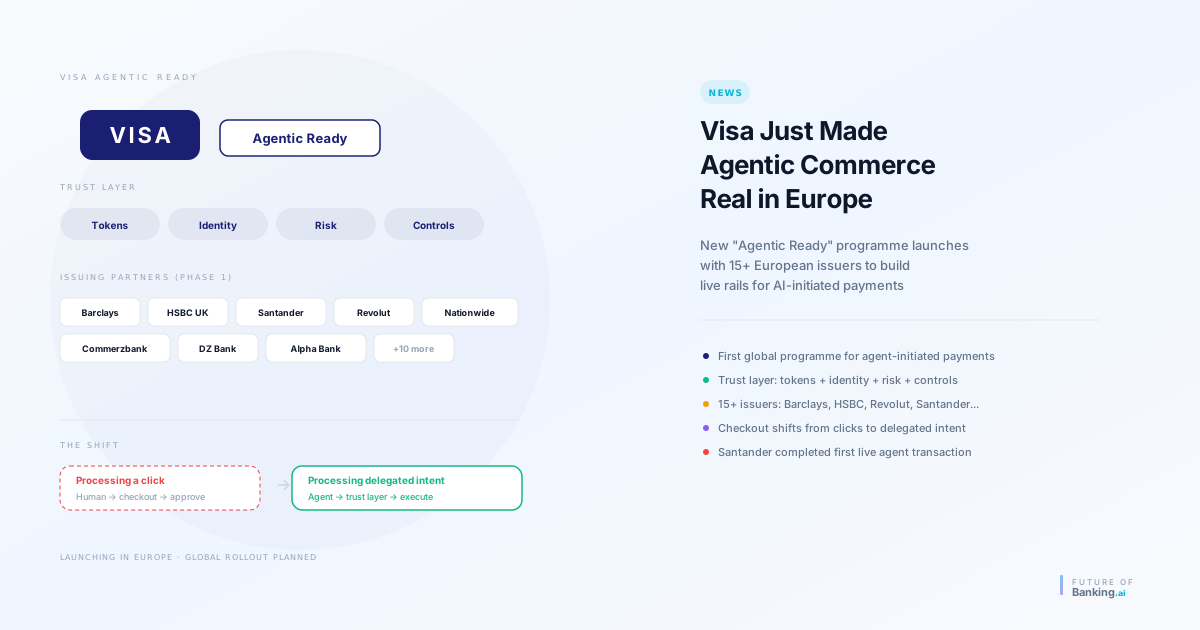
Visa has announced Visa Agentic Ready, a new global programme designed to help the payments ecosystem prepare for agentic commerce — a world where AI agents do not just help consumers discover products, but can actually initiate and complete transactions on their behalf. The programme is launching first in Europe, including the UK, and sits on top of Visa's broader Intelligent Commerce strategy for trusted AI-driven payments.
That matters because it marks a clear shift in posture from one of the world's largest payments networks. For the last year, much of the market has treated AI in commerce as an interface story: chat-based shopping, smarter recommendations, better search, prettier assistants. Visa's announcement suggests the real story is now becoming infrastructure. The question is no longer whether AI will sit inside the shopping journey. It is whether the payment system itself is ready when AI starts acting, not just advising.
From AI assistant to AI transaction layer
In its first phase, Visa Agentic Ready is focused on issuer readiness. Participating issuing partners will test and validate agent-initiated transactions with Visa and selected merchants in controlled production environments. The goal is to understand how these payments can operate securely and at scale while preserving the trust, protections and controls associated with the Visa network.
This is the important part.
Visa is not pitching a loose future where bots roam the internet spending freely on behalf of users. It is designing for a much more structured model: one where AI agents can act within a framework of identity, consent, authentication, risk controls and clear user authority. Visa says the programme is powered by its "trust layer," combining tokens, identity, risk and controls, and explicitly says that tokenisation and biometric authentication will help ensure agent-initiated payments remain tied to a real person, with consent and control at key moments.
That framing is likely to define the next phase of AI payments. The winners may not simply be the companies with the most impressive assistant. They may be the ones that can build the most trusted permissioning layer around machine-led action.
Why Europe first?
Visa says Europe offers a strong testing environment because of the region's high adoption of tokenisation, passkeys and advanced authentication, all of which are critical to trusted AI-led commerce. The company is positioning the European launch as the first phase of a broader global rollout rather than a local experiment.
That choice makes strategic sense. Europe is one of the few regions where digital identity, authentication maturity, bank participation and regulatory discipline can coexist in a way that makes live experimentation credible. Agentic commerce will not scale on clever demos alone. It will need payment credentials, device trust, issuer controls, merchant acceptance and regulatory comfort to work together. Visa appears to be using Europe as the place to pressure-test that stack.
A serious line-up of banking partners
This is not a one-bank pilot dressed up as an ecosystem announcement.
Visa says early issuing partners already engaged in the programme include Barclays, HSBC UK, Nationwide, Revolut, Santander, Commerzbank, DZ Bank, Erste Bank Oesterreich, Alpha Bank, Banca Transilvania, Bank Leumi, Bank of Cyprus, Nexi Group, Piraeus Bank, Raiffeisen Bank International and others, with more expected to join as the programme expands.
The significance of that list is not just size. It is diversity. Traditional banks, digital players, processor-linked groups and large European issuers are all showing up. That suggests agentic payments are moving out of speculative innovation decks and into real strategic planning.
One especially notable detail: Banco Santander demonstrated a live use case by purchasing a book with a Santander España Visa card, showing how agent-enabled commerce can work in practice. The use case is small, but symbolically important. The industry has now crossed from theory into real transaction testing.
The bigger shift Visa is signalling
What Visa is really saying here is simple: checkout is about to change.
For decades, digital payments have been built around humans manually moving through interfaces: clicking buttons, filling forms, authenticating at the end of a flow. Agentic commerce changes that model. In the future, a consumer may simply define intent — buy this within a budget, use this card, prefer this merchant, deliver by this time, ask me only if the amount crosses a threshold — and let an AI agent do the rest.
If that happens, the payment stack has to evolve from processing a user's final click to processing a user's delegated intent.
Why this matters for banks, fintechs and merchants
For banks, this creates a new readiness challenge. It will no longer be enough to issue credentials and manage fraud in the traditional sense. Banks will need to think about agent permissions, transaction boundaries, liability logic, consent frameworks and new trust models for AI-mediated activity.
For fintechs, the bar just got higher. Many have spent the last year attaching "AI" to dashboards, support layers and customer service workflows. But agentic payments demand something deeper: a product architecture that lets AI safely initiate financial actions within hard rails. Visa is effectively telling the market that the next battleground is not AI as insight, but AI as execution.
For merchants, the implication is equally large. As more shopping journeys become machine-assisted or machine-conducted, merchant systems may need to support payment experiences where the "customer" is not navigating a checkout page in the traditional way.
The strategic subtext
The most interesting thing about the announcement is that Visa is moving early enough to shape the rules.
If agentic commerce becomes meaningful, the payments layer cannot remain fragmented. Networks, issuers, merchants and AI platforms will all need a common framework for trust, control and interoperability. By launching Agentic Ready now, Visa is trying to place itself at the center of that framework.
And that is probably the smartest part of the move. Because in an AI-driven commerce future, the biggest value may not come from the flashiest assistant. It may come from the infrastructure that decides who is allowed to act, under what authority, with which protections, and on whose behalf.
The bottom line
Visa's new Agentic Ready programme does not mean agentic commerce has already arrived at scale. But it does mean the payments industry has moved into a new phase: preparing the live rails for AI-initiated transactions, not just talking about them.
That is not hype. That is infrastructure. And in payments, infrastructure is where the future becomes real.