
In the battle for AI-agent payments, Visa may have made the smartest move by refusing to pick a side.
For the last year, the payments industry has been moving toward a new frontier: AI agents that can shop, compare, negotiate, and pay on behalf of humans and businesses.
But there has been one big unresolved question. When an AI agent decides to make a purchase, how exactly should it pay? That question has triggered the early stages of a protocol war.
- Visa has its own Trusted Agent Protocol
- Stripe has been associated with machine-payment infrastructure
- OpenAI has pushed agentic commerce flows through its ecosystem
- Google has been building universal agent payment standards
- Crypto-native players are experimenting with agent-to-agent and machine-to-machine payment rails
Each protocol is trying to become the standard language for AI agents and merchants.
Visa's new move, Intelligent Commerce Connect, or ICC, is important because it does something unexpected.
Visa is not simply saying: "Use our protocol." It is saying: use any protocol, any network, any token vault — and connect through us.
That changes the game.
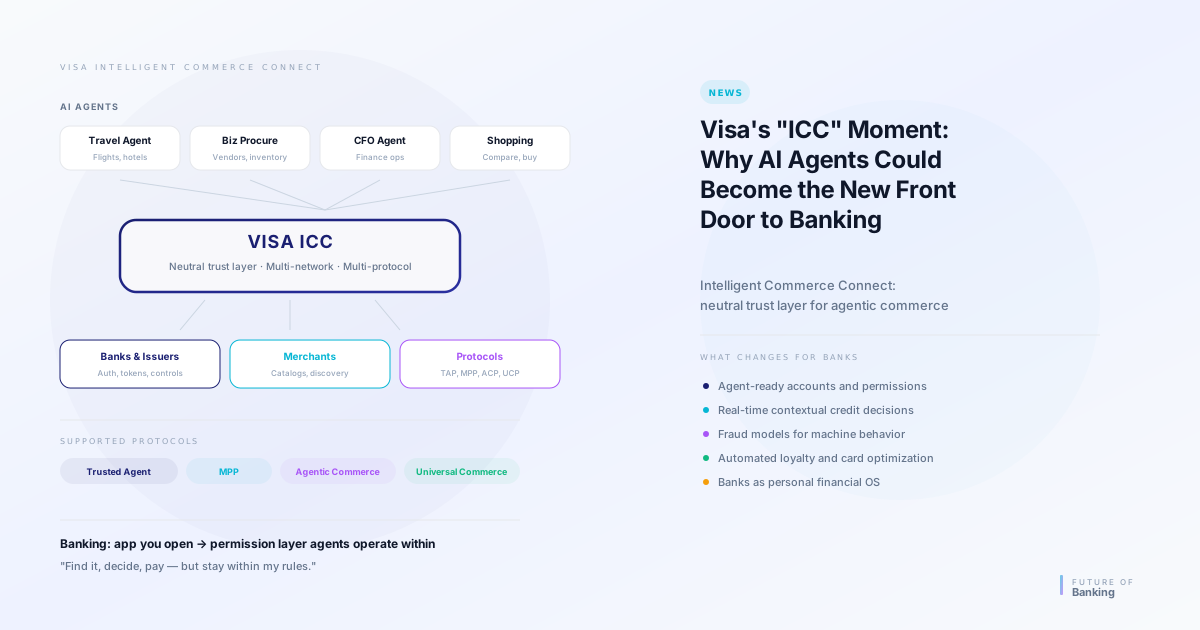
Visa describes Intelligent Commerce Connect as a network, protocol, and token-vault agnostic on-ramp for agentic commerce. Through a single integration via the Visa Acceptance Platform, it enables payment initiation, tokenization, spend controls, and authentication for AI-agent transactions. Importantly, Visa says it can support both Visa and non-Visa cards by integrating Visa Intelligent Commerce APIs as well as other networks' APIs.
In simple language: Visa is trying to become the neutral operating layer underneath the coming AI-commerce economy.
The protocol war is not the real war
Most people looking at agentic payments are focused on which protocol will win. Will it be Visa's protocol? Will it be Stripe's? Will OpenAI define the standard because ChatGPT has consumer distribution? Will Google win because it controls search, Android, Chrome, and commerce discovery? Will a crypto-native protocol become the settlement layer for machine-to-machine payments?
These are important questions. But Visa's ICC suggests a different strategic reading.
The winner may not be the company that owns the protocol. The winner may be the company that makes all protocols usable.
That is exactly what Visa did in earlier waves of commerce. Visa did not need to own every store, every website, every shopping cart, or every bank account. It became the acceptance and trust layer that allowed money to move between consumers, merchants, banks, and processors. Now, Visa appears to be applying the same playbook to AI agents.
For merchants, agent builders, banks, and payment enablers, that is the real value: one integration instead of multiple bets.
Why neutrality matters in the AI-agent economy
AI commerce will not look like today's e-commerce. Today, customers visit websites or apps. They scroll through product pages. They compare reviews. They add items to a cart. They reach checkout. They enter payment details or use a saved card.
In agentic commerce, much of that disappears. The customer may simply say:
"Find me the best noise-cancelling headphones under $300, compare reviews, check delivery time, use my preferred card, and buy only if there is a return policy."
The agent does the work. The payment becomes embedded inside the decision. The future of checkout may not be a button. It may be an instruction.
But for that to work, the ecosystem needs trust:
- The agent must be verified
- The user's consent must be captured
- The payment credential must be protected
- The merchant must know the transaction is legitimate
- The bank must understand whether the transaction is authorized
- The customer must be protected if something goes wrong
Visa is trying to say: do not wait for the protocol war to end. Build once, connect to all.
The real product is not payment. It is the on-ramp.
The most powerful line in Visa's announcement is not that ICC enables AI-agent payments. It is that ICC is an on-ramp.
That word matters. An on-ramp is not the road itself. It is the access point that lets everyone enter the road safely. In the future of banking, this is a very powerful position to occupy.
Visa does not need to own the consumer AI assistant. It does not need to own the merchant website. It does not need to own the bank account. It does not need to own every protocol. It needs to sit at the point where agent intent becomes trusted payment execution.
That is the new checkout counter.
The machine-readable merchant layer may be the hidden breakthrough
The most underappreciated part of agentic commerce is not the payment. It is discovery.
In today's internet, products are designed for humans to browse. Product pages, menus, images, descriptions, reviews, and offers are built for visual consumption. AI agents need something different. They need structured, machine-readable catalogs. They need to know what exists, what is available, what it costs, whether delivery is possible, whether offers apply, whether the merchant is trusted, and whether the payment can be completed.
If a merchant is not visible to AI agents, that merchant may become invisible in the next version of commerce.
This is especially important for banks and fintechs. Today, banks fight to be top-of-wallet. Tomorrow, they may need to fight to be top-of-agent. A credit card that gives better rewards but is not readable by an AI agent may lose to a less attractive card that is better integrated. A bank that has strong SME products but no agent-ready APIs may lose to a fintech whose products can be called instantly by a business AI agent.
What this means for banks
Banks have spent years building mobile apps, internet banking, APIs, embedded finance partnerships, and card programs. But AI agents introduce a new interface. The customer may not open the bank app every time. The customer's AI agent may operate the bank relationship.
That creates a new banking category: agent-ready banking.
Banks will need to decide what their products look like when accessed by agents. The bank account of the future may include an "agent permissions" section where a user defines:
- "Travel agent can spend up to $1,200 on flights"
- "Grocery agent can reorder weekly essentials below $80"
- "Procurement agent can pay only verified vendors"
- "Finance agent can initiate payroll payments, but requires approval above $600"
- "Do not allow agents to use credit unless cash balance is below a set threshold"
This is where banking becomes programmable, but in a consumer-friendly way.
What this means for business banking
The bigger opportunity may be in SME and enterprise banking. For consumers, agentic commerce may mean easier shopping. For businesses, it could mean automated financial operations.
An SME agent could compare vendors, raise purchase orders, match invoices, trigger approvals, pay vendors, reconcile bank statements, update accounting systems, optimize card rewards, manage credit lines, and forecast cash flow.
That is not just a better checkout experience. That is a new financial operating system.
The future of SME banking may not be about providing a current account and waiting for the business owner to log in. It may be about powering autonomous workflows around money movement. In that world, the bank becomes the trusted balance sheet, compliance layer, identity provider, risk engine, and settlement partner for AI agents.
The threat: banks may lose the customer interface
There is also a risk. If AI platforms become the new front door to commerce, banks may become invisible utilities. Tomorrow, the customer may simply ask an AI assistant: "Use the best payment option for this purchase." The AI agent may choose the card, apply the offer, select the account, initiate the payment, and complete the purchase.
If the bank is not deeply integrated into that agentic layer, it may lose influence over customer choice. The battle will move from app design to agent preference.
The question for banks is no longer only, "Are we digital?" It is: Are we callable by agents?
The strategic lesson
Visa's move is powerful because it avoids the trap of trying to control everything. Instead of saying, "Our protocol must win," Visa is saying, "Whichever protocol wins, we will help it pay."
That is a classic infrastructure strategy. In a new market, application layers change quickly. Interfaces change. Consumer behavior changes. Protocols compete. Standards evolve. But everyone still needs trust, acceptance, authentication, tokenization, fraud management, settlement, and compliance. Visa is positioning itself at that layer.
The big picture
The first era of banking was branch-led. The second era was app-led. The third era was API-led. The next era may be agent-led.
In the branch era, customers spoke to bankers. In the app era, customers tapped screens. In the API era, companies embedded finance into products. In the agent era, customers will delegate financial actions to intelligent software.
That changes the role of every player in the ecosystem:
- Banks must become permission engines
- Merchants must become machine-readable
- Payment networks must become trust layers
- Fintechs must become agent-ready
- Consumers must gain control over what their agents can and cannot do
The protocol war will continue. Stripe, OpenAI, Google, Visa, crypto networks, and others will keep building their standards.
But Visa's real bet is that the winning move is not choosing a protocol. It is becoming the neutral layer that makes all of them work.
And in the future of banking, neutrality may be the most powerful position of all.