
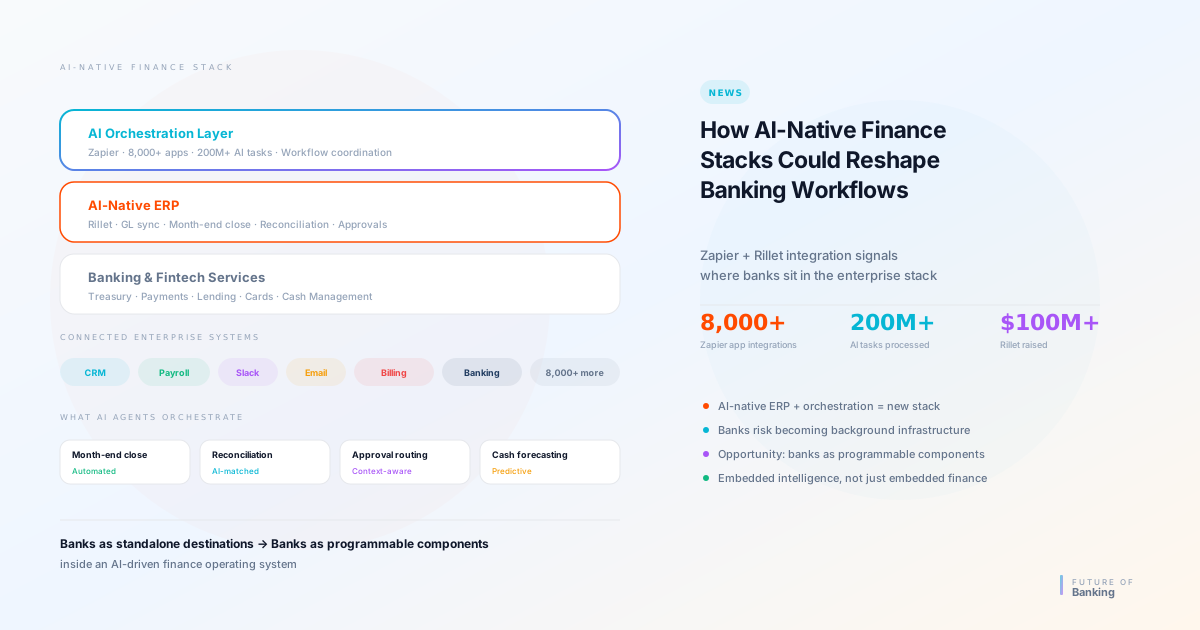
Zapier and Rillet have announced a new integration that connects Rillet's AI-native ERP with Zapier's network of more than 8,000 applications, creating what the companies describe as a fully AI-native finance stack. The move is positioned as a way for finance teams to automate workflows such as month-end close, approvals, reconciliations, and GL synchronization without relying on engineering teams or costly implementation projects.
On the surface, this looks like another enterprise software integration. But for banking and fintech leaders, it signals something bigger: the finance software stack is being rebuilt around AI-native orchestration, and that could change where banks and fintech platforms sit inside the enterprise.
Why this matters for banking
Finance teams have long been forced to work across disconnected systems. ERP platforms manage the ledger, banks handle accounts and payments, payroll providers run salary workflows, CRMs hold revenue data, and collaboration tools like Slack and email become the glue for approvals and exceptions. The Zapier-Rillet integration aims to connect those pieces so that AI agents can coordinate workflows across the finance function with less manual intervention.
That matters because the future of business banking may not be defined only by who owns the account or issues the card. It may increasingly be defined by who becomes embedded in the day-to-day operating system of the finance team.
What the integration enables
Rillet says the integration enables AI-orchestrated month-end close, intelligent ERP data sync, AI-powered approval routing, and predictive finance workflows. Zapier extends that reach beyond Rillet's native integrations by allowing finance teams to connect the ERP with thousands of additional applications across the enterprise stack.
For banks, this creates both a threat and an opportunity.
The threat
If enterprise finance workflows become orchestrated primarily through AI-native ERP and automation layers, traditional banks risk being pushed further into the background as commodity infrastructure providers. In that model, the daily user relationship belongs to the software stack, not the bank.
The opportunity
Banks that expose treasury, payments, cash management, lending, FX, virtual accounts, and reconciliation services in ways that can plug directly into these AI-native systems could become part of an automated financial control plane. Instead of waiting for finance teams to log into bank portals, banking services could be invoked inside workflows where work is actually happening.
In practical terms:
- Reconciliation and close automation could reduce manual effort around bank transaction matching and exception handling
- Treasury and cash visibility become more real-time when ERP intelligence connects to operational systems
- Embedded banking products become easier to distribute when the finance stack can trigger actions across the company's tools
- Banks and fintechs can potentially plug into these AI-native stacks as service layers rather than just external providers
Not just embedded finance — embedded financial intelligence
This is where the fintech angle becomes especially important. Fintech platforms have historically won by embedding financial products inside software. What is emerging now is the next version of that idea: not just embedded finance, but embedded financial intelligence. If AI agents can reason over business context and trigger workflows across connected systems, then payments, treasury actions, credit decisions, collections, and compliance checks can become part of a continuous finance process rather than isolated tasks.
A new software category is emerging
The announcement also reinforces a broader market pattern: the rise of "AI-native" financial infrastructure. Rillet is positioning itself as an AI-native ERP rather than a legacy accounting platform with AI added on top, while Zapier is increasingly presenting itself as an AI orchestration platform rather than only an integration tool. Together, they are pointing toward a new software category where financial systems do not just record activity after the fact, but actively coordinate and optimize it.
What this means for enterprise banking leaders
The next battleground is not only digital onboarding, payments UX, or API banking. It is whether banks can participate in the AI-native workflow layer that sits above core financial products and increasingly determines how finance work gets done.
If that layer is controlled by AI-native ERP, orchestration, and agent platforms, banks will need to rethink how they integrate into the enterprise stack. The institutions that succeed may be the ones that stop thinking of themselves as standalone destinations and start thinking of themselves as programmable components inside an AI-driven finance operating system.
Zapier says it now supports more than 8,000 app integrations and has processed over 200 million AI tasks, while Rillet says it has raised more than $100 million, serves over 200 customers, and recently doubled ARR in 12 weeks. Those numbers do not just indicate momentum for two software companies. They suggest that AI-native finance infrastructure is moving from early experimentation toward real enterprise adoption.
For banks and fintechs, that is the real story.